

Digital rolling stock maintenance in rail transportation role of digital twin and iot




Try Before you Buy Download Free Sample Product
 Impress Your
 Audience
 100%
100% Editable
 Save Hours
 of Time


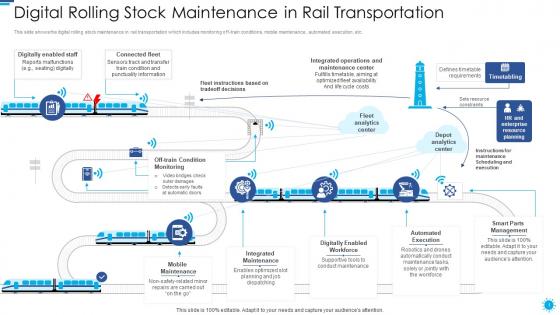
This slide shows the digital rolling stock maintenance in rail transportation which includes monitoring off train conditions, mobile maintenance, automated execution, etc.
People who downloaded this PowerPoint presentation also viewed the following :
Digital rolling stock maintenance in rail transportation role of digital twin and iot with all 6 slides:
Use our Digital Rolling Stock Maintenance In Rail Transportation Role Of Digital Twin And Iot to effectively help you save your valuable time. They are readymade to fit into any presentation structure.





FAQs for Digital rolling stock maintenance in rail transportation role of digital
Honestly, predictive maintenance is where the magic happens - you catch issues before stuff breaks down completely. Instead of those rigid maintenance schedules, digital twins show you what's actually going on with each component in real time. Way smarter approach. Your downtime drops by 30-50% easy, plus assets last way longer. The data also helps you figure out better scheduling and where to put your resources. Oh, and don't try to do everything at once - just pick your most critical assets first and build from there. Makes the whole process less overwhelming.
So basically IoT sensors feed your digital twins live data instead of you having to guess or wait for scheduled checks. Temperature, vibration, structural stress - all that stuff streams in constantly from the actual rail components. Way better than working with theoretical conditions, honestly that's a huge difference. The sensors catch things like bearing issues or track problems way before any human would spot them during inspections. I'd start with your most critical assets first though - don't try to do everything at once. You'll see the predictive accuracy improve pretty much immediately once you get those key sensors deployed.
Honestly, data integration will be your biggest pain point. Legacy systems hate talking to each other, so getting clean data into your digital twin is brutal. Plus your maintenance teams will probably resist hard - they've been doing things the same way forever and suddenly you want them using fancy new tech? Good luck with that. Executives will want proof of ROI like, immediately, which makes budgeting tricky. The actual technical setup is usually way easier than dealing with people. My advice? Start with small pilot projects first. Show some wins, then expand from there.
Digital twins save you money because they catch problems before stuff actually breaks - way cheaper than emergency fixes or swapping out whole components. Instead of surprise failures screwing up your operations, you can plan maintenance during downtime. The predictive analytics help parts last longer too. No more tossing equipment just because it hit some random replacement schedule. Fuel savings from optimized performance can be massive, honestly. Oh, and start with your biggest pain points - wherever failures cost you the most. That's where you'll see results fastest.
So basically, digital twins flip the whole maintenance game. Instead of checking everything every 6 months like clockwork, you're watching real-time sensor data from tracks and switches. The system flags what's actually wearing down vs stuff that's fine but just hit some random calendar date. Honestly, it's pretty brilliant - you get this live priority list telling your crew exactly where to focus. Rail sections showing stress? Jump on those. Switches acting weird? Fix 'em first. I'd start with your riskiest assets and sensor those up before expanding out.
Okay so think of data analytics as the brain that actually makes sense of all that sensor info flooding in from your rail system. Without it? You're drowning in useless data. Machine learning spots weird patterns in vibration and temperature readings that signal trouble weeks ahead - honestly blew my mind when I first saw it work. Short sentences hit different sometimes. The algorithms predict component failures so you can fix stuff before it breaks, which saves tons of money. Just make sure you're using analytics built for rail conditions specifically, not some generic IoT setup that'll miss the nuances.
First thing - get end-to-end encryption running on all your sensor data and use TLS 1.3 for communications. Set up role-based access so only the right people see what they need to see. Nobody needs access to everything, trust me on that one. Check your local data protection laws too, and anonymize data where you can. Regular security audits will save your ass later. Oh, and start with a risk assessment of your current setup - figure out which data streams are most sensitive and protect those first. That's honestly where I'd focus my energy.
Dude, you should definitely look into Deutsche Bahn's digital twin stuff - they cut unplanned maintenance by 25% using IoT sensors to predict track failures. Network Rail does similar things with their signaling systems, and it's really improved reliability. Japan Railway East can now spot Shinkansen issues weeks ahead of time, which is pretty impressive honestly. Even smaller companies like Go-Ahead Group are saving 20% on maintenance costs. When you pitch this to your bosses, lead with those Deutsche Bahn numbers. Executives eat up that concrete ROI data every time.
So digital twins give you this real-time digital copy of all your rail stuff, which honestly makes compliance so much less painful. Instead of digging through stacks of paperwork when inspectors arrive, everything's already tracked - maintenance schedules, safety inspections, the whole deal. It monitors safety parameters 24/7 and warns you before things get sketchy. You can even test out safety scenarios without risking actual equipment, which is pretty cool. My advice? Figure out which compliance reports currently eat up most of your time and tackle those first.
Look, without real-time data, your digital twin is basically just an expensive screenshot. The sensors feeding in temperature, vibration, wear patterns - that's what makes it actually work. You'll start seeing degradation trends and can predict failures before stuff breaks down. Way better than the old "check it every few months and hope for the best" approach, honestly. Maintenance schedules become based on what's actually happening instead of some generic timeline. First step? Figure out which sensors matter most for whatever you're trying to solve.
So basically digital twins let your maintenance teams practice on virtual copies of your real rail equipment before they mess with the actual stuff. Pretty neat concept - they can simulate breakdowns, try different repair methods, test worst-case scenarios. All without shutting anything down or creating safety headaches. Think of it like a really advanced simulator but for maintenance work. New guys can practice on equipment failures they won't see for years otherwise. Your experienced crews can perfect tricky procedures too. I'd start with whatever components cost you the most when they break - build your training around those critical pieces first.
Rail maintenance is about to get crazy smart with digital twins. Predictive analytics will spot problems weeks ahead instead of scrambling last-minute. 5G networks are making real-time data processing actually feasible now. The sensors coming out can catch micro-fractures before they turn into expensive disasters - which honestly should've happened years ago. Machine learning keeps getting better at this stuff. Edge computing means you won't need constant cloud connection for critical calls. I'd seriously look into partnering with IoT sensor companies soon. Companies that move early on this will crush it when everyone else catches up.
So basically, digital twins give everyone - operators, maintenance teams, suppliers, whoever - access to the same real-time view of your rail assets. No more dealing with different spreadsheets or outdated info that nobody's sure about. Everyone's looking at actual asset conditions and predictive maintenance data from one platform. Decisions happen way faster when you're all on the same page. Just make sure you figure out who gets access to what level of data first - that part's honestly crucial but easy to overlook when you're excited about the tech.
Vibration and temperature sensors are your best starting point - they're cheap and work with most platforms. For tracks, go with vibration sensors and strain gauges on rails/bridges. Temperature monitors catch bearing issues before they become expensive problems. Acoustic sensors are ridiculously good at finding rail cracks early, honestly saved my last project from a nightmare. GPS gives you solid location tracking for rolling stock. Camera systems with AI analysis are getting pretty impressive for visual stuff, though maybe overkill if you're just starting out. Accelerometers help with track geometry changes too. Start simple, then build up.
Honestly, digital twins are a game-changer for cutting rail emissions. You can simulate different routes and schedules to find the most fuel-efficient patterns without actually burning diesel. Pretty smart, right? Maintenance gets way more precise too - you'll know exactly when parts need fixing instead of guessing or waiting for breakdowns. The coolest part? Testing green upgrades like electrification virtually before dropping millions on them. I'd start by tracking your current energy patterns first, then build from there. Way less risky than the old trial-and-error approach.
-
Visually stunning presentation, love the content.
-
Attractive design and informative presentation.