

DISC Assessment Model For Effective Team Communication





Try Before you Buy Download Free Sample Product
 Impress Your
Audience
 100%
Editable
 Save Hours
of Time


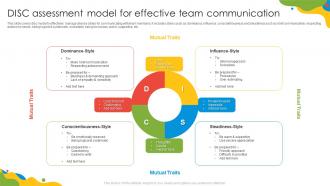
This slide covers disc model to effectively manage diverse styles for communicating with team members. It includes styles such as dominance, influence, conscientiousness and steadiness such as brief communication, respecting autonomy needs, being logical and systematic, socialable, being humorous, warm, supportive, etc.
People who downloaded this PowerPoint presentation also viewed the following :
DISC Assessment Model For Effective Team Communication with all 6 slides:
Use our DISC Assessment Model For Effective Team Communication to effectively help you save your valuable time. They are readymade to fit into any presentation structure.





FAQs for DISC Assessment Model For
The four primary personality types in the DISC Assessment Model are Dominance (results-focused and direct), Influence (people-oriented and enthusiastic), Steadiness (supportive and reliable), and Conscientiousness (detail-oriented and analytical). These personality frameworks enable organizations to enhance team dynamics, streamline communication approaches, and optimize role assignments, with many companies finding that DISC assessments ultimately deliver improved workplace collaboration and increased productivity across departments.
Understanding your DISC profile improves workplace communication by revealing your natural communication preferences, identifying potential friction points with different personality types, and providing strategies to adapt your approach for maximum effectiveness. This self-awareness enables professionals to tailor their messaging, adjust their interaction styles, and build stronger collaborative relationships, ultimately enhancing team productivity and reducing workplace conflicts across diverse organizational environments.
Teams can leverage DISC assessments to enhance collaboration by understanding communication preferences, identifying complementary strengths, resolving conflicts more effectively, and optimizing task assignments based on behavioral styles. Through strategic application of DISC insights, organizations streamline project workflows, improve cross-functional coordination, and foster psychological safety, with many teams finding that this behavioral awareness ultimately delivers stronger performance outcomes and workplace cohesion.
Cultural differences significantly influence DISC assessment interpretation, as communication styles, leadership expectations, and behavioral norms vary across cultures, potentially affecting how individuals respond to assessment questions and interpret results. Organizations implementing DISC globally must consider cultural context when analyzing profiles, with many multinational companies finding that localized interpretation frameworks enhance accuracy and ensure assessments deliver meaningful insights across diverse teams.
Leaders can effectively leverage the DISC model by adapting their communication styles to match team members' behavioral preferences, assigning roles that align with individual strengths, and fostering understanding between different personality types. This strategic approach enhances team collaboration, reduces workplace conflicts, and improves productivity, with many organizations finding that DISC-informed leadership ultimately delivers stronger employee engagement and performance outcomes.
Common misconceptions about the DISC Assessment Model include believing it boxes people into fixed categories, predicts job performance alone, or represents permanent personality traits. While DISC provides valuable behavioral insights, it measures adaptable communication preferences rather than unchangeable characteristics, with many organizations finding that combining DISC with other assessment tools delivers more comprehensive employee development and team optimization strategies.
Organizations can implement DISC assessments by integrating them into initial screening phases, combining results with traditional interviews, and using profiles to evaluate role-specific behavioral fit. Many companies in sales, customer service, and leadership positions find that DISC data enhances hiring decisions by predicting workplace performance, reducing turnover, and ultimately building more cohesive, strategically aligned teams.
The DISC Assessment Model enhances conflict resolution by identifying communication styles and behavioral preferences that drive workplace disputes. Understanding whether colleagues are Dominant, Influential, Steady, or Conscientious enables managers to tailor resolution approaches, address root behavioral mismatches, and facilitate more effective dialogue, with many organizations finding that DISC-informed mediation significantly reduces recurring interpersonal conflicts.
Industries that rely heavily on team dynamics and customer interactions benefit most from DISC Assessment, including sales, healthcare, financial services, retail, and manufacturing. These sectors leverage DISC insights to enhance team collaboration, improve customer service approaches, streamline conflict resolution, and optimize leadership development, ultimately delivering better workplace productivity and customer experiences.
Individuals can best interpret their DISC results by understanding their primary behavioral style's strengths and potential blind spots, then identifying specific areas for growth and communication improvements. By recognizing how their style interacts with others in workplace scenarios, professionals can enhance their leadership approach, teamwork effectiveness, and conflict resolution skills, while leveraging their natural tendencies to build stronger relationships and advance their careers.
DISC assessment tools include online platforms like Everything DiSC, PeopleKeys, Extended DISC, Crystal, and Thomas International's proprietary systems. These resources streamline evaluation through automated scoring, detailed reporting, and team analysis features, with many organizations finding that comprehensive platforms deliver faster insights, enhanced accuracy, and strategic workforce development capabilities.
DISC complements other personality frameworks by focusing specifically on observable behavioral styles, while Myers-Briggs explores cognitive preferences and Emotional Intelligence measures interpersonal skills and self-awareness. Organizations increasingly use these assessments together, with DISC providing immediate behavioral insights for team dynamics, Myers-Briggs offering deeper personality understanding for role alignment, and EQ assessments enhancing leadership development, ultimately delivering comprehensive employee development and improved workplace communication.
Effective DISC feedback focuses on observable behavioral patterns rather than personal judgments, emphasizing communication preferences, work style strengths, and potential growth areas specific to each profile. Feedback should highlight how D-types prefer direct communication, I-types value collaborative recognition, S-types appreciate consistent support, and C-types benefit from detailed, data-driven insights, ultimately enabling individuals to leverage their natural strengths while developing complementary skills.
Individuals should retake the DISC assessment every 12-18 months or during significant life transitions, career changes, or role shifts, as behavioral styles can evolve with experience and circumstances. While core personality traits remain relatively stable, workplace dynamics, leadership responsibilities, and professional development can influence responses, with many organizations finding that regular reassessment enhances team dynamics and personal growth strategies.
Practical exercises include role-playing scenarios where team members practice adapting their communication styles, cross-style partnering for projects, conflict resolution workshops using DISC frameworks, and communication preference mapping activities. These approaches enhance collaboration by teaching teams to recognize behavioral cues, adjust their interaction methods, and leverage diverse working styles, ultimately delivering improved project outcomes and stronger workplace relationships.
-
Top Quality presentations that are easily editable.
-
They had the topic I was looking for in a readymade presentation…helped me meet my deadline.