


Team Performance Management And Development Plan Developing Effective Team




Try Before you Buy Download Free Sample Product
 Impress Your
 Audience
 100%
100% Editable
 Save Hours
 of Time


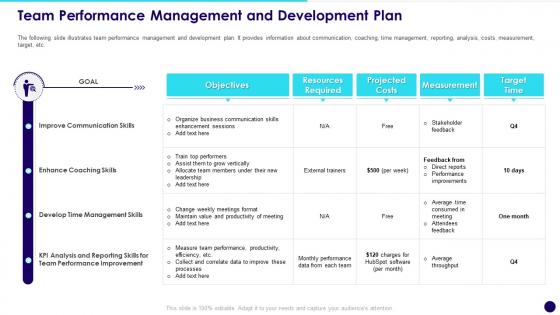
The following slide illustrates team performance management and development plan. It provides information about communication, coaching, time management, reporting, analysis, costs, measurement, target, etc.
People who downloaded this PowerPoint presentation also viewed the following :
Team Performance Management And Development Plan Developing Effective Team with all 6 slides:
Use our Team Performance Management And Development Plan Developing Effective Team to effectively help you save your valuable time. They are readymade to fit into any presentation structure.





FAQs for Team Performance Management And Development Plan
So for KPIs, I'd focus on productivity stuff first - like output per person or hour. Quality scores matter too, obviously. Customer satisfaction is big, and honestly employee engagement tells you a lot about where things are headed. Revenue per employee is clutch if you're in sales. Project completion rates are solid metrics, plus time-to-market for new stuff. Oh and retention - turnover absolutely murders performance, I've seen it happen. Don't try tracking everything though. Pick maybe 3-4 that actually match what you're trying to accomplish. You'll get way better data that way instead of drowning in numbers.
Dude, team composition is HUGE for performance. Like, I've seen amazing people fail because the mix was all wrong. You need different skills obviously, but personality balance matters just as much. Too many alpha types? Chaos. All introverts? Nothing gets decided. What works is getting people who think differently but can actually work together. Someone detail-oriented, someone big-picture, maybe a devil's advocate who won't let bad ideas slide. I learned this the hard way on a project that should've taken weeks but dragged on for months because we were all basically the same person. Map out what you actually need before you start hiring - saves so much headache later.
Dude, leadership literally makes or breaks team performance. You set the whole vibe - people either feel energized or completely drained based on your approach. Clear goals and open communication are huge. Trust your people to actually do their jobs instead of micromanaging (learned that one the hard way). Remove obstacles, get them what they need, and celebrate wins when they happen. The best leaders I've seen? They make tough calls fast and don't dodge awkward conversations. Honestly, just being more thoughtful in your daily interactions makes a massive difference. Those little moments really add up.
Honestly, daily standups are a game changer - keeps everyone on the same page without those awful email chains that go nowhere. Get your tools sorted too. Slack for quick stuff, shared docs for the real work. Oh, and set boundaries around response times or people will expect instant replies at like 11pm (learned that one the hard way). The biggest thing though? Make sure your team feels safe calling out problems early. Nobody should be scared to say "hey, this isn't working." And actually listen in meetings instead of just planning what you'll say next.
Don't let that stuff just sit there and get worse - deal with it now. Make sure people can actually speak up without getting thrown under the bus later. Honestly, I've watched way too many good teams fall apart because their manager just pretended everything was fine! Focus on what's really bugging people, not the petty surface stuff. Help them actually listen to each other and see where the other person's coming from. You'll want clear rules about how disagreements work, plus everyone needs to remember what you're all trying to accomplish together. Turn that tension into something useful instead of personal drama.
Honestly? Asana or Monday.com are solid for tracking who's doing what. Slack beats email every time for quick team chats. Google Workspace is pretty much essential - or Notion if you're feeling fancy. Oh, and Loom is clutch for remote teams since you can record quick explanations instead of hopping on another damn video call. Here's the thing though - don't go crazy with tools. Pick maybe 3-4 max and actually make sure everyone knows how to use them. I've seen teams waste so much time because half the people are still doing everything in email while the other half moved to Slack months ago.
Honestly, diverse teams just crush problems better. You get people attacking issues from totally different angles instead of everyone thinking the exact same way. Like, someone's background might help them spot a blind spot you'd never see coming. Different experiences = different solutions on the table. The tricky part though? Making sure people actually speak up and aren't just there for show. I've seen teams where they had diversity but everyone still deferred to the loudest person in the room. That defeats the whole point, you know?
Honestly, the best approach I've found is getting everyone together to brainstorm goals first - like, actually letting people have input instead of just handing down orders from above. Make them SMART goals (specific, measurable, all that stuff) but don't go crazy with too many at once. Maybe 2-3 max or you'll overwhelm people. Break the big stuff into smaller chunks you can check weekly. Those regular check-ins are huge - just quick reviews of what's working and what isn't. Oh, and definitely celebrate the small wins! I've watched too many teams burn out because they never acknowledged progress along the way.
Honestly, you've gotta create feedback loops that go both directions - can't just be those awkward annual reviews. I'd start with weekly one-on-ones and maybe monthly team retrospectives. Daily check-ins help too, but keep them quick. The tricky part? Making people feel safe to actually tell you when stuff's broken. Nobody wants to be that person, you know? Also grab some real data on how your team's performing so you're not just winging it based on vibes. Oh, and this is huge - actually DO something with their feedback. Otherwise they'll just stop bothering to share.
Trust is huge - like, way bigger than people think. Your team needs to feel safe speaking up without getting shut down. Clear roles help too so nobody's confused about who does what. Don't avoid conflict either, that just makes things worse later. When everyone shares the same goals, you get that whole "we're all in this together" thing going. Individual personalities matter, but honestly? The environment you create beats trying to manage everyone's weird habits. Start with building trust first - everything else falls into place after that. Communication style makes or breaks it.
Honestly, morale makes or breaks everything. Happy teams get way more done and actually work together instead of just existing in the same space. Plus you won't be constantly replacing people - which is such a pain. When morale tanks though? That negativity spreads fast. People stop communicating, do bare minimum work, make more mistakes. I've seen it happen so many times. The good news is motivated teams get creative and will actually hustle when deadlines hit. Just check in with people regularly and don't let problems fester.
Honestly, it all comes down to communication that doesn't suck. Regular check-ins help, but don't go crazy with meetings - trust me, everyone's already burned out on video calls. I'd focus more on what people actually accomplish rather than tracking their hours like some micromanager. Give your team decent tools and let them work how they work best. The tricky part is staying connected when you can't just walk over to someone's desk anymore. Maybe start by looking at how you're communicating now and figuring out what's broken? Oh, and one-on-ones are clutch for keeping people engaged.
Honestly? Bad communication kills teams every time. When people don't know what they're supposed to do or how their work fits in, everything falls apart. Trust issues make it worse - like when someone's hoarding info or whatever. Start with regular check-ins so problems don't explode later. Make sure everyone feels safe calling out issues without getting their head bitten off. Oh, and deal with conflicts right away instead of pretending they'll magically disappear (they won't). Having a shared goal helps too, otherwise you're just herding cats.
Honestly? Start with one thing that's driving you nuts and fix that first. Be super clear about what you want and when - then actually check in regularly. I've found that having people report to the whole team works way better than just reporting to you. Peer pressure is real! Also make sure nobody's afraid to say "hey, I'm drowning here" without getting roasted for it. Oh, and don't be that manager who demands accountability but never admits their own screwups. People see right through that. Maybe try a simple tracking system this week?
Honestly, training makes a huge difference - like 10-25% performance boosts, which is pretty solid. Your team will collaborate better and make fewer expensive screwups. People also stay longer when they're actually learning stuff (makes sense, nobody wants to feel stuck). Here's the thing though - generic training is mostly useless. You want to focus on the real problems your team faces day-to-day. I'd start by figuring out where the biggest skill gaps are hurting you most. That's where your training budget should go first. Way more bang for your buck that way.
-
If you are looking for satisfactory PowerPoint services, SlideTeam is your go-to place. I am fully contented with their research and development team.
-
I was really impressed with the presentation I created with their templates. I’ll be using their services moving forward.