


Ecosystem service layout ppt sample download




Try Before you Buy Download Free Sample Product
 Impress Your
 Audience
 100%
100% Editable
 Save Hours
 of Time


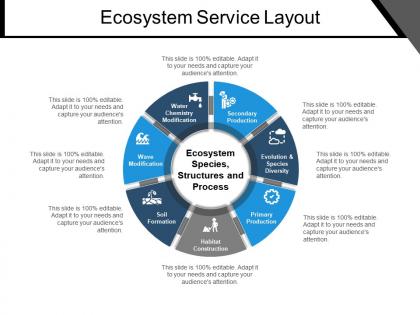
Select this ecosystem service layout PPT sample download PPT slide and discuss about providing your business and clients with a wide range of goods and services while delivering an organizational presentation. Start managing your company in connecting to ecosystems by availing our professionally designed business ecosystem figure PowerPoint shape which helps the user to avoid being blindsided by unexpected risks arising from the degradation of ecosystems. Pick this corporate environment diagram PowerPoint presentation and discuss how ecosystem service considerations can be integrated into business performance systems that helps business managers to incorporate into environmental management systems, sustainability reporting and other performance systems. The user may choose this template to start requiring new clients to assess the projects’ impact and dependence on ecosystem services in order to evaluate and report its potential impacts on long-term water availability, fish spawning areas and nature tourism which further ensures that its clients look at ecosystem services before a project begins, rather than be faced with unintended business risks after a project starts impacting valuable ecosystem services. The designs of our Ecosystem Service Layout Ppt Sample Download are genuinely awesome. You will find them artistically brilliant.
People who downloaded this PowerPoint presentation also viewed the following :
Ecosystem service layout ppt sample download with all 5 slides:
Get on your guard with our Ecosystem Service Layout Ppt Sample Download. Build up an impenetrable defense.




FAQs for Ecosystem service layout
So there are four types you need to know. Provisioning services are the obvious stuff - food, water, timber that we grab directly. Then regulating services work behind the scenes doing climate control, cleaning water, keeping diseases in check. Cultural services are more about recreation and spiritual stuff (honestly, think any park you'd actually want to hang out in). Supporting services are like the foundation for everything else - soil formation, nutrient cycling, photosynthesis. The main thing is whether you're directly using something or it's just quietly keeping everything alive. Look around your area and see what services you can spot - you'll be surprised how much is actually happening.
Dude, ecosystems are literally what keep us alive and our economy from tanking. Clean water, bees pollinating crops, forests storing carbon - we're talking trillions in value here. Just bees alone bring in billions for agriculture, which is wild when you think about it. Then there's tourism money from people visiting parks and stuff. But when these systems fail? You're stuck paying way more for water treatment, flood repairs, crop failures. Honestly, protecting nature upfront costs way less than fixing the mess later. It's like preventive maintenance but for the planet.
So basically cities can add tons of green stuff to help with ecosystem services. Parks, green roofs, urban forests - they all filter air and water naturally plus cool things down. Wetlands are great for managing stormwater, and pollinator corridors are pretty cool too. Rain gardens and permeable pavement help with water retention. Honestly the cities that do this right just feel way nicer to live in - like there's actually space to breathe, you know? Don't overthink it though. Pick one green project in your neighborhood and see what happens from there.
So basically, pollinators are like nature's wingmen - they move pollen around and we get 35% of our food because of it. Coffee, chocolate, apples, almonds - yeah, bees are behind all that good stuff. But their numbers are tanking hard right now. Pesticides are killing them, plus we keep destroying their habitats and climate change isn't helping either. It's honestly pretty terrifying when you think about it. The whole food web starts falling apart without them. You should definitely support local beekeepers if there are any near you, and maybe plant some native flowers? Even small stuff actually helps.
So there's a few ways to tackle this. Market pricing works for obvious stuff like timber sales. For things like water filtration, you'd use replacement cost - basically what it would cost to build infrastructure that does the same job. Travel cost method is pretty clever actually - you calculate how much people spend getting to natural areas for recreation. Willingness-to-pay surveys are another route, though honestly those can get messy with people's responses. Oh, and benefit transfer lets you borrow values from similar ecosystems that researchers have already studied. I'd start with the straightforward services first - carbon storage and water purification have good established frameworks you can work with.
Honestly, climate change is messing with everything nature normally does for us. Wetlands are drying up so water isn't getting filtered properly. Bees are super stressed and not pollinating like they used to. Forests can't store carbon when they're constantly dealing with droughts and fires - which seems to be every summer now. Don't even get me started on coral reefs bleaching while sea levels keep rising. Food production's probably what hits closest to home though. Crops are struggling with weird weather patterns and all these extreme storms. You should figure out what your area relies on most and start planning some backup strategies sooner rather than later.
Oh this is actually pretty straightforward! More species = better ecosystem services. Think of it like - when you've got tons of different plants and animals around, everything just works better. Pollination, water cleanup, climate stuff, you name it. But start losing species and it all falls apart fast. Honestly, I learned this the hard way on a project once. Fewer bees meant our whole food system got sketchy. Same with wetlands - lose those species and suddenly you're dealing with flooding. So yeah, if you're planning anything environmental, protecting biodiversity isn't optional. It's what keeps everything else running.
Honestly, I'd tackle the invasive species problem first - otherwise you're just wasting time since they'll choke out whatever you plant. Native reforestation and wetland restoration are your best bet for maximum impact. Urban areas? Community gardens are awesome, and bioswales actually get people excited (weird but true). Partner up with local environmental groups and universities - they've got the know-how and free labor from volunteers. Oh, and definitely start with something small to prove it works. Once you've got that success story, scaling up becomes way easier. People love backing a winner, you know?
So cultural ecosystem services are all the non-material stuff we get from nature - spiritual connections, recreation, cultural identity, that kind of thing. They're massive for local communities because entire ways of life get built around them. Sacred forests, traditional fishing spots, places where generations gathered medicinal plants. Honestly, people don't realize how tied together culture and economics are in these spaces. Lose a sacred grove to development? You're not just losing trees - you're potentially wiping out cultural practices, traditional knowledge, and whatever tourism or craft economies depend on them. It's like erasing someone's entire heritage in one go.
Dude, freshwater ecosystems are so underrated. Rivers and lakes literally save us billions by filtering our water naturally - like having a massive treatment plant that runs itself. They prevent floods, recharge groundwater, and support fisheries that feed millions worldwide. Wetlands are honestly incredible at this stuff. Plus they help control local weather patterns and create tons of recreation jobs. We never think about it until there's a drought or major flooding, you know? It's wild how much these systems do behind the scenes.
So first thing - map out what your local ecosystems actually do. Water filtering, storing carbon, preventing floods, all that stuff. Getting decent data is honestly the biggest pain in the ass. Work these services into your zoning rules so developers can't just ignore them. Buffer zones around important areas help too. I'd definitely get locals involved early though - farmers and residents know way more about what actually matters than some consultant. Maybe throw in some incentives for developers who don't wreck everything? Test it small first before going big.
Costa Rica's got this amazing program from 1997 where they literally pay landowners for keeping forests intact - it's basically the gold standard everyone copies. China did something massive too, converting millions of hectares of farmland back to forest with their grain-for-green thing. Oh and the U.S. has this huge Conservation Reserve Program that pays farmers to retire sensitive land. Mexico's doing something similar that works pretty well. Honestly, if you're researching this stuff, I'd start with Costa Rica since their model is what most other countries try to replicate when they're setting up their own programs.
Dude, it's wild how everything falls apart when ecosystems break down. No more bees means your crops don't get pollinated. Soil turns to crap without all those natural processes working. Water filtration systems just... stop working, so good luck with irrigation. Plus you get crazy weather patterns that wreck harvests left and right. The whole thing feeds on itself too - less food, higher prices, more problems. Honestly, I never realized how much we depend on this stuff until I started reading about it. Support some local conservation groups if you can, because our grocery bills are gonna get ugly otherwise.
Start by figuring out which ecosystem services you actually need to track first - don't try to monitor everything at once. Satellites and remote sensing work great for big picture stuff like forest cover and water quality. For detailed local work, drones are your best bet (plus they're pretty fun to fly around). IoT sensors can continuously monitor soil health and air quality, which is super helpful. Machine learning comes in handy for analyzing all that data and spotting problems early. The key is matching your tech choices to your budget and how tech-savvy your team is. You'll probably want to start small and scale up.
Honestly, the stuff that works best mixes hands-on activities with examples people actually recognize. Take them to local wetlands or urban gardens - seeing pollination and water filtration happen right in front of you is way more powerful than just talking about it. Citizen science projects are gold because people get invested while helping collect real data. Interactive workshops where you calculate what your local ecosystem is worth in dollars? That really hits different. Oh, and gaming works surprisingly well with younger crowds - didn't expect that at first. Mix a few approaches and always tie abstract concepts back to things they experience daily, like cleaner air.
-
Very unique and reliable designs.
-
Great experience, I would definitely use your services further.