Employee Hiring Process Raci Matrix With Task Status
Try Before you Buy Download Free Sample Product
Audience
Editable
of Time
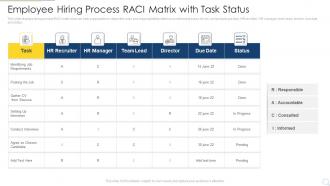
This slide displays hiring process RACI matrix that can help organization to depict the roles and responsibilities within a recruitment process. Its key components are task, HR recruiter, HR manager, team lead, director, due date and status.
People who downloaded this PowerPoint presentation also viewed the following :
Employee Hiring Process Raci Matrix With Task Status with all 6 slides:
Use our Employee Hiring Process Raci Matrix With Task Status to effectively help you save your valuable time. They are readymade to fit into any presentation structure.
FAQs for Employee Hiring Process Raci Matrix
So you'll start with posting the job, then screen resumes - that part's usually pretty tedious tbh. Next comes phone or video interviews, followed by final rounds (sometimes in-person). Reference checks happen after that, then you make the offer. Some places add skills tests or panel interviews depending on the role. Honestly, panels can be overkill for junior positions but whatever. Make sure you set clear criteria for each stage though - you don't want to be making random decisions. The whole thing takes about 2-4 weeks if you stay on top of it. Map out your timeline early and actually tell candidates what to expect.
Skip all that generic fluff like "excellent communication skills" - seriously, what does that even tell anyone? Get specific about the actual day-to-day stuff. Instead, say something like "you'll be presenting quarterly numbers to the CEO" or "expect to handle at least 3 angry client calls per week." Also throw in some real talk about your team vibe and where they could grow. Paint the whole picture - the messy parts AND the cool wins. That way you're not wasting time with people who'd hate the job anyway, and you'll actually attract folks who get excited about what you're really asking them to do.
Your company's reputation as a workplace? That's employer branding, and it totally changes who applies for your jobs. Strong branding pulls in people who genuinely want to work there - not just whoever's desperate. The hiring process gets way faster too since candidates already get your vibe. Honestly makes recruiting so much easier when people are already pumped about your culture. Oh, and skip the corporate fluff on your careers page. Real employee stories work way better than that generic nonsense most companies post.
Honestly, behavioral questions are a game-changer for interviews. You're asking people to walk through actual situations they've handled, not just give you some polished answer about what they *think* they'd do. Way harder to fake your way through a detailed story about something that really happened. The STAR thing (Situation, Task, Action, Result) keeps their answers organized so you're not getting a rambling mess. I've found you get so much better insight into how someone actually works under pressure or deals with conflict - stuff you'd never learn from typical interview questions. Try throwing 2-3 of these into your next interview and you'll see what I mean.
First thing - get written consent and use a legit FCRA-compliant company. Run the same checks for everyone in similar roles, otherwise you're setting yourself up for discrimination drama. Only check what matters for the actual job though - like financial stuff for accounting positions, driving records if they're delivering things. People lie about work history and degrees ALL the time, so definitely verify those. My last company caught someone claiming they had an MBA when they never even graduated undergrad. Wild. Give candidates a shot to explain any issues before you write them off. Set this whole process up now so you're not panicking later when you need to move fast on someone good.
Oh totally agree on cultural fit! Skills you can train, but if someone's values don't mesh with your team? Good luck with that. I'd ask behavioral stuff - like how they deal with pushback or work through team drama. Watch how they treat the receptionist too, not just you. Honestly, I'm big on having different people interview them since we all notice different things. My manager picks up on work style, I notice communication vibes. Just make sure you actually know what your culture IS first - can't hire for "good culture fit" if it's just code for "people I'd grab drinks with," you know?
Honestly, start with an ATS like Greenhouse or Workday - that's gonna give you the biggest bang for your buck right away. It handles job postings, resume screening, all that organizational stuff. For video interviews, HireVue or just Zoom work great, especially with remote people. AI resume screening is pretty wild these days - cuts through hundreds of applications fast. Oh, and if you're hiring tech folks, Codility's solid for coding tests. Personality assessments can be helpful too for culture stuff. The ATS should be your first move though, it'll clean up your whole process immediately.
Okay so first thing - post your jobs on diverse boards and partner with groups that help underrepresented people. Structured interviews are a game changer, seriously. Same questions for everyone cuts down on bias way more than most people realize. Mix up your interview panels too, don't just have the same three people every time. Oh and removing names from resumes during initial screening helps a ton. Train your hiring managers on inclusive stuff - some of them need it more than others, let's be real. Just bake this into every step instead of slapping it on at the end.
Focus on time-to-hire, cost-per-hire, and quality-of-hire first. The time metric shows if your process is dragging on forever. Cost helps with budgeting, obviously. Quality's harder to pin down but track performance reviews and retention at 90 days, 6 months, and a year. Offer acceptance rates matter too - nobody talks about those enough. Don't forget candidate satisfaction surveys, though half the people won't fill them out anyway. Honestly? Pick like 3-4 metrics max or you'll drown in spreadsheets. Start basic and add complexity later when you've got bandwidth.
Honestly, just focus on what actually makes someone succeed in that specific job. Figure out your must-haves first - like if they need certain certifications or software skills, that's non-negotiable. But don't sleep on the soft skills either. I've watched so many "perfect on paper" hires completely bomb because they couldn't work with the team or communicate worth a damn. Maybe do like 60/40 or 70/30 split depending on the role? And definitely use behavioral questions to dig into the soft stuff - you can't just assume someone's a team player because their resume looks good.
Honestly, start with quick phone screens - weeds out people fast before you waste time on full interviews. Get your whole team on the same page about what you actually want first (seriously, I've watched companies interview for months because they kept changing their minds). Do panel interviews instead of dragging candidates through like 5 rounds. Structure your questions so you're not just winging it every time. Oh, and have reference checks ready to fire off right after final interviews. But here's the thing - once you find someone good, just pull the trigger. Don't overthink it to death.
Definitely get back to them within a week - timing matters. Start with something they actually did well, then give 1-2 specific reasons why you went another direction. Like "the other person had more direct PM experience" instead of that vague "not a good fit" nonsense everyone hates. Honestly, people just want to know *something* happened to their application rather than getting ghosted completely. Oh, and make sure you're saying basically the same thing to everyone you reject so you don't accidentally create weird legal problems later. Having a template ready makes this way less painful.
Okay so the biggest thing that'll bite you is discrimination laws - don't make decisions based on race, gender, age, religion, all that protected stuff. Your job posts and interviews need to be clean too. Background checks and drug testing? Those rules are all over the place depending where you are, so double-check your local laws. Honestly, documentation is your best friend here. Write down why you picked someone because if they come after you later, you'll need proof it was legit job reasons. Keep records of everything - trust me on this one.
So you need real structure for getting everyone's thoughts. Do debrief sessions right after each interview while everything's still fresh in people's heads. Use the same scorecard for everyone - trust me, it prevents so much confusion later. One thing I've learned the hard way: people will just sit on their concerns unless you explicitly tell them to speak up about red flags. Also pick someone to collect all the feedback and make the final call, otherwise you'll be stuck in those awful meetings where you talk in circles for hours and get nowhere.
Honestly, most people mess up by rushing and letting their biases take over. Don't hire someone just because they seem like "your type" - I've watched teams totally regret those snap decisions. Set up structured interviews with the same questions for everyone, and actually call those references (I know, it's annoying but people who skip it always wish they hadn't). Get a few team members involved so it's not just your perspective. Oh, and decide your must-haves upfront so you're not just winging it. Better to take extra time now than deal with a bad hire later.
-
I faced no difficulty while searching for the slide I wanted. Honestly, the website’s interface is easy to use and can be navigated easily!
-
“One of the best experiences with SlideTeam for my presentation.Everything on time, communication is efficient and price is reasonable. All good in one place.”