


Employee Motivation Program To Integrating Technology To Enhance Working Efficiency Strategy SS V




Try Before you Buy Download Free Sample Product
 Impress Your
 Audience
 100%
100% Editable
 Save Hours
 of Time


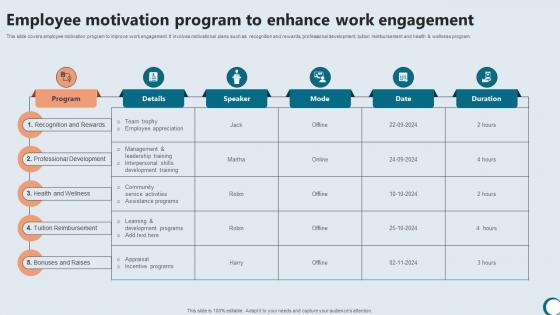
This slide covers employee motivation program to improve work engagement. It involves motivational plans such as recognition and rewards, professional development, tuition reimbursement and health and wellness program.
People who downloaded this PowerPoint presentation also viewed the following :
Employee Motivation Program To Integrating Technology To Enhance Working Efficiency Strategy SS V with all 9 slides:
Use our Employee Motivation Program To Integrating Technology To Enhance Working Efficiency Strategy SS V to effectively help you save your valuable time. They are readymade to fit into any presentation structure.








FAQs for Employee Motivation Program To Integrating Technology To Enhance Working Efficiency
Technology enhances employee motivation through performance analytics, recognition platforms, flexible work tools, personalized learning systems, and real-time feedback mechanisms. These solutions streamline goal tracking, automate recognition programs, and enable remote collaboration, with many organizations finding that strategic technology integration delivers improved engagement, reduced turnover, and ultimately stronger competitive advantage in talent retention.
Data analytics measures motivation strategy effectiveness by tracking key performance indicators like employee engagement scores, productivity metrics, retention rates, turnover patterns, and performance benchmarks. Through advanced analytics platforms, organizations can correlate specific motivational interventions with measurable outcomes, identify which strategies resonate with different employee segments, and optimize their approaches in real-time, ultimately delivering higher engagement and improved organizational performance.
Employee engagement and motivation technologies include gamification platforms, real-time feedback systems, peer recognition apps, performance analytics dashboards, and AI-powered pulse survey tools. These solutions enhance workplace culture by streamlining communication, automating recognition processes, and delivering personalized development insights, with many organizations finding that strategic technology integration ultimately drives higher retention rates and improved productivity across teams.
Companies leverage gamification to boost employee morale by implementing point systems, leaderboards, achievement badges, team challenges, and progress tracking within their workflows. These interactive elements enhance engagement and productivity by creating healthy competition, recognizing accomplishments, and providing clear advancement pathways, with many organizations finding that gamified environments increase participation rates and job satisfaction while delivering improved performance metrics.
Remote work technology significantly impacts employee motivation by enhancing flexibility, improving work-life balance, and enabling seamless collaboration through digital platforms and communication tools. While these technologies streamline remote operations and increase productivity, they also present challenges like digital fatigue and reduced face-to-face interaction, with many organizations finding that strategic implementation ultimately delivers higher employee satisfaction and retention rates.
Feedback technology enhances employee satisfaction through real-time performance dashboards, peer recognition platforms, continuous survey tools, and AI-driven coaching recommendations that streamline communication and development processes. These systems enable managers to deliver timely, personalized feedback while empowering employees with transparent growth metrics, ultimately creating more engaged workforces and improved retention rates across organizations.
Mobile apps facilitate continuous motivation through real-time feedback systems, gamified achievement tracking, peer recognition platforms, personalized goal setting, and instant access to learning resources. These technologies streamline engagement by delivering immediate performance insights, enabling social collaboration, and providing flexible reward mechanisms, with many organizations finding that mobile-first approaches significantly enhance employee participation rates and ultimately deliver sustained behavioral change and improved productivity across distributed teams.
Artificial intelligence personalizes employee motivation strategies by analyzing individual performance patterns, communication preferences, engagement levels, and career aspirations to create tailored recognition programs, development pathways, and incentive structures. Through machine learning algorithms, organizations can deliver customized feedback timing, personalized goal-setting frameworks, and targeted learning opportunities, ultimately enhancing employee satisfaction and retention rates.
Companies should look for real-time feedback systems, goal tracking and milestone recognition, peer-to-peer appreciation tools, personalized rewards management, and comprehensive analytics dashboards in motivation management software. These features streamline employee engagement by automating recognition processes, tracking performance metrics, and delivering targeted incentives, with many organizations finding that integrated platforms significantly enhance workforce productivity and retention rates.
Social media platforms motivate employees through peer recognition systems, gamified achievement sharing, collaborative project showcases, real-time feedback mechanisms, and interactive team challenges. Companies like Salesforce and HubSpot leverage internal social networks to celebrate milestones, foster cross-departmental collaboration, and create engaging workplace communities, ultimately enhancing employee engagement while building stronger organizational culture.
Learning Management Systems (LMS), virtual reality simulations, microlearning platforms, AI-powered personalized learning paths, and gamified training modules can significantly enhance skill development and motivation. These technologies streamline knowledge acquisition by delivering targeted content, tracking progress, and providing interactive experiences, with many organizations finding that employees feel more engaged and valued when offered modern, flexible learning opportunities that advance their careers.
Employee recognition platforms enhance motivation and performance by providing real-time feedback, peer-to-peer acknowledgment, and data-driven insights into employee achievements and contributions. These digital solutions streamline recognition processes while enabling managers to track performance trends, ultimately delivering improved employee engagement, reduced turnover, and stronger organizational culture across teams.
Technology adoption significantly enhances employee retention by streamlining workflows, enabling remote flexibility, and creating engaging digital experiences that reduce frustration and burnout. Organizations implementing comprehensive tech solutions, particularly in healthcare and financial services, experience 20-40% higher retention rates, as employees feel more empowered, productive, and connected to meaningful work outcomes.
Virtual reality enhances team-building and motivation by creating immersive collaborative experiences, simulating challenging scenarios, and enabling remote team connections through shared virtual environments. Through VR platforms, organizations streamline team cohesion with problem-solving adventures, cross-cultural experiences, and skills-based challenges, while delivering enhanced engagement and stronger interpersonal relationships, ultimately boosting productivity and workplace satisfaction.
**INPUT**: What are the challenges organizations face when integrating technology for employee motivation? **OUTPUT**: Technology integration for employee motivation presents challenges including resistance to change, privacy concerns, implementation costs, selecting appropriate platforms, and ensuring meaningful engagement rather than superficial gamification. While organizations across sectors like healthcare and financial services navigate these complexities, many find that strategic planning, comprehensive training, and employee feedback integration ultimately deliver enhanced productivity and competitive advantage. [Word count: 57 words]
-
Great product, helpful indeed!
-
“Detailed and great to save your time.”