


Employee value proposition template 2 ppt styles guide




Try Before you Buy Download Free Sample Product
 Impress Your
 Audience
 100%
100% Editable
 Save Hours
 of Time


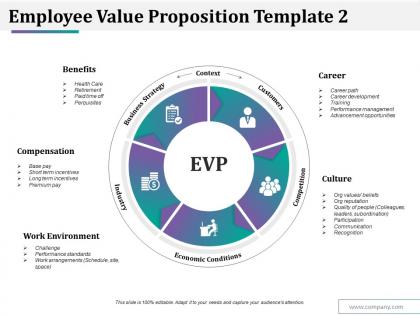
This employee value proposition template 2 PPT styles guide is a slightly detailed out slide visual as compared to the other EVP slides designed and crafted by us. In the provided EVP PPT PowerPoint visual one can see the in and out model of employee value proposition. We believe that a well designed employ value proposition PowerPoint presentation model facilitates the recruiting process and increases employee retention within the organization. More competitive is your work environment or economic condition, more is the need for a uniquely designed and well presented employee value retention benefits program PPT template. All of you out there want to go for a unique EVP design, and so to cater to the varied taste buds of the multiple employers, we have come up with a complete platter of EVP slides, with each of them holding a USP of its own. Approach the subject with our Employee Value Proposition Template 2 Ppt Styles Guide. You will never get a diffident response.
People who downloaded this PowerPoint presentation also viewed the following :
Employee value proposition template 2 ppt styles guide with all 5 slides:
Build your chemistry with the audience. Our Employee Value Proposition Template 2 Ppt Styles Guide have the correct formula.
FAQs for Employee value proposition template 2
Key EVP elements include compensation and benefits, career development opportunities, work-life balance initiatives, company culture and values, recognition programs, and meaningful work alignment. These components work together by attracting top talent, enhancing employee retention, and strengthening organizational reputation, with many companies finding that comprehensive EVPs ultimately deliver competitive hiring advantages and improved employee engagement across all business functions.
Organizations effectively communicate their EVP through multi-channel strategies including career websites, social media campaigns, employee testimonials, recruitment materials, and employer branding initiatives. These approaches streamline candidate attraction by showcasing authentic workplace culture, growth opportunities, and competitive benefits, with many companies finding that consistent EVP messaging across touchpoints ultimately delivers stronger talent acquisition and reduced hiring costs.
**INPUT**: What metrics can be used to measure the effectiveness of an EVP in attracting or retaining talent? **OUTPUT**: EVP effectiveness metrics include employee retention rates, time-to-fill positions, candidate quality scores, employee engagement levels, and recruitment cost-per-hire. These measurements enable organizations to track talent attraction success, retention improvements, and overall workforce satisfaction, with many companies finding that strategic EVP implementation delivers measurable competitive advantages in increasingly competitive talent markets. [Word count: 53 words]
EVP components vary significantly across industries, with tech companies emphasizing innovation and flexibility, healthcare focusing on purpose-driven work, and finance highlighting stability and compensation packages. Companies should consider their unique market position, talent competition landscape, and organizational culture, while conducting thorough research on what motivates their specific workforce demographics, ultimately creating authentic propositions that differentiate them from competitors.
Employee feedback can shape EVP templates through regular surveys, focus groups, exit interviews, performance reviews, and pulse checks that identify gaps between promised and delivered experiences. This ongoing input enables organizations to refine messaging, update benefits offerings, and adjust workplace policies, ensuring the EVP remains authentic and competitive while addressing evolving employee expectations and market conditions.
A strong EVP enhances employer brand by clearly communicating unique benefits, culture, and career opportunities that differentiate your organization from competitors. Through authentic messaging and consistent delivery, companies build reputation as employers of choice, attract higher-quality candidates, and reduce recruitment costs, with many organizations finding that compelling EVPs significantly decrease time-to-hire while improving candidate quality.
Company culture serves as the foundation for an authentic Employee Value Proposition, defining workplace values, behavioral expectations, collaborative approaches, and growth opportunities that attract and retain talent. A strong culture enables organizations to differentiate themselves through unique experiences, meaningful work environments, and aligned values, with many companies finding that culture-driven EVPs significantly enhance employee engagement, reduce turnover, and ultimately deliver competitive advantage in talent acquisition.
Organizations ensure EVP resonance across diverse demographics by conducting comprehensive employee surveys, focus groups, and demographic analysis to understand varied needs, values, and motivations. Through targeted messaging that addresses different career stages, cultural backgrounds, and work preferences, companies create inclusive value propositions that speak to multigenerational workforces, ultimately enhancing retention and attraction across all employee segments.
Common pitfalls include making generic promises that lack authenticity, overpromising benefits the organization cannot deliver, focusing solely on compensation while ignoring culture and development opportunities, and failing to differentiate from competitors. Many organizations also create EVPs without employee input, ignore diverse workforce needs, or develop compelling statements but fail to integrate them into actual HR practices, ultimately undermining credibility and employee trust.
EVPs should emphasize flexibility, technology support, and virtual collaboration tools for remote employees, while highlighting workplace culture, in-person mentorship, and office amenities for on-site staff. Organizations increasingly find that successful tailoring involves addressing location-specific motivators like work-life balance for remote workers and community connection for office-based teams, ultimately delivering personalized employee experiences that enhance retention across all work arrangements.
Integrating career development opportunities enhances an EVP by demonstrating long-term investment in employees, offering clear advancement pathways, and providing skill-building programs that increase marketability. These initiatives strengthen retention while attracting ambitious talent, with many organizations finding that robust development frameworks deliver higher engagement, reduced turnover costs, and ultimately stronger competitive positioning in talent acquisition.
Benefits and compensation can be highlighted through transparent salary ranges, comprehensive benefits packages, performance-based incentives, professional development funding, and flexible work arrangements. Organizations like tech companies and consulting firms effectively showcase total compensation value, career advancement opportunities, and work-life balance perks, ultimately attracting top talent while demonstrating their commitment to employee growth and financial well-being.
Organizations align their EVP with long-term goals by ensuring compensation, benefits, career development, and workplace culture directly support strategic objectives like innovation, customer service, or market expansion. This strategic alignment enables companies to attract talent with relevant skills, retain employees who embody organizational values, and ultimately drive performance outcomes that advance competitive positioning in increasingly talent-driven markets.
Storytelling transforms EVP presentations by creating emotional connections, demonstrating authentic company culture, and showcasing real employee experiences through compelling narratives. These stories enable organizations to differentiate themselves in competitive talent markets, with many companies finding that candidates who connect with their cultural narrative show higher engagement, better role alignment, and increased likelihood of accepting offers.
Technology enhances EVP delivery through personalized communication platforms, data analytics for targeted messaging, mobile apps for real-time engagement, and AI-driven feedback systems. These tools streamline employee experiences by automating onboarding processes, providing instant access to benefits information, and enabling continuous dialogue, with many organizations finding that digital EVP platforms significantly improve retention rates and employee satisfaction.
-
Best way of representation of the topic.
-
Designs have enough space to add content.