Employee value proposition canvas ppt styles summary

Rating:
90%
Employee value proposition canvas ppt styles summary
Slide 1 of 5
Favourites Favourites

Try Before you Buy Download Free Sample Product

Audience Impress Your
Audience
Editable 100%
Editable
Time Save Hours
of Time
The Biggest Sale is ending soon in
0
0
:
0
0
:
0
0
Rating:
90%
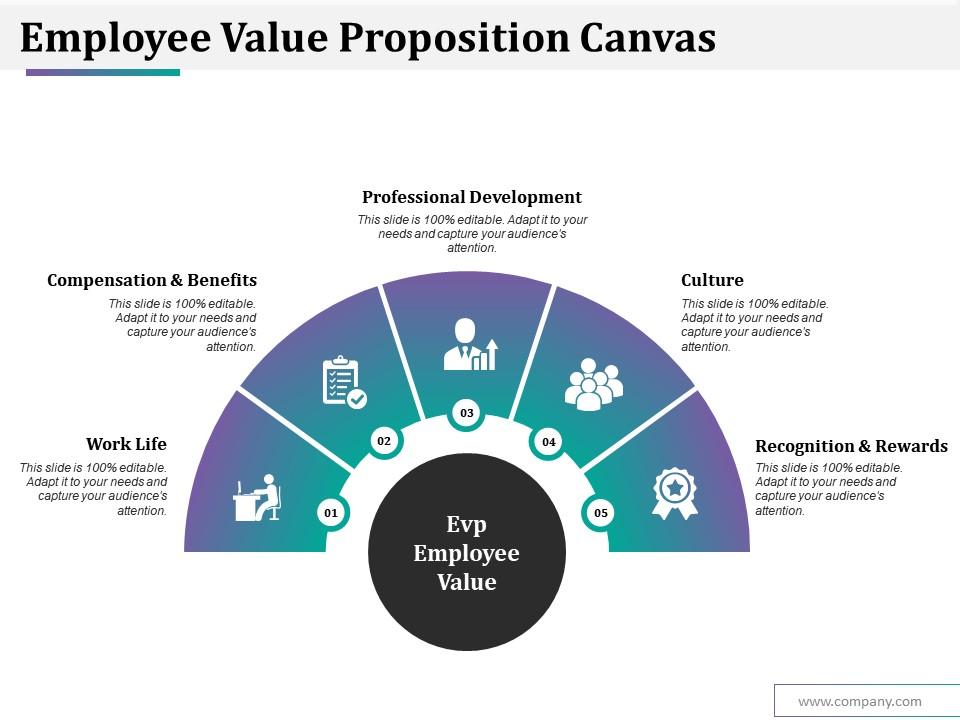
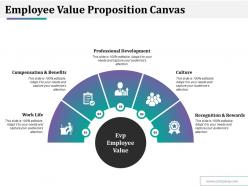
Presenting this set of slides with name - Employee Value Proposition Canvas Ppt Styles Summary. This is a five stage process. The stages in this process are Work Life, Culture, Recognition And Rewards, Professional Development.

FAQs for Employee value proposition canvas

Key EVP Canvas components include compensation and benefits, career development opportunities, work environment and culture, recognition and rewards, and work-life balance initiatives. These elements work together by attracting top talent, enhancing employee engagement, and reducing turnover costs, with many organizations finding that a well-structured EVP delivers competitive recruitment advantages and improved retention rates.

Organizations can effectively identify their unique EVP by conducting comprehensive employee surveys, analyzing competitor offerings, evaluating current talent retention data, and assessing organizational culture strengths. Through strategic workshops involving HR, leadership, and cross-functional teams, companies streamline messaging around compensation, growth opportunities, and workplace culture, ultimately delivering authentic value propositions that resonate with target talent and enhance recruitment effectiveness.

Employee feedback serves as the foundational data source for creating an authentic EVP Canvas, providing direct insights into what employees truly value, their pain points, current satisfaction levels, and desired improvements across compensation, culture, and career development. Through surveys, focus groups, and exit interviews, organizations can identify gaps between perceived and actual employee experience, enabling them to craft compelling value propositions that resonate with their workforce and attract top talent.

The EVP Canvas differs from traditional employee engagement surveys by focusing on strategic value proposition design rather than satisfaction measurement, identifying specific employee needs and organizational offerings through collaborative workshops instead of periodic questionnaires. While surveys capture sentiment snapshots, the Canvas enables continuous value proposition refinement, with many organizations finding that this proactive approach delivers stronger talent retention and competitive positioning than reactive survey responses.

Effective EVP alignment techniques include cultural audits, employee focus groups, leadership workshops, value mapping exercises, and cross-functional collaboration sessions. These approaches ensure authenticity by involving current employees in defining what truly represents the organization, while leadership workshops help translate core values into compelling employee benefits, ultimately delivering stronger retention and more authentic employer branding.

The EVP Canvas helps organizations attract top talent by systematically identifying unique value propositions, mapping competitive advantages, and aligning offerings with candidate priorities across compensation, culture, and career development. This strategic approach enables companies to differentiate themselves through targeted messaging, personalized recruitment experiences, and compelling narratives, with many finding that data-driven EVP positioning significantly enhances their talent acquisition success rates.

Common pitfalls include making generic promises without differentiation, failing to align EVP with actual employee experiences, focusing solely on compensation while ignoring culture and growth opportunities, and developing EVP in isolation without employee input. Many organizations find that misaligned messaging between HR promises and manager delivery ultimately undermines credibility, while successful companies ensure their EVP authentically reflects workplace realities and delivers measurable improvements in retention and engagement.

Leaders ensure EVP relevance through regular employee feedback collection, continuous market research, and quarterly alignment reviews with evolving workforce demographics and expectations. By leveraging pulse surveys, focus groups, and competitive analysis, organizations can adapt their value propositions to address changing priorities like remote work flexibility, career development opportunities, and purpose-driven initiatives, ultimately maintaining competitive talent attraction and retention advantages.

EVP effectiveness metrics include employee engagement scores, retention rates, recruitment time-to-fill, candidate quality assessments, and employer brand perception surveys. These measurements enable organizations to track talent attraction improvements, retention cost reductions, and workforce satisfaction levels, with many companies finding that regular EVP assessment ultimately delivers stronger competitive positioning and enhanced organizational performance.

The EVP Canvas integrates with talent management strategy by aligning recruitment, retention, and development initiatives with clearly defined value propositions that resonate across different employee segments. Through strategic mapping of benefits, career growth opportunities, and cultural elements, organizations streamline their talent acquisition processes, enhance employee engagement programs, and reduce turnover, with many companies finding that this integrated approach delivers measurable improvements in both recruitment efficiency and long-term retention rates.

**INPUT**: What approach should be taken to communicate the EVP to both current employees and prospective hires? **OUTPUT**: EVP communication requires multi-channel strategies including authentic storytelling through employee testimonials, integration across recruitment materials, onboarding programs, and internal communications platforms. Organizations should leverage social media, career pages, and manager conversations to consistently reinforce value propositions, with many companies finding that transparent, personalized messaging ultimately enhances retention and attracts quality talent.

Organizations leverage their EVP to enhance retention and satisfaction by clearly communicating career development opportunities, competitive compensation packages, flexible work arrangements, and meaningful company culture initiatives. Through strategic EVP implementation, companies like Google and Microsoft create compelling workplace experiences that reduce turnover, boost engagement, and attract top talent, ultimately delivering stronger organizational performance and competitive advantage.

The global workforce landscape significantly impacts EVP development by requiring organizations to address diverse cultural values, varying compensation expectations, remote work preferences, and generational differences across markets. Companies must balance local customization with global brand consistency, incorporating flexible benefits, digital-first experiences, and cross-cultural career development opportunities to attract talent in an increasingly competitive, borderless employment environment.

Diversity and inclusion enhance the EVP Canvas by broadening talent attraction, improving employee engagement, and strengthening organizational culture across diverse workforce segments. These elements enable companies to create more comprehensive value propositions that resonate with varied backgrounds and perspectives, with many organizations finding that inclusive EVPs deliver stronger retention rates, enhanced innovation, and competitive advantage in increasingly diverse markets.

Companies can tailor their EVP by conducting demographic research, creating segment-specific value propositions, and customizing communication channels for different employee groups. For example, younger employees might prioritize career development and flexibility, while experienced professionals value stability and recognition, with organizations like tech companies and healthcare systems successfully implementing targeted approaches that enhance retention and engagement across diverse workforce segments.

Ratings and Reviews

90% of 100
Review Form
Write a review
Most Relevant Reviews
  1. 80%

    by Danny Kennedy

    Excellent Designs.
  2. 100%

    by Christopher Wood

    Very well designed and informative templates.

2 Item(s)

per page: