

Encryption For Data Security Powerpoint Presentation Slides Cybersecurity CD





Try Before you Buy Download Free Sample Product
 Impress Your
Audience
 100%
Editable
 Save Hours
of Time


Check out our professionally designed Encryption for data security PowerPoint presentation. This Encryption PPT includes methods, algorithms, and strategies to fortify sensitive information across networks, databases, and devices. Moreover, this Endpoint Protection Service PowerPoint addresses prevalent cybersecurity concerns, offering solutions to data breaches and privacy concerns. Also, this Template explores Encryptions pivotal role in compliance adherence, risk mitigation, and safeguarding intellectual property. Further, the Endpoint Detection and Response PPT include applications from industries like finance, healthcare, e-commerce, etc. Lastly, this module can help businesses implement Encryption to ensure data integrity, confidentiality, and regulatory compliance for organizational trust and reputation. Download now for actionable insights on deploying encryption protocols effectively.
People who downloaded this PowerPoint presentation also viewed the following :
Content of this Powerpoint Presentation
Slide 1: The slide introduces Encryption for Data Security. State your Company name and begin.
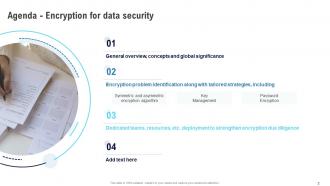
Slide 2: This is your Agenda slide. State your Agenda here.
Slide 3: The slide displays Table of Contents for the presentation.
Slide 4: The slide represents Introduction to cybersecurity awareness.
Slide 5: This slide showcases general overview of encryption technology which acts as a cornerstone of data privacy.
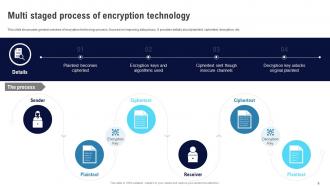
Slide 6: This slide displays general overview of encryption technology process, focused on improving data privacy.
Slide 7: This slide depicts significant role of encryption technology, focused on improving data privacy.
Slide 8: This slide major types of encryption technology, focused on improving data privacy and security of today’s business.
Slide 9: This slide continues major types of encryption technology, focused on improving data privacy and security of today’s business.
Slide 10: This slide highlights Current cybersecurity scenario.
Slide 11: This slide covers challenges organization is facing relating to encryption.
Slide 12: This slide showcases challenges organization is facing relating to encryption further.
Slide 13: This slide renders financial impact of poor practices relating to encryption.
Slide 14: This slide contains gap analysis relating to encryption running in the organization.
Slide 15: This slide represents Building a comprehensive encryption strategy.
Slide 16: This slide showcases timeline of encryption to be implemented in the organization.
Slide 17: This slide displays Building a comprehensive encryption strategy.
Slide 18: This slide illustrates training plan focused on building key encryption skills amongst organization’s employees.
Slide 19: This slide showcases password encryption policies which can help organizations achieve maximum data security.
Slide 20: This slide shows caesar algorithm deployment which can help employees learn basic techniques for basic encryption.
Slide 21: This slide presents Building a comprehensive encryption strategy.
Slide 22: This slide showcases encryption best practice focused on defining security requirements.
Slide 23: This slide illustrates encryption best practice focused on classifying organizational data.
Slide 24: This slide covers encryption best practice focused on ensuring right selection of tools and solutions.
Slide 25: This slide highlights encryption best practice focused on implementing security defense arsenal for data protection.
Slide 26: The slide depicts Building a comprehensive encryption strategy.
Slide 27: This slide showcases advanced encryption standard (AES) algorithm deployment which can help employees learn basic techniques for data encryption.
Slide 28: This slide displays secure socket layer (SSL) deployment which can help employees perform secure communication within businesses.
Slide 29: This slide highlights public key cryptography deployment which can help employees increased speed and user experience of their platforms.
Slide 30: This slide also shows public key cryptography deployment which can help employees increased speed and user experience of their platforms.
Slide 31: This slide renders homomorphic cryptography deployment which can help employees increase data privacy and outsourcing security.
Slide 32: This slide showcases post-quantum cryptography deployment which can help employees secure their communication protocols.
Slide 33: The slide represents Building a comprehensive encryption strategy.
Slide 34: This slide demonstrates one time pad (OTP) encryption deployment which can help employees secure their communication protocols.
Slide 35: This slide showcases key management protocols which can help companies increase efficiency and generation time.
Slide 36: This slide represents key management and strength improvement techniques which can help companies increase security.
Slide 37: This slide highlights encryption key management best practices which can help companies increase security.
Slide 38: The slide describes Cybersecurity team for encryption.
Slide 39: This slide showcases hierarchy chart focused on building cybersecurity teams to help improve business data encryption.
Slide 40: This slide renders roles and responsibilities of cybersecurity teams which can help improve business data encryption.
Slide 41: The slide depicts Encryption costs analysis.
Slide 42: This slide showcases encryption costs under an annual information technology budget, helping companies adjust their expenses.
Slide 43: This slide illustrates comparative analysis of major encryption software, helping companies choose according to their needs.
Slide 44: The slide presents Positive impact analysis of above strategies.
Slide 45: This slide showcases post implementation analysis of encryption strategies.
Slide 46: This slide shows endpoint encryption progress monitoring dashboard focused on tracking protection status of organization’s computers.
Slide 47: This slide is titled as Additional Slides for moving forward.
Slide 48: This is Our Mission slide with related imagery and text.
Slide 49: This is a Financial slide. Show your finance related stuff here.
Slide 50: This slide shows Post It Notes. Post your important notes here.
Slide 51: This is a Timeline slide. Show data related to time intervals here.
Slide 52: This slide presents Bar chart with two products comparison.
Slide 53: This slide depicts Venn diagram with text boxes.
Slide 54: This is a Thank You slide with address, contact numbers and email address.
Encryption For Data Security Powerpoint Presentation Slides Cybersecurity CD with all 62 slides:
Use our Encryption For Data Security Powerpoint Presentation Slides Cybersecurity CD to effectively help you save your valuable time. They are readymade to fit into any presentation structure.













FAQs for Encryption For Data Security Powerpoint Presentation
So basically encryption scrambles your data using math formulas and special keys. Only people with the right key can unscramble it back - kinda like those tamper seals on pill bottles but way more complex. It's got three main jobs: keeping stuff secret, making sure nobody messed with your files, and proving who sent what. Oh, and it uses checksums to catch tampering. Honestly, the math behind it is pretty wild when you dig into it. Just make sure you're using strong encryption whenever you're moving or storing anything sensitive - it'll save you headaches later.
So basically, symmetric encryption is like having one key for your house - same key locks and unlocks everything. Pretty straightforward but kinda risky if you need to give copies to people. Asymmetric uses two keys instead: a public one anyone can use and a private one only you have. It's like that mailbox example where people can drop stuff in but can't take it out. Most of the time you'll see symmetric for big files since it's way faster. Asymmetric gets used more for sharing keys securely or digital signatures. Honestly depends what you're trying to protect first.
So encryption is basically like putting your messages in a digital safe - it scrambles everything so only the person you're sending to can actually read it. Your text gets turned into gibberish while it's traveling through the internet, then gets decoded on their end. Super important because otherwise anyone snooping could read all your stuff (which honestly happens way more than people think). WhatsApp and Signal already do this automatically. If you email a lot of sensitive stuff, you might want to switch to ProtonMail or something similar instead of regular Gmail.
So basically, AES and RSA turn your data into complete nonsense that hackers can't read. AES is the fast one - same key encrypts and decrypts everything, perfect for your files. RSA works differently with those public/private key pairs, which honestly took me forever to understand when I first learned about this stuff. Here's the cool part though - they often work together. RSA securely shares the AES key first, then AES handles the heavy lifting. Both would take centuries to crack with today's computers. Just make sure you're using 256-bit AES and at least 2048-bit RSA keys.
Oh man, bad crypto implementation will absolutely destroy you even with solid algorithms. Key management is usually the killer - people store keys in plaintext or hardcode them right in the source code. Then you've got folks still using ancient stuff like MD5, botched custom implementations, and sketchy certificate validation. Random number generation gets screwed up too. I swear, one tiny mistake and your whole security model falls apart. Just use proven libraries instead of building your own - seriously, don't even think about rolling custom crypto. Get someone who actually knows this stuff to review your work.
So basically with end-to-end encryption, your messages get scrambled on your phone and only unscramble when they reach whoever you're texting. The company running the app can't even read them - which is honestly pretty wild when you think about it. If hackers break in or the government comes knocking, all they'll see is complete nonsense instead of your actual texts. I'd stick with Signal if you really care about privacy, though WhatsApp and iMessage do it too. Just make sure you're not using like... regular SMS or something dumb like that.
Yeah, encryption does add overhead - you're talking about 10-20% more storage space plus some slowdown when you're reading/writing files. Large files especially take a hit, though honestly modern systems aren't too bad about it. Most cloud providers just do it automatically now, which is cool for security but you'll pay for that extra storage. Totally worth it though if there's ever a breach. Oh, and check whether they do client-side or server-side encryption - makes a difference for who actually controls your keys.
So here's the thing - encryption is like your get-out-of-jail-free card for compliance stuff. GDPR won't even make you report breaches if the data's properly encrypted since hackers can't actually use it. HIPAA's the same way, they basically give you a pass on penalties if encrypted patient data gets stolen. Regulators love seeing it too because it shows you actually care about security (which, honestly, you should anyway). Just don't screw up the key management part - that's where most people shoot themselves in the foot. Oh, and make sure you're using decent encryption standards, not some janky old protocol.
Skip the boring slides and hit them with real horror stories - like when Target or Equifax got hammered because of weak encryption. That stuff actually sticks. Interactive workshops work way better, and honestly? Show them side-by-side examples of encrypted vs plain text data so they can literally see what hackers would grab. Connect it to whatever they're doing daily - their customer files, payment info, whatever. Don't get all technical on them right away. Focus on why encryption matters first, then maybe touch on how it works later. Those quick lunch sessions are gold for questions too.
Honestly, key management is gonna be your biggest headache - tracking who has access to what across thousands of keys is brutal. Performance takes a hit too since everything slows down when you're constantly encrypting/decrypting (databases are the worst for this). Getting security, dev, and ops teams aligned is like herding cats since everyone's got different priorities. Legacy systems? Total pain to retrofit since they weren't designed for this stuff. Oh, and rotation schedules become a mess real quick. My advice: start with your most sensitive data, get the key management sorted first, then slowly expand from there.
Honestly, quantum computers could mess up most encryption we use today. They'd crack RSA and ECC way faster than regular computers - that's the stuff protecting your credit cards and all. But there's already new "quantum-resistant" methods being developed. Lattice-based crypto, hash signatures, things like that. They're designed to survive quantum attacks. I'd say start thinking about switching now, though we probably have like 10-15 years before it's actually a problem. Better to get ahead of it than scramble later, you know?
So basically you've got privacy rights clashing with cops needing to solve crimes. Encryption keeps us safe from hackers and sketchy governments, but then police can't crack phones even with warrants. Creating backdoors for law enforcement? Terrible idea - those same holes get exploited by criminals too. Security folks are pretty unanimous that you can't build access that magically only works for the good guys (which honestly should be obvious). This whole mess directly affects what security tools your company can actually use, so yeah, worth paying attention to.
So AI is basically a double-edged sword here. It's helping us create better encryption while simultaneously making it easier to crack existing stuff. Machine learning can spot vulnerabilities humans miss and optimize algorithms, but attackers are using the same tech for more sophisticated brute force attempts. The real nightmare scenario? Quantum computing plus AI could demolish current encryption methods entirely. Honestly, post-quantum cryptography isn't just some distant concern anymore - companies are already rolling out quantum-resistant algorithms. You'll want to start thinking about your transition plan sooner rather than later, trust me.
So PKI is basically your trusted middleman for all the encryption key stuff - handles the messy parts so you don't have to. It creates digital certificates that prove who owns which public keys. That way you're not accidentally sending sensitive data to some random attacker pretending to be your contact (which honestly happens more than you'd think). Think digital ID system but way more complex behind the scenes. Also manages key distribution and revokes compromised keys through those certificate authorities everyone relies on. Bottom line - get your PKI setup right before worrying about anything else encryption-wise.
So basically we update encryption when hackers get too good at breaking the old stuff, or when computers get powerful enough to crack them. DES got replaced by AES for this reason. Now everyone's freaking out about quantum computers potentially breaking everything we use today - honestly, it's pretty crazy to think about. NIST rolled out some new quantum-resistant standards this year. There's also cool tech like homomorphic encryption where you can actually do math on encrypted data without decrypting it first. Oh, and zero-knowledge proofs are getting big too. For now though, just stick with AES-256 minimum and maybe start thinking about migration plans.
-
Nothing beats the well-formatted and professionally designed templates offered. Kudos to SlideTeam for their amazing collection of PPT slides.
-
Unique research projects to present in meeting.