

Cloud Cryptography Powerpoint Presentation Slides




Try Before you Buy Download Free Sample Product
 Impress Your
 Audience
 100%
100% Editable
 Save Hours
 of Time


This Cloud Cryptography IT PPT includes a cloud computing overview, cryptography basics, and applications of cryptographic security. Our Symmetric encryption PowerPoint presentation demonstrates the key features, global market analysis, emerging trends, and benefits of cloud cryptography. Additionally, our hashing deck explored the various forms of cyber-attacks that can be thwarted through the implementation of cryptographic algorithms. This data security in cloud computing PPT also demonstrates the working steps and architecture of the cloud cryptography framework. Furthermore, the cloud encryption techniques module explains the implementation of the symmetric algorithm, asymmetric algorithm, and hashing in cloud computing. It also discusses the working of the Standard for Advanced Encryption AES, Common Data Encryption DES, Rivest Shamir Adleman RSA, and the Elliptic Curve Cryptography ECC algorithm. Moreover, this cloud data protection template contains sections about the services, tools, training, and budget for cloud cryptography. Lastly, this cloud privacy deck comprises a roadmap, a 30-60-90 days plan, a timeline, a checklist for implementing cryptography in the cloud, and a dashboard to monitor their performance. Download our 100 percent editable and customizable template, which is also compatible with Google Slides.
People who downloaded this PowerPoint presentation also viewed the following :
Content of this Powerpoint Presentation
Slide 1: This slide introduces Cloud Cryptography. State Your Company Name and begin.
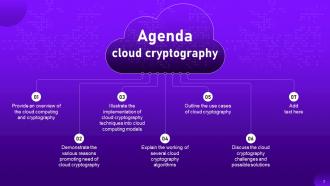
Slide 2: This slide is an Agenda slide. State your agendas here.
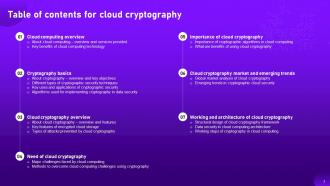
Slide 3: This slide shows a Table of Contents for the presentation.
Slide 4: It is in continuation with the previous slide.
Slide 5: This slide is an introductory slide.
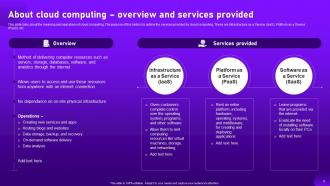
Slide 6: This slide talks about the meaning and operations of cloud computing.
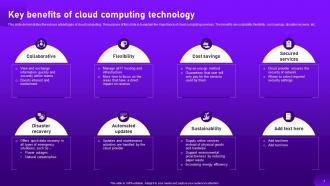
Slide 7: This slide demonstrates the various advantages of cloud computing.
Slide 8: This slide is an introductory slide.
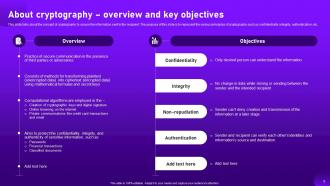
Slide 9: This slide details about the concept of cryptography to secure the information sent to the recipient.
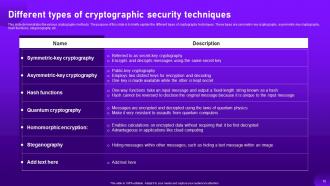
Slide 10: This slide demonstrates the various cryptography methods.
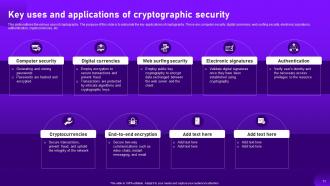
Slide 11: This slide outlines the various uses of cryptography.
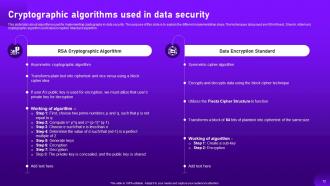
Slide 12: This slide shows about algorithms used for implementing cryptography in data security.
Slide 13: This slide is an introductory slide.
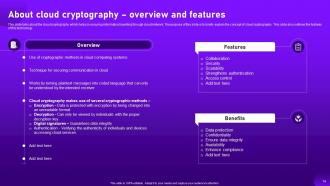
Slide 14: This slide showcases about the cloud cryptography which helps in securing information travelling through cloud network.
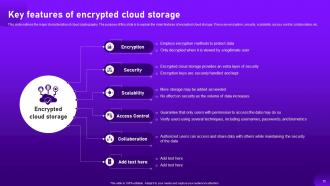
Slide 15: This slide outlines the major characteristics of cloud cryptography.
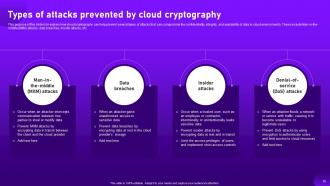
Slide 16: This purpose of this slide is to explain how cloud cryptography can help prevent several types of attacks.
Slide 17: This slide is an introductory slide.
Slide 18: This slide discusses the limitations of cloud computing services.
Slide 19: The purpose of this slide is to elaborate some ways that cloud cryptography can help overcome cloud data security challenges.
Slide 20: This slide is an introductory slide.
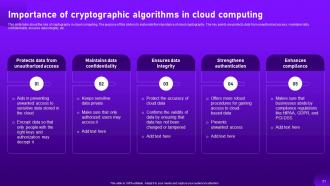
Slide 21: This slide entails about the role of cryptography in cloud computing.
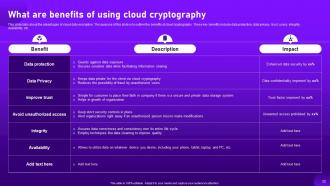
Slide 22: This slide illustrates about the advantages of cloud data encryption.
Slide 23: This slide is an introductory slide.
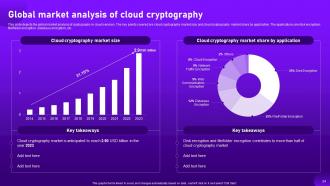
Slide 24: This slide depicts the global market analysis of cryptography in cloud services.
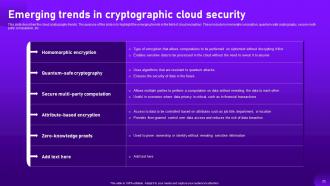
Slide 25: This slide describes the cloud cryptography trends.
Slide 26: This slide is an introductory slide.
Slide 27: The purpose of this slide is to illustrate the design of cryptography cloud framework.
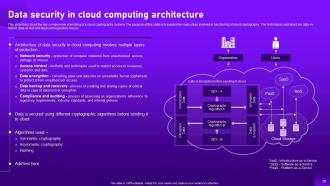
Slide 28: This slide highlights about the key components of working of a cloud cryptography system.
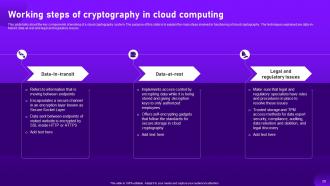
Slide 29: This slide showcases about the key components of working of a cloud cryptography system.
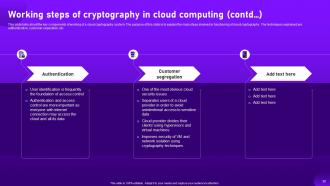
Slide 30: This slide talks about the key components of working of a cloud cryptography system.
Slide 31: This slide is an introductory slide.
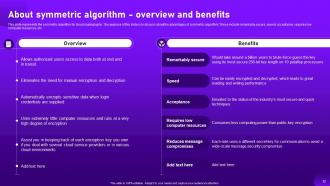
Slide 32: This slide caters to the symmetric algorithm for cloud cryptography.
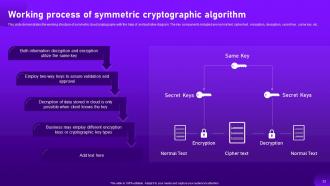
Slide 33: This slide demonstrates the working structure of symmetric cloud cryptography with the help of an illustrative diagram.
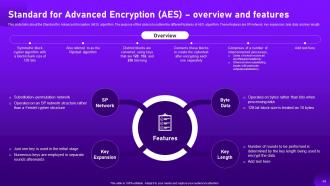
Slide 34: This slide talks about the Standard for Advanced Encryption (AES) algorithm.
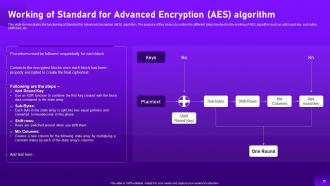
Slide 35: This slide describes the functioning of Standard for Advanced Encryption (AES) algorithm.
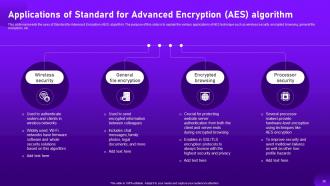
Slide 36: This slide represents the uses of Standard for Advanced Encryption (AES) algorithm.
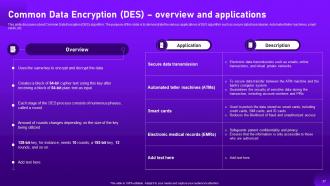
Slide 37: This slide discusses about Common Data Encryption (DES) algorithm.
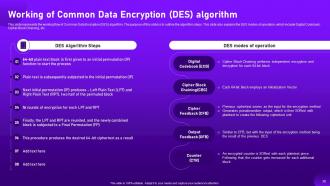
Slide 38: This slide presents the working flow of Common Data Encryption (DES) algorithm.
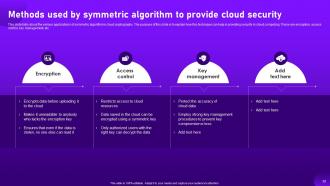
Slide 39: This slide contains about the various applications of symmetric algorithm in cloud cryptography.
Slide 40: This slide is an introductory slide.
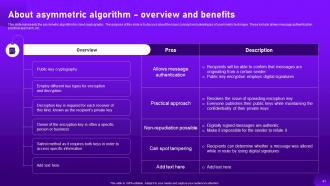
Slide 41: This slide represents the asymmetric algorithm for cloud cryptography.
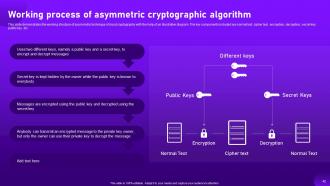
Slide 42: This slide processes the working structure of asymmetric technique of cloud cryptography with the help of an illustrative diagram.
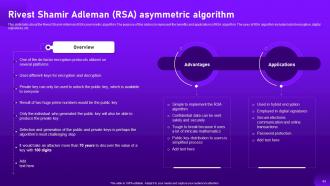
Slide 43: This slide talks about the Rivest Shamir Adleman (RSA) asymmetric algorithm.
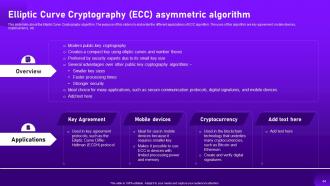
Slide 44: This slide talks about the Elliptic Curve Cryptography algorithm.
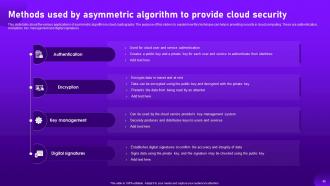
Slide 45: This slide portrays about the various applications of asymmetric algorithm in cloud cryptography.
Slide 46: This slide is an introductory slide.
Slide 47: This slide represents the hashing algorithm for cloud cryptography.
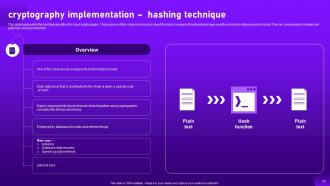
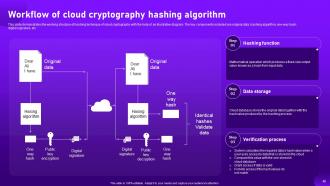
Slide 48: This slide demonstrates the working structure of hashing technique of cloud cryptography with the help of an illustrative diagram.
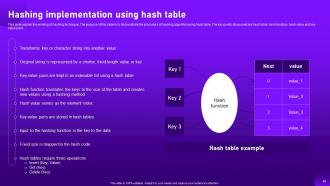
Slide 49: This slide explains the working of hashing technique.
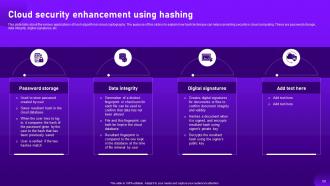
Slide 50: This slide entails about the various applications of hash algorithm in cloud cryptography.
Slide 51: This slide is an introductory slide.
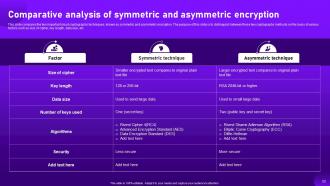
Slide 52: This slide compares the two important cloud cryptographic techniques, known as symmetric and asymmetric encryption.
Slide 53: This slide is an introductory slide.
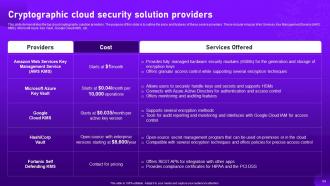
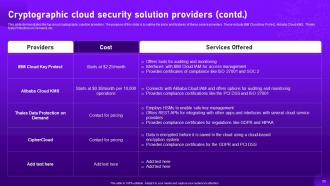
Slide 54: This slide demonstrates the top cloud cryptography solution providers.
Slide 55: This slide describes the top cloud cryptography solution providers.
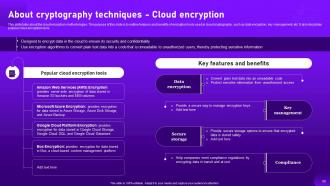
Slide 56: This slide talks about the cloud encryption methodologies.
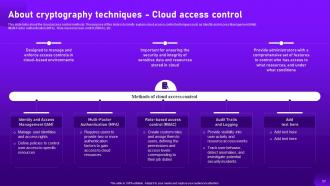
Slide 57: This slide showcases about the cloud access control methods.
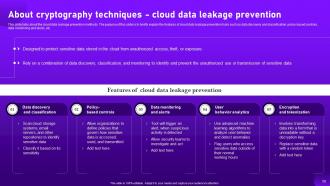
Slide 58: This slide shows about the cloud data leakage prevention methods.
Slide 59: This slide is an introductory slide.
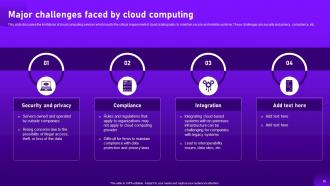
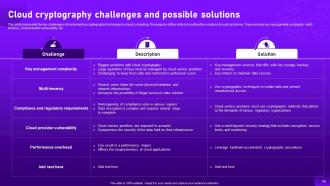
Slide 60: This slide represents the key challenges of implementing cryptographic techniques in cloud computing.
Slide 61: This slide is an introductory slide.
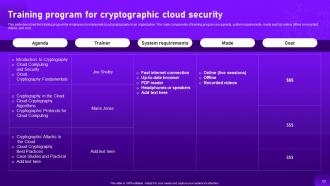
Slide 62: This slide describes the training program for employees to implement cloud cryptography in an organization.
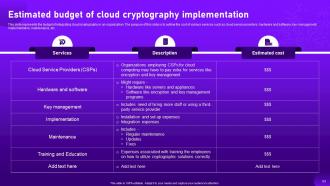
Slide 63: This slide represents the budget of integrating cloud cryptography in an organization.
Slide 64: This slide is an introductory slide.
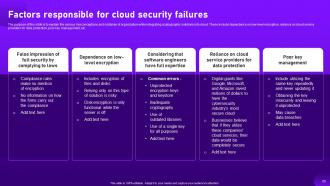
Slide 65: The purpose of this slide is to explain the various misconceptions and mistakes of organization.
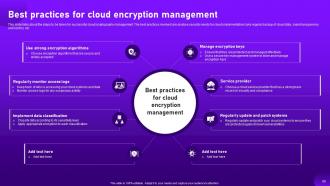
Slide 66: This slide showcases about the steps to be taken for successful cloud cryptography management.
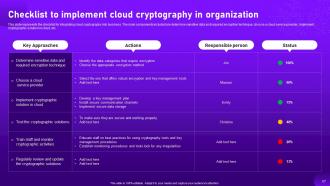
Slide 67: This slide illustrates the checklist for integrating cloud cryptography into business.
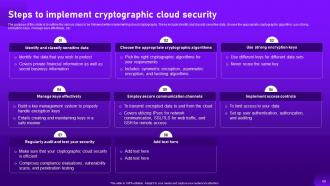
Slide 68: The purpose of this slide is to outline the various steps to be followed while implementing cloud cryptography.
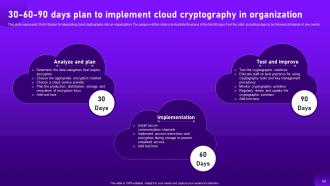
Slide 69: This slide highlights 30-60-90 plan for integrating cloud cryptography into an organization.
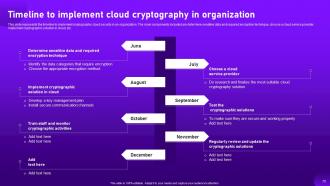
Slide 70: This slide represents the timeline to implement cryptographic cloud security in an organization.
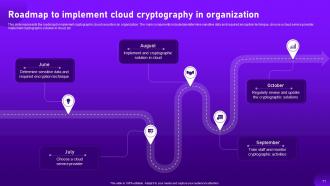
Slide 71: This slide highlights the roadmap to implement cryptographic cloud security in an organization.
Slide 72: This slide is an introductory slide.
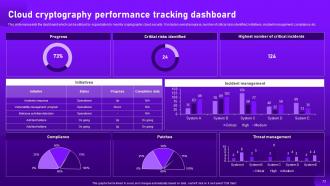
Slide 73: This slide entails the dashboard which can be utilized by organization to monitor cryptographic cloud security.
Slide 74: This slide is an introductory slide.
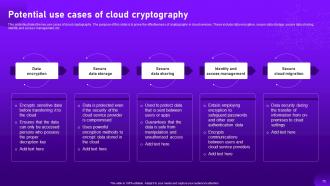
Slide 75: This slide illustrates the key use cases of cloud cryptography.
Slide 76: This slide shows all the icons included in the presentation.
Slide 77: This slide is titled Additional Slides for moving forward.
Slide 78: This slide is an About Us slide to show company specifications etc.
Slide 79: This slide is a Timeline slide. Show data related to time intervals here.
Slide 80: This slide contains a Puzzle with related icons and text.
Slide 81: This slide is an Idea Generation slide to state a new idea or highlight information, specifications, etc.
Slide 82: This slide shows SWOT describing- Strength, Weakness, Opportunity, and Threat.
Slide 83: This slide shows Post-It Notes. Post your important notes here.
Slide 84: This slide depicts a Venn diagram with text boxes.
Slide 85: This slide is a thank-you slide with address, contact numbers, and email address.
Cloud Cryptography Powerpoint Presentation Slides with all 93 slides:
Use our Cloud Cryptography Powerpoint Presentation Slides to effectively help you save your valuable time. They are readymade to fit into any presentation structure.














FAQs for Cloud Cryptography
So basically, traditional crypto means you're doing everything in-house - your keys, your encryption, all on your own systems. Cloud crypto hands some (or all) of that over to a third party. I'll be honest, it made me pretty nervous the first time I considered it! But you get way better scaling without having to babysit complex infrastructure. The downside? You're trusting someone else with your sensitive stuff. My advice - dig into exactly how they handle your keys before you jump in. Don't just take their marketing at face value.
So cloud cryptography is basically like having multiple locks on your stuff when you move it online. Your data gets scrambled both when it's just sitting there and when it's moving around between servers. Even if hackers grab it, they can't actually read anything - it's just gibberish to them. Most cloud providers are honestly way better at managing encryption keys than your average company IT department (no offense if you work in IT lol). The big thing you need to figure out though? Who actually controls those encryption keys. That's what determines whether you're really in control of your security or not.
So you've got three main ones that pretty much run everything - AES-256, RSA, and SHA-256. AES does most of the heavy lifting for actual data encryption since it's crazy fast. RSA handles the key swapping and signatures, though ECC is starting to take over because it's way more efficient. Honestly, if you're using AWS or Azure they probably already have you set up with AES-256 by default. SHA-256 covers your hashing needs. Oh and fun fact - you're likely using all of these right now without even knowing it. Just double-check you're on AES-256 minimum and you should be good to go.
So basically you gotta figure out which regulations hit your data first - GDPR, HIPAA, SOX, whatever applies to your situation. Then build your cloud encryption around those rules, not the other way around. Most of them are pretty picky about key management - like where your keys can actually live (hint: probably not with AWS or whoever). You'll need proper key rotation, audit trails, maybe even those fancy hardware security modules if you're in a regulated industry. Trust me, trying to bolt compliance on after the fact is a nightmare. Way easier to plan it from the start.
Honestly, the biggest thing is you're giving up control of your encryption keys. Cloud providers handle all that stuff - the encryption, key management, security practices. But what if they mess up or have backdoors? Government requests are another headache to think about. Some companies use weird proprietary encryption that locks you in too. I'd definitely go with client-side encryption if you can swing it. Look for providers where you actually control your own keys instead of just hoping they're doing everything right. Way less stress that way.
Definitely go with AWS KMS, Azure Key Vault, or Google Cloud KMS instead of doing it yourself. Trust me on this one - manual key management is a nightmare waiting to happen. I've watched so many dev teams shoot themselves in the foot trying to build their own solution. These services automatically handle rotation and access controls, which honestly saves you tons of headaches. Just set up your IAM policies right so only the services that need keys can grab them. Oh, and never hardcode keys directly in your app (obviously). Check your key usage logs every now and then too.
So zero-trust is this security approach where you don't trust anything by default - everything gets verified and encrypted constantly. Your network perimeter? Forget about it. Every single data flow between services, users, apps gets authenticated and encrypted. Honestly, setting it up is kind of a nightmare initially, but your crypto game becomes way stronger. You'll have encryption everywhere - stored data, stuff moving around, even while it's being processed. My advice? Map out how your data actually moves first, then figure out where you need those encryption checkpoints between components.
Honestly, cloud breaches are terrifying because of the sheer scale - like millions of records gone at once. Your encryption won't mean much if hackers grab your keys alongside the encrypted data. That's the real nightmare scenario. Keep your keys completely separate from your data - different servers, different services, whatever it takes. Hardware security modules are clutch for this, though they're not cheap. I always tell people to assume everything will get breached eventually. Sounds paranoid but it's just reality now. Design your whole setup like attackers already have one foot in the door.
Honestly, the biggest pain point I see is when people don't keep their encryption consistent between on-prem and cloud. Pick one key management system - AWS KMS or Azure Key Vault are solid choices - and stick with it everywhere. Don't forget to encrypt data moving between environments (I've seen this bite people so many times). Your identity management needs to play nice across both sides too, otherwise users get frustrated with multiple logins. Oh, and document what data lives where. Sounds boring but you'll thank yourself later. Start with an audit of your current setup first.
So basically your data gets scrambled on your device before it even hits the cloud. You're the only one with the key to unscramble it. The cloud company? They're just storing what looks like random gibberish to them. Think of it like locking your diary in a safe before giving it to someone to hold - even if they're nosy (or get robbed), they can't read it. Pretty smart system honestly. Just double-check that whatever service you're using actually does real end-to-end encryption. Some companies are sneaky about their wording there.
Oh man, your old systems definitely weren't built for cloud encryption - expect major compatibility issues. Those ancient APIs won't play nice with newer standards, and some legacy apps are so fragile they'll crash from any changes. Performance will take a hit too when you add encryption layers. Key management becomes a total mess across both environments. My advice? Audit everything first - like actually map out what you're working with. Then do it in chunks instead of all at once. Trust me, the "rip the band-aid off" approach never works with this stuff.
Honestly, blockchain can be pretty solid for beefing up your cloud crypto. You get this unchangeable record of every operation - who touched what data, when keys got used, all that good stuff. No more putting all your faith in just your cloud provider. The distributed thing means you're spreading risk around instead of banking on one company. Smart contracts can handle your security policies automatically too, which is nice. I'd probably test it out with some throwaway data first though - see how it plays with what you've already got running. Don't go full send right away, you know?
Quantum-resistant encryption is the big one to watch - quantum computers could literally break everything we use now. Kinda wild how fast that's happening. There's also homomorphic encryption, which lets you work with encrypted data without actually decrypting it first. Game changer for privacy stuff. Zero-trust is reshaping cloud security too by assuming everything's already compromised from the start. Oh, and you'll want to start looking at your current encryption setup soon. Planning migration paths to quantum-safe algorithms now beats scrambling later when everyone else is doing it.
Honestly, ML can do some pretty cool stuff for your cloud crypto setup. You can use it to catch weird patterns that might signal someone's messing with your encrypted data or keys - that anomaly detection is solid. Performance gets better too since it predicts workloads and tweaks your encryption algorithms automatically. Plus it helps generate stronger keys by analyzing entropy sources. The homomorphic encryption optimization is actually kind of nuts - makes those heavy computations way more bearable. I'd start with ML monitoring on whatever encryption you're already running. You'll spot threats quicker and your performance improves at the same time.
Start with pen testing your encrypted data flows and key management - that's where the real vulnerabilities hide. Document every crypto incident, even tiny ones (I know it's tedious but trust me on this). Monitor for latency spikes and processing delays. Set up alerts for cert expirations and failed encryption attempts. Test your disaster recovery procedures regularly - key rotation, backups, the whole deal. Track compliance audit results over time too. Honestly, most people skip the quarterly end-to-end testing because they assume everything's fine, but that's usually when things break spectacularly.
-
Informative design.
-
The service is fast, and I could access any presentation after buying the subscription. I don’t think I’ll ever have to worry about a presentation in my life.