


End To End Recruitment Process Flowchart




Try Before you Buy Download Free Sample Product
 Impress Your
 Audience
 100%
100% Editable
 Save Hours
 of Time


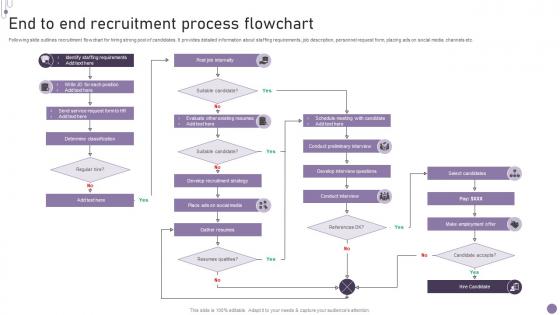
Following slide outlines recruitment flowchart for hiring strong pool of candidates. It provides detailed information about staffing requirements, job description, personnel request form, placing ads on social media channels etc.
People who downloaded this PowerPoint presentation also viewed the following :
End To End Recruitment Process Flowchart with all 6 slides:
Use our End To End Recruitment Process Flowchart to effectively help you save your valuable time. They are readymade to fit into any presentation structure.





FAQs for End To End
So the main steps are job analysis, posting it, screening apps, interviews, reference checks, then making an offer. Define what you actually need upfront - trust me, it saves so much hassle later. Screen resumes for your non-negotiables first. Do phone interviews, then bring the best ones in person. Always call at least two references before you decide anything. The whole thing typically takes 2-4 weeks, maybe longer for senior roles. Oh, and definitely keep candidates in the loop throughout. Good people have options and will bounce if you go radio silent for weeks.
Honestly, just be upfront with people from the start - give them real timelines and actual salary ranges. Don't make candidates go through like 6 rounds of interviews for a regular job (seriously, who has time for that?). Keep them posted even when nothing's happening. Your interviewers should actually know what they're looking for before they sit down. Quick feedback after interviews is huge too. I guess the main thing is just... treat people like people? Even if someone doesn't get the job, they shouldn't walk away thinking your company sucks. Clear job descriptions help a ton too.
Dude, employer branding is everything right now. It's literally your company's rep as a workplace. Strong branding means top people actually come to YOU instead of the other way around. Candidates dig deep - they're checking Glassdoor reviews, stalking your Instagram, asking their network about you before they even apply. Some places honestly get away with lower salaries just because everyone knows they're awesome to work for. You'll see way more qualified applications rolling in. Less time spent convincing people to take the job. Oh, and make sure your current team would actually recommend working there first!
Honestly, start with an ATS system - it'll filter resumes based on whatever keywords you want so you're not drowning in applications. Video interviews are huge too because you skip all that scheduling email nonsense (seriously, such a time saver). AI ranking helps remove bias from candidate selection. Oh, and set up automated follow-ups so people don't think you've ghosted them - candidates hate that. Don't try implementing everything at once though. Pick one tool first, get comfortable with it, then add more. The automation handles the boring stuff while you focus on actually talking to good candidates.
Honestly, blind resume screening works wonders - just strip out names and other identifying stuff upfront. Get your interview panels mixed up with different people, trust me on this one. Same questions for everyone plus those scoring rubrics, even though they feel super formal at first. Skills tests before you even meet candidates? Game changer. Your hiring managers probably need that bias training too (yeah I know, more training, but whatever). The trick is making this stuff automatic so you don't have to think about being fair every single time. Oh, and shorter sentences mixed with longer ones keep things from sounding robotic.
Honestly, focus on time-to-hire and cost-per-hire first - those are pretty straightforward to track. Quality of hire is huge though, way more important than speed (trust me on this one). Bad hires will absolutely wreck your budget and team morale. Also check your offer acceptance rates and retention after like 6-12 months. Oh, and definitely send candidate experience surveys! Even people you don't hire will tell others about your process. My advice? Pick maybe 2-3 metrics max that actually relate to whatever's driving you crazy right now. Don't try measuring everything at once.
Talk about what they'll actually be doing every day instead of drowning them in requirements. Nobody cares about corporate buzzword soup. Lead with the cool stuff - interesting projects, good team, room to grow. And honestly? Stop asking for 5 years experience when you mean entry-level. Include salary ranges since that's literally the first thing people want to know. Make the application process simple - not like they're buying a house. Skip the jargon that makes everyone zone out. Be specific about responsibilities. End with something that actually makes them want to apply instead of running away.
Honestly, LinkedIn's your best bet for the professional stuff - job posts, networking, all that. But Instagram and TikTok? Total game changers for reaching younger people and showing what it's actually like to work there. I've seen companies kill it just by posting random office moments instead of the usual corporate nonsense. Twitter's solid too for jumping into industry conversations and spotting people who know their stuff. Behind-the-scenes content works way better than polished marketing speak. Target your job posts smart, but really just be genuine when you're engaging with people. Makes all the difference.
Ugh, where do I start? Vague job descriptions are the worst - like, what am I actually gonna be doing here? Companies also ghost people for weeks (your employer brand is toast if you do this). Interview processes are usually a mess too - one person asks about technical skills, another person randomly brings up hobbies. Most places obsess over "culture fit" instead of whether you can actually do the job. Or they drag things out so long that decent candidates bail for other offers. Oh and interviewers who clearly didn't read your resume beforehand? Super awkward. Just set realistic timelines and actually follow them - you'd be surprised how rare that is.
Dude, you NEED to get candidate feedback - it's like looking in a mirror and realizing your hair's been messy all day. You'll discover stuff you never noticed, like maybe your job posting is confusing or one of your interviewers is accidentally being rude. Yeah, some feedback hurts, but that's usually the stuff that helps most. Don't just ask the people you hire either - rejected candidates often give the best insights about timing or where communication broke down. Just send a quick survey after interviews. Trust me, you'll learn things that'll blow your mind.
Okay so obviously check if they can actually do the technical stuff. But here's the thing - I've watched amazing coders completely fail because they couldn't work with anyone. Communication and problem-solving matter just as much, maybe more? During interviews, notice if they ask good questions or seem genuinely interested. I always throw them a curveball scenario to see how they react. Oh and cultural fit is huge - like, will they mesh with your team's vibe? Make yourself a simple scoring thing for each area so you're not all over the place with different candidates.
Oh man, remote work totally flips recruiting on its head. Geography doesn't matter anymore, so you get access to way more talent - but everyone else does too, so competition is brutal. Make sure your job posts are super clear about remote policies because people will literally skip over vague ones. Video interviews are weird though, right? You miss all those little moments that help you figure out if someone actually fits. I'd say start by going through your current job descriptions and being way more specific about what remote work looks like at your company. The onboarding part is honestly the hardest - you really have to sell your remote culture hard since they can't just feel it out naturally.
Oh man, hiring laws are such a pain but you really can't mess around with them. No discrimination based on race, age, gender, religion, disability - the usual suspects. Job descriptions and interview questions have to stick to actual job requirements only. Background checks have their own set of rules about timing and what you can even ask for. Document everything you do and apply the same standards across the board. Seriously though, I'd run this whole thing past your HR team or legal first because one slip-up can cost you big time. Trust me on that one.
So here's the thing - data analytics can completely change how you recruit. Track which job boards actually bring you good people, not just tons of resumes (some are seriously just cash drains). You can predict who'll succeed and catch hiring bias before it screws you over. I'd start with something simple like measuring where your best hires come from. Then maybe look at which job description keywords pull in the right candidates. Oh, and analyzing your top performers helps you know what to look for next time. Don't try to do everything at once though.
Dude, AI screening tools are everywhere now - you should probably start playing around with those. Skills matter way more than degrees these days, which is about time honestly. Remote hiring's obviously not going anywhere either. Companies are finally realizing candidate experience actually matters, so they're speeding up their whole process. Oh, and internal mobility programs are blowing up since it's so much cheaper than hiring externally. My take? Use AI for the initial stuff but keep humans involved for final rounds. The places figuring this out early are getting way better hires already.
-
Excellent work done on template design and graphics.
-
Topic best represented with attractive design.