


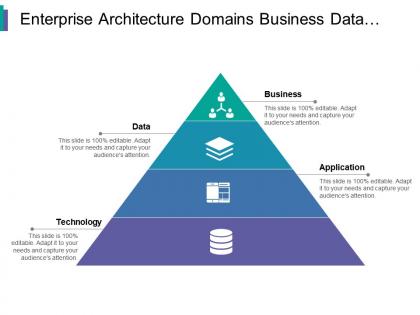
Enterprise architecture domains business data application and technology




Try Before you Buy Download Free Sample Product
 Impress Your
 Audience
 100%
100% Editable
 Save Hours
 of Time


Our Enterprise Architecture Domains Business Data Application And Technology enable you to exercise discretion. Be able to compare different factors.
People who downloaded this PowerPoint presentation also viewed the following :
Enterprise architecture domains business data application and technology with all 5 slides:
Draw folks into fruitful discussions with our Enterprise Architecture Domains Business Data Application And Technology. Bring an end to all the jabber.


FAQs for Enterprise architecture domains business data
**INPUT**: What are the key components of an effective enterprise architecture framework? **OUTPUT**: Effective enterprise architecture frameworks include business architecture, application architecture, data architecture, technology infrastructure, and governance structures. These components work together by aligning IT investments with strategic objectives, streamlining operational processes, and ensuring scalable integration, with many organizations finding that this comprehensive approach ultimately delivers enhanced agility and competitive advantage. [Word count: 52 words]
Enterprise architecture aligns IT strategy with business goals by creating comprehensive frameworks that map technology investments to organizational objectives, standardizing processes across departments, and ensuring scalable infrastructure supports growth initiatives. Through strategic planning and governance structures, companies streamline operations, enhance decision-making capabilities, and accelerate digital transformation, ultimately delivering competitive advantage and measurable business outcomes.
Enterprise architecture serves as the strategic blueprint for digital transformation, aligning technology investments with business objectives, standardizing processes, and ensuring seamless integration across systems. Through comprehensive frameworks, organizations streamline operations, reduce redundancy, and accelerate innovation deployment, with many enterprises finding that structured EA approaches deliver faster transformation outcomes and sustainable competitive advantages.
Organizations can measure enterprise architecture success through key performance indicators like reduced IT costs, improved system integration times, enhanced business-process efficiency, and faster project delivery cycles. Many companies track metrics such as application portfolio optimization, infrastructure utilization rates, and stakeholder satisfaction scores, with successful implementations typically delivering 20-30% cost reductions and significantly streamlined operations.
Common implementation challenges include resistance to change, lack of executive support, insufficient stakeholder alignment, complex legacy system integration, and inadequate governance frameworks. These obstacles often stem from organizational silos and competing priorities, with many enterprises finding that establishing clear communication channels, securing dedicated resources, and demonstrating early wins through pilot programs ultimately delivers smoother adoption and stronger buy-in.
Enterprise architecture facilitates better decision-making by providing comprehensive visibility into business processes, technology dependencies, and resource allocation across organizational layers. Through standardized frameworks and data integration, leadership teams can assess strategic initiatives more effectively, minimize operational risks, and align technology investments with business objectives, ultimately delivering enhanced governance transparency and competitive advantage.
Effective enterprise architecture development relies on frameworks like TOGAF, Zachman, and FEAF, combined with modeling tools such as ArchiMate, Sparx Enterprise Architect, and IBM Rational System Architect. These methodologies streamline organizational alignment, technology integration, and strategic planning, with many large corporations finding that structured approaches significantly reduce implementation complexity while enhancing operational efficiency and competitive positioning.
Enterprise architecture supports interoperability by establishing standardized data formats, common communication protocols, and unified integration frameworks across organizational systems. Through strategic API management, middleware solutions, and service-oriented architectures, organizations streamline data exchange, reduce system silos, and enhance operational efficiency, ultimately delivering seamless workflows and improved business agility.
Emerging trends impacting enterprise architecture include cloud-native architectures, API-first design, microservices adoption, zero-trust security models, and AI-driven automation capabilities. These approaches streamline digital transformation by enhancing scalability, reducing operational complexity, and enabling faster innovation cycles, with many organizations finding that strategic architecture evolution delivers significant competitive advantages in increasingly dynamic markets.
Enterprise architecture enhances organizational agility by standardizing technology platforms, streamlining data flows, and creating modular system designs that enable rapid adaptation to market changes. Through strategic architectural frameworks, companies can accelerate product launches, minimize integration complexities, and respond faster to customer demands, with many financial services and retail organizations finding that well-designed architecture reduces deployment times significantly.
Enterprise architecture and data governance maintain a symbiotic relationship where EA provides the structural framework for data management strategies, policies, and standards across organizational systems. Through integrated governance models, enterprises streamline data quality, compliance, and accessibility while ensuring architectural decisions support data-driven initiatives, ultimately delivering improved operational efficiency and strategic decision-making capabilities.
Ensuring stakeholder engagement requires regular communication touchpoints, collaborative workshops, transparent progress reporting, and clear demonstration of value delivery at each phase. Through structured governance committees, cross-functional design sessions, and milestone reviews, organizations maintain alignment across business and IT teams, while ultimately building consensus and securing ongoing support for architectural initiatives.
Essential skills for enterprise architects include strategic thinking, business process modeling, technology architecture design, stakeholder communication, and change management expertise. These competencies enable architects to align IT infrastructure with business objectives, facilitate cross-functional collaboration, and drive digital transformation initiatives, with many organizations finding that skilled architects deliver improved operational efficiency and competitive advantage.
Cloud computing transforms enterprise architecture by enabling scalable, flexible infrastructure through distributed services, microservices architectures, and API-driven integrations. This shift allows organizations to reduce capital expenditures, accelerate deployment cycles, and enhance system resilience, with many enterprises finding that cloud-native designs ultimately deliver greater agility and competitive advantage in increasingly dynamic markets.
TOGAF provides a methodology-driven approach with detailed implementation processes, governance structures, and standardized deliverables, while Zachman offers a comprehensive classification framework focusing on six interrogative perspectives across organizational layers. TOGAF emphasizes practical implementation with step-by-step guidance and stakeholder management, whereas Zachman delivers structural completeness for organizing enterprise artifacts, with many organizations finding that combining both frameworks enhances architectural rigor and execution effectiveness.
-
Easy to edit slides with easy to understand instructions.
-
Easily Editable.