

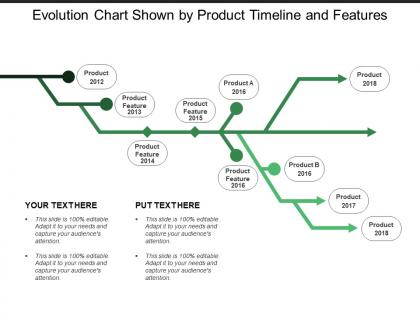
Evolution chart shown by product timeline and features




Try Before you Buy Download Free Sample Product
 Impress Your
 Audience
 100%
100% Editable
 Save Hours
 of Time


Beard the lion in his den. Enter armed with our Evolution Chart Shown By Product Timeline And Features.
People who downloaded this PowerPoint presentation also viewed the following :
Evolution chart shown by product timeline and features with all 5 slides:
Our Evolution Chart Shown By Product Timeline And Features clearly display all important data. It ensures information is forthcoming.
FAQs for Evolution chart shown by product
**INPUT**: What are the key stages in the product evolution timeline? **OUTPUT**: Key stages in product evolution include ideation and concept development, market research and validation, design and prototyping, testing and refinement, and launch with scaling. These phases enable organizations to systematically transform concepts into market-ready solutions, with many companies finding that structured evolution timelines significantly reduce development risks while accelerating time-to-market and competitive positioning. **Word count: 54 words**
Consumer feedback has fundamentally reshaped product evolution by driving faster iteration cycles, user-centric design approaches, and data-driven development strategies. Through social media, online reviews, and direct customer insights, companies across industries streamline product improvements, enhance user experiences, and accelerate time-to-market, ultimately delivering competitive advantages and sustained market relevance.
Technology accelerates product evolution by enabling rapid prototyping, real-time data analysis, automated testing, and continuous integration processes. Through AI-driven insights and cloud-based development platforms, companies in automotive, software, and consumer electronics streamline iteration cycles, reduce time-to-market significantly, and enhance product quality, ultimately delivering competitive advantages and faster customer value realization.
Companies effectively track and analyze their product evolution through version control systems, customer feedback analytics, performance metrics monitoring, feature adoption tracking, and competitive analysis tools. These methodologies streamline decision-making by identifying successful iterations, measuring user engagement, and predicting market trends, with many organizations finding that systematic evolution tracking ultimately delivers faster innovation cycles and enhanced competitive positioning.
Notable product evolution case studies include Apple's iPhone transformation from basic smartphone to ecosystem hub, Netflix's shift from DVD rentals to streaming giant, Amazon's expansion from bookstore to cloud services leader, and Microsoft's pivot from software licensing to subscription services. These companies revolutionized their offerings by embracing technological advances, anticipating market shifts, and continuously innovating core functionalities, ultimately delivering sustained competitive advantage and market leadership.
Market trends fundamentally drive product evolution by revealing shifting consumer preferences, emerging technologies, competitive pressures, and regulatory changes that demand strategic responses. Companies across sectors, from automotive manufacturers embracing electric vehicles to financial institutions adopting digital-first services, continuously adapt their offerings based on these market signals, ultimately delivering enhanced customer experiences and sustained competitive advantage.
Essential metrics for evaluating product evolution success include user adoption rates, customer satisfaction scores, revenue growth, feature utilization analytics, and market share expansion. These measurements enable organizations to track performance comprehensively, with many companies finding that combining quantitative data with customer feedback delivers clearer insights into product-market fit and competitive positioning.
Competitors significantly influence product evolution by driving innovation cycles, forcing feature enhancements, and accelerating development timelines through market pressure. Companies must continuously analyze competitive offerings, differentiate their value propositions, and adapt roadmaps accordingly, with many organizations finding that strategic competitive intelligence enables faster pivots, improved customer retention, and sustained market positioning.
Sustainability can be integrated through eco-friendly material selection, energy-efficient design phases, circular economy principles, lifecycle assessment integration, and carbon footprint reduction targets at each development stage. Manufacturing companies increasingly find that embedding sustainability metrics early streamlines compliance, reduces long-term costs, and delivers competitive advantage, while enhancing brand reputation and meeting evolving consumer expectations.
Product evolution and brand identity share a symbiotic relationship where strategic product changes reinforce core brand values while adapting to market demands. Through consistent design language, messaging, and customer experience enhancements, companies like Apple and Nike maintain brand recognition while innovating, ultimately delivering stronger market positioning and customer loyalty across evolving product portfolios.
Companies should reassess their product evolution timeline quarterly or biannually, depending on market volatility, customer feedback cycles, and competitive pressures in their industry. Through regular strategic reviews, organizations can adapt to changing consumer demands, technological advances, and market opportunities, with many finding that flexible timelines enable faster innovation cycles, better resource allocation, and sustained competitive advantage in increasingly dynamic markets.
Common pitfalls during product evolution include ignoring user feedback, over-engineering features, rushing updates without testing, and losing sight of core value propositions. These challenges can derail development timelines, increase costs, and alienate existing customers, with many organizations finding that systematic feedback integration and phased rollouts ultimately deliver stronger market positioning and sustained growth.
AI and IoT accelerate product evolution by enabling real-time data collection, predictive analytics, and automated decision-making throughout development cycles. These technologies streamline prototyping, enhance user experience personalization, and facilitate continuous improvement through smart feedback loops, with companies in automotive, healthcare, and consumer electronics finding faster time-to-market and more responsive product iterations.
UX design significantly influences product evolution by driving user-centered improvements, identifying pain points through research and testing, and guiding feature prioritization based on actual user needs. Through iterative design processes, companies like Apple and Google continuously refine their products, ultimately delivering enhanced customer satisfaction, reduced development costs, and stronger market positioning in increasingly competitive landscapes.
Agile methodologies enhance product evolution timelines by enabling iterative development cycles, continuous customer feedback integration, and rapid prototype testing. Through sprint-based approaches, organizations streamline feature development, minimize time-to-market delays, and adapt quickly to changing requirements, with many software companies finding that agile frameworks ultimately deliver faster innovation cycles and improved competitive positioning.
-
Wonderful templates design to use in business meetings.
-
Great experience, I would definitely use your services further.