

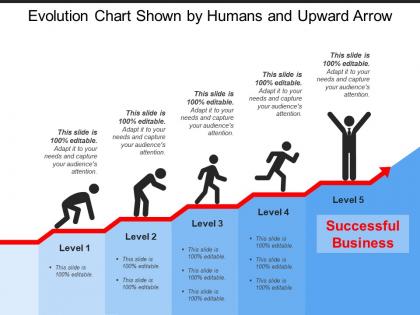
Evolution chart shown by humans and upward arrow




Try Before you Buy Download Free Sample Product
 Impress Your
 Audience
 100%
100% Editable
 Save Hours
 of Time


Our Evolution Chart Shown By Humans And Upward Arrow have a dynamic format. They can adjust to changing demands.
People who downloaded this PowerPoint presentation also viewed the following :
Evolution chart shown by humans and upward arrow with all 5 slides:
Derive greater growth with our Evolution Chart Shown By Humans And Upward Arrow. Give a big boost to existing capabilities.




FAQs for Evolution chart shown by humans
So there's Lucy (Australopithecus) from like 4 million years ago - she's probably the most famous early one. Then you've got Homo habilis making the first stone tools around 2.8 million years back. Homo erectus came next and actually made it out of Africa, which is pretty cool when you think about it. Archaic Homo sapiens showed up maybe 300,000 years ago, then modern humans around 200,000 years ago in Africa. The big stuff is walking upright, brain growth, tools, and eventually language. Honestly the timeline's always changing with new discoveries, but East African fossils are your best starting point.
So basically our ancestors had to evolve or die when the environment kept changing. Ice ages made them smarter - you literally needed better problem-solving to not starve. The big one though was when forests turned into grasslands. Walking upright suddenly made way more sense in open areas than being hunched over. Pretty crazy that geography shaped us that much, right? Like, terrain was basically sculpting human bodies over millions of years. Makes me think differently about landscapes now - they're not just pretty, they actually built us.
So bipedalism was huge - like, the thing that started everything human about us. Our ancestors went upright around 6-7 million years ago, which freed their hands for tools and carrying things. Pretty smart evolutionary move if you ask me. Tool-making then boosted brain development since it takes serious thinking skills. Plus walking upright was way more energy-efficient than that knuckle-dragging thing apes do. Better for long-distance hunting too. For your studies, definitely focus on how walking upright connects to bigger brains and tool use - that's where you'll see how one thing led to another.
So basically, tool-making was huge for early humans - like 2.5 million years ago huge. Once they figured out cutting tools and hunting weapons, everything changed. Groups had to start cooperating way more because someone needed to teach the techniques, organize hunts, you know? They could suddenly access tougher foods and defend themselves better. Honestly, it's crazy how this one innovation completely flipped how communities worked together. Before tools, they're just surviving individually. After? Boom - specialized tasks, shared knowledge, actual teamwork. It wasn't just about what they could do anymore, but how they did it together.
So genetic research is basically like having a time machine for human history. Scientists compare DNA between different populations and you can actually see how people migrated around the world. Short sentences work too. The really mind-blowing stuff happens when they extract DNA from ancient fossils - like we're literally reading our ancestors' genetic code. You'll find migration patterns, when human groups split off from each other, even our connection to other primates. Oh and mitochondrial DNA studies are where I'd start if you're curious - that's the bread and butter of this field. It shows which genes faced evolutionary pressure and when major adaptations happened.
Neanderthals were basically built like tanks compared to us. Bigger bones, wider chests, way more muscle - perfect for surviving ice ages. Their skulls looked different too with those heavy brow ridges, plus they had larger brains (doesn't automatically mean smarter though). What's wild is they made sophisticated tools and buried their dead, which honestly shows they weren't the caveman stereotypes we picture. Most differences just boil down to climate stuff. Oh and here's something crazy - recent DNA research shows most of us actually have Neanderthal genes floating around in there.
So basically when humans first left Africa around 70,000 years ago, they took only some of their genes with them - not the full set. Picture it like this: each time a small group split off to settle somewhere new, they'd lose a bit more genetic variety. That's why African populations still have the most genetic diversity today, while places like isolated islands have way less (but sometimes really unique stuff). It's honestly pretty cool how scientists can trace our migration paths just from this pattern. Also explains why certain genetic diseases pop up more in specific regions - those groups just happened to carry those particular genes when they settled.
So basically modern humans evolved in Africa like 200,000 years ago, then started spreading everywhere else around 70,000 years ago. What's crazy is the genetic evidence - Africa has the most human genetic diversity, and it gets less diverse the further you go from there. Makes sense if you think about it, right? We're all way more recently related than most people realize. The mitochondrial DNA studies are actually pretty cool if you're into that stuff. Honestly changed everything we thought we knew about where we came from and how we got around the world.
Honestly, fossil records have been huge for backing up human evolution theories. Lucy and other *Australopithecus* finds filled massive gaps in our family tree - you can literally trace how brain size and bipedalism developed over millions of years. But here's the thing: recent discoveries keep flipping the script on what we thought we knew. Turns out evolution wasn't this neat linear progression at all. Multiple human species were actually hanging out at the same time, which is wild when you think about it. Some fossils have completely messed with our timelines too. So yeah, fossils are definitely your best starting point, but don't get too attached to any one theory.
Dude, fire totally changed everything for early humans. Cooking food meant way more calories and nutrients - like, suddenly your ancestors didn't need massive teeth or huge guts anymore. All that saved energy? Went straight to bigger brains instead. Fire also let them stay up past sunset and scared off predators, which is pretty clutch if you ask me. Oh and this all started around 1.9 million years ago, crazy to think about. Honestly, if you're trying to understand human evolution, fire's probably the biggest game-changer there is.
So yeah, culture totally shapes how we evolve biologically! Like when our ancestors started cooking food, it actually made our jaws smaller and changed our whole digestive system. Wild, right? Agriculture gave some populations lactose tolerance. Tools helped develop better hand coordination and bigger brains. The crazy part is how quickly some of these changes happened - way faster than you'd expect for evolution. It's basically this feedback loop where we create cultural stuff, then our bodies adapt to it over generations. I find it fascinating how intertwined biology and culture really are.
Yeah so technology is definitely messing with how we evolve, just not in that crazy sci-fi way. We're not selecting for physical strength anymore - it's more about cognitive stuff or disease resistance thanks to medicine. Global connectivity means our gene pool is way more mixed than before, which honestly seems like a good thing for genetic diversity. The wild part? Cultural evolution through tech is happening so much faster than biological evolution. Oh and CRISPR might totally speed up biological changes beyond just natural selection - that rabbit hole gets pretty intense if you start digging into it.
Yeah, so different human populations adapted to their environments over thousands of years. Lactose tolerance? Super common where people historically farmed dairy, but rare elsewhere. Skin color varies based on UV exposure - darker skin protects against harsh sun, lighter skin helps with vitamin D when there's less sunlight. High-altitude populations actually developed bigger lung capacity for oxygen processing. It's pretty cool how specific each adaptation is. Oh, and this is key - think of it as different survival tools for different places, not some weird ranking system. Each trait served a purpose.
Language basically gave humans cheat codes for survival. Think about it - other animals can't warn their kids about specific dangers or teach complex hunting tricks. We could suddenly share knowledge without everyone dying to figure stuff out themselves. Coordinating hunts became way easier, and you could actually talk through conflicts instead of just fighting. The social aspect was huge too - bigger communities, better alliances. Honestly, it's wild how much communication changed everything. Every time you text someone "don't go down that street, construction's crazy," you're flexing millions of years of evolutionary advantage.
Dude, the whole "humans evolved in a straight line from Africa" thing is totally dead now. All these new discoveries - Homo naledi, Denisovans, those super early tool users - show that multiple human species were hanging out together and even having kids with each other for way longer than we thought. The timeline's gotten completely wild too. People were leaving Africa hundreds of thousands of years earlier than we realized. Honestly, it's kind of embarrassing how wrong the textbooks were. Your presentations should show it as more of a tangled web now instead of that clean family tree we used to draw.
-
Design layout is very impressive.
-
I discovered this website through a google search, the services matched my needs perfectly and the pricing was very reasonable. I was thrilled with the product and the customer service. I will definitely use their slides again for my presentations and recommend them to other colleagues.