


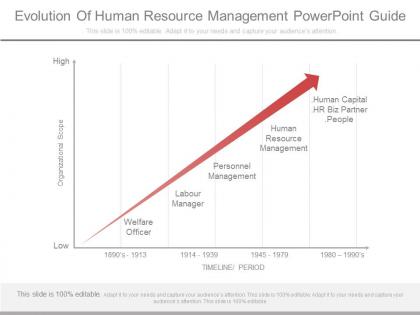
Evolution of human resource management powerpoint guide




Try Before you Buy Download Free Sample Product
 Impress Your
 Audience
 100%
100% Editable
 Save Hours
 of Time


Cue it in with our Evolution Of Human Resource Management Powerpoint Guide. Your thoughts will sound just right.
People who downloaded this PowerPoint presentation also viewed the following :
Evolution of human resource management powerpoint guide with all 7 slides:
Competition in the presentation world can be brutal. Get the edge through world class Evolution Of Human Resource Management Powerpoint Guide for all of your presentation needs.
FAQs for Evolution of human resource
So it basically started during the Industrial Revolution - companies needed "personnel departments" just for basic admin work. Labor relations became huge in the 1930s because of all the union stuff happening. But honestly, the 1960s civil rights laws were the real turning point. HR suddenly had to worry about fair hiring instead of just cutting paychecks. The 80s changed everything though. Companies finally realized employees weren't just expenses - they were actually what made businesses competitive. That's when "Personnel" died and "Human Resources" was born. It's wild how all those layers built up over time. Modern HR juggles compliance, strategy, and keeping people happy because each era added something new.
Dude, it's crazy how much this has changed things. HR used to be seen as just the complaint department, you know? Now companies actually view it as something that makes them money. Your people strategies directly tie into business goals instead of just handling paperwork all day. Better hiring, smarter training programs, decisions based on actual data that the C-suite cares about. You're solving real business problems before they happen rather than constantly putting out fires. The whole perception flip is honestly pretty impressive - going from cost center to profit driver isn't something most departments pull off.
Honestly, HR tech has blown up in the last few years. We went from those ancient filing cabinets to having AI do half the work for us. ATS systems now screen resumes automatically, which saves so much time it's ridiculous. HRIS handles payroll and benefits instantly, plus video interviews beat those weird phone calls any day. Analytics can actually predict who's gonna quit (wild, right?), chatbots answer basic questions around the clock, and people request PTO from their phones now. Performance reviews happen digitally too with real-time feedback tools. Best part? You can focus on big picture stuff instead of drowning in paperwork. I'd start by figuring out what manual tasks are killing you first.
Oh man, this goes way back! Companies didn't just decide to be nice one day. Workers in the early 1900s got fed up and started organizing unions for better treatment. That freaked out management, so they created HR departments instead of letting random supervisors handle everything badly. Then laws like the Wagner Act basically said "figure it out or we'll make you" - stuff about wages, hours, collective bargaining. The civil rights era added even more rules around hiring and discrimination. Honestly, every boring policy at your job exists because someone fought for it decades ago.
Honestly? Global expansion completely flipped how we think about HR. Each country has its own labor laws, communication norms, feedback styles - the whole nine yards. What crushes it in NYC could be a total disaster in Tokyo. I learned this the hard way when we tried rolling out American-style performance reviews in Germany... yikes. Short version: get local HR people involved from day one. Train your managers on cultural differences before they dive into international work. Oh, and work-life balance expectations? They're wildly different everywhere you go.
Honestly, data analytics is probably the biggest one - you can't make smart hiring decisions without it anymore. Digital skills are a must too since AI tools are everywhere now. Business knowledge matters way more than it used to because HR actually impacts profits directly, not just paperwork. Everything moves so fast that you need to think on your feet constantly. Emotional intelligence is still super important for handling all the workplace drama and keeping people happy. Communication is obviously key, but now you're influencing executives too. I'd figure out what you suck at most and start there.
Honestly, companies finally figured out that treating people like actual humans works better than the old "shut up and work" approach. Mental health support, flexible schedules, regular check-ins - it's night and day from just having basic insurance and yearly reviews. Engaged employees stick around way longer and get more done, which makes the CFOs happy too. I mean, some places still suck at this obviously, but the shift is real. If your company isn't tracking how people actually feel about working there yet, they're behind the curve. The whole thing just makes sense - happy people do better work.
Honestly, HR is scrambling to figure this out right now. Boomers want that traditional structure and job security, but Gen Z? They're all about flexibility and working somewhere that actually means something. Communication alone is a nightmare - you need everything from old-school meetings to those quick TikTok-style training videos (which still feels weird to me). Benefits can't be cookie-cutter anymore since a 25-year-old couldn't care less about what motivates someone in their 50s. Smart companies are splitting their workforce into segments and building different tracks for each group instead of pretending everyone wants the same thing.
Honestly, it's completely changing how HR works. You can actually predict which employees might quit or figure out who'd be best for a role instead of just going with your gut. The AI catches patterns we'd never notice - it's kind of crazy how much data reveals. Resume screening and scheduling interviews gets automated, so you're not stuck doing boring admin stuff all day. I'd probably start with something simple like recruitment analytics first though. Don't try to overhaul everything at once or you'll drive yourself nuts.
Oh man, remote work flipped HR upside down. Now you're hiring people from anywhere - which is amazing btw, way better talent pool. Onboarding had to go completely virtual and structured (no more wing-it office tours). Performance reviews? Total shift from watching people work to just caring about results. The tricky part is keeping everyone engaged when you can't randomly chat by the coffee machine. Culture building takes so much more effort when your team's spread across time zones. Everything has to be way more intentional now.
Dude, recruiting is totally different now. Instead of just posting jobs and hoping, companies are out there hunting people down on LinkedIn, GitHub, even TikTok (which honestly still feels weird to me). You gotta start building relationships way before you actually need to hire anyone. It's become this whole data-driven thing where you're predicting what roles you'll need months ahead. The whole candidate experience feels more like marketing now - you're basically selling your company. Focus on finding people who'll actually stay, not just warm bodies to fill desks. Start that talent pipeline today.
So D&I has totally changed HR from just checking compliance boxes to actually driving business strategy. Now you're shaping company culture instead of just pushing paperwork around. The tech side got interesting too - recruiting software that spots bias, performance metrics that don't suck. Your job's way more complicated now but honestly more meaningful. You're part culture architect, part data person, part change maker. Oh and definitely audit your current processes first - I bet you'll find some biases hiding where you least expect them.
Dude, employer branding is huge right now. People are literally stalking your company online before they even think about applying - it's wild how much research candidates do now. Your reputation as a place to work affects everything: who applies, how many employee referrals you get, even salary negotiations. The talent market's so competitive that companies with solid employer brands are just crushing everyone else. Here's what I'd do first - ask your current team what they actually tell their friends about working there. That's your real brand right there, not whatever's on your website.
Ugh, the worst part is how HR stuff is always behind whatever's actually happening at work. Like, you're scrambling to catch up with new roles and team changes constantly. And people get SO tired of hearing about "transformation" - I swear, by the third big announcement everyone just zones out completely. Your job descriptions become useless pretty fast, plus you end up needing totally different recruiting skills than what you originally planned for. Honestly? Build flexibility into your HR stuff now instead of redoing everything each time things shift.
Honestly, ethics are what pushed HR from just doing paperwork to actually mattering in business decisions. Look at recruitment - AI algorithms are biased as hell, and someone has to fix that. Pay gaps are still a mess too. The "people first" thing sounds cheesy, but companies that ignore it usually implode eventually. Your job now means juggling employee happiness with business goals while dealing with data privacy headaches our predecessors never faced. It's way more complex than it used to be. I'd start by looking at what you're doing now with fresh eyes - bet you'll find some sketchy practices that need fixing ASAP.
-
Top Quality presentations that are easily editable.
-
Qualitative and comprehensive slides.