


Upward arrow with five circles and icons




Try Before you Buy Download Free Sample Product
 Impress Your
 Audience
 100%
100% Editable
 Save Hours
 of Time


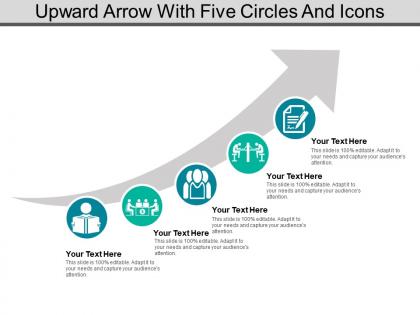
Infuse your business with our remarkable upward arrow with five circles and icons PowerPoint template. With the help of our upward arrow PPT design you can represent your business information in an attractive manner. Five staged arrow process with icons has been used to craft this Presentation Diagram. Use this upward arrow growth Presentation slideshow for business and marketing related presentations. You can plan your growth objectives and targets and then showcase these on each stage of our growth PPT slide. Growth is necessary for any business organization to survive and remain attractive to its investors and analysts. Icons are also added on each stage to represent the information in a visually appealing manner. Also, the content displayed in this business growth PPT illustration can be completely altered by any user at any point of time as the slide is fully editable. Simply click download and let your thoughts fall into viewer’s mind. Calm apprehensions that are expressed with our Upward Arrow With Five Circles And Icons. It allows for any inquisitiveness.
People who downloaded this PowerPoint presentation also viewed the following :
Content of this Powerpoint Presentation
Description:
The image is a PowerPoint slide titled "Upward Arrow With Five Circles And Icons." It depicts an upward-pointing arrow with five circular icons aligned along its length, each containing a different symbol. These symbols represent various business concepts or stages. Each icon has an accompanying text box for further explanation or detail, which are placeholders labeled "Your Text Here". This slide design is typically used to illustrate a progression, process steps, growth, or sequential elements in a business context.
Text Elements:
The title at the top suggests the theme is about growth or progress, as indicated by the upward arrow.
Each circular icon is paired with a text placeholder, signaling that detailed descriptions are to be added corresponding to the icons.
Use Cases:
This type of slide can be used in various industries:
1. Corporate Training:
Use: Illustrating stages of employee development or skill acquisition.
Presenter: Training Coordinator
Audience: New employees, trainees
2. Marketing:
Use: Showing phases of a marketing campaign from conception to execution.
Presenter: Marketing Strategist
Audience: Marketing team, stakeholders
3. Sales:
Use: Depicting the sales funnel stages.
Presenter: Sales Manager
Audience: Sales personnel, business development team
4. Project Management:
Use: Outlining project milestones or phases of project life cycle.
Presenter: Project Manager
Audience: Project team, clients
5. Financial Services:
Use: Presenting investment growth or financial planning steps.
Presenter: Financial Advisor
Audience: Investors, clients
6. Health Care:
Use: Detailing patient care pathway or treatment steps.
Presenter: Healthcare Administrator
Audience: Medical staff, patients
7. Education:
Use: Representing educational progression or curriculum development.
Presenter: Academic Coordinator
Audience: Educators, students
Upward arrow with five circles and icons with all 5 slides:
Convince folks that conditions are better than expected with our Upward Arrow With Five Circles And Icons. It will drastically alter impressions.

FAQs for Upward arrow with five
Honestly, you'll know when you stop taking everything so damn personally - that's the big one for me. Better emotional regulation kicks in too. You actually start changing those annoying patterns instead of just bitching about them. Relationships get easier because you're not as reactive and can actually listen. When stuff goes wrong, you bounce back faster and think "okay what can I learn here" rather than spiraling. Oh, and you become way more self-aware about your triggers and reactions. Try keeping a quick weekly journal - just note times you handled something totally different than old you would've. It's pretty eye-opening.
Dude, templates are seriously a lifesaver for pitches. I used to just stare at blank slides forever - total nightmare. With a good framework, you can actually organize your growth data and projections without looking like an amateur. Plus you won't forget important stuff like market research or financials (happened to me once, super awkward). Honestly, investors notice when your presentation flows well versus when it's all over the place. Grab a basic growth strategy template and throw in your own numbers and timeline. Way less stressful.
Honestly, feedback is what makes teams actually grow instead of just staying mediocre. People need the good stuff to build confidence, but they also need someone to call out their blind spots. Annual reviews are basically worthless for this - you want regular conversations happening. The tricky part is making sure everyone feels safe enough to be honest with each other. I'd start by asking your own team for feedback on how you're doing. When they see you can take criticism without getting defensive, they'll be way more open to giving and receiving it themselves.
Dude, charts basically turn your boring spreadsheet numbers into actual stories. I can't tell you how many times I've spotted weird trends or caught data errors just by throwing stuff into a graph first - way easier than squinting at rows of numbers. Heat maps are clutch for seeing which customers are actually growing. Line charts show you seasonal patterns you'd totally miss otherwise. The trick is picking the right chart type though. Bar charts for comparing things, line graphs when you want to track changes over time. Dashboards are perfect if you're juggling multiple metrics at once.
Honestly, the main things that kill growth are being scared to fail, not knowing what you're actually trying to achieve, and - this one gets everyone - attempting way too much at once. You just end up going nowhere fast. Most people make it way harder than it needs to be though. Figure out what "growth" even means for your situation first, then chop it into bite-sized pieces. Pick one thing and stick with it instead of juggling like ten different projects. Consistency beats being perfect every time. Check in with yourself regularly to see what's actually working, then pivot if something isn't.
Dude, stories are like magic for getting people to actually *want* to struggle and learn. I always share my messiest failures - the ones where I totally face-planted before figuring things out. Makes everyone realize that sucking at something first is completely normal. Way better than just listing reasons why failure's good (so boring). Your audience needs to see the behind-the-scenes chaos, not just your highlight reel. When you're honest about being terrible at stuff initially, others feel way less weird about being beginners. Oh, and definitely throw in at least one embarrassing personal story next time you present!
Diverse teams are straight-up game changers for growth. Different backgrounds mean fresh perspectives and creative problem-solving you'd never get otherwise. Your team starts spotting opportunities in markets you didn't even know existed. Sure, communication can get messy at first - I've seen that happen. But here's the thing: companies dominating right now aren't the homogeneous ones. They're the ones figuring out how to make diversity actually work. Don't just hire diverse talent though. Make sure those voices are actually influencing big decisions, not sitting quietly in meetings.
Honestly, AI and machine learning are everywhere right now - healthcare, supply chains, you name it. Manufacturing's getting automated like crazy, and cloud computing lets companies scale super fast. Oh, and all those IoT devices? They're giving businesses tons of new data to work with. 5G is opening up possibilities we couldn't even think of before (though I still can't get good signal in my apartment lol). The wild part is how these technologies feed off each other. Each one makes the others more powerful. You should definitely check out what's happening specifically in your field - that's where you'll see the real impact.
Make it part of the everyday routine, not some yearly thing. Ask about their goals during regular check-ins - like what do they actually want to learn? Stretch assignments are gold here, honestly. Push them just outside their comfort zone. They need to feel safe screwing up while they figure stuff out. I always celebrate the learning itself, not just when someone nails it perfectly. Here's the thing - if you're constantly learning new stuff and talking about it, they'll do the same. Oh, and actually budget for courses or conferences. Books work too if money's tight.
Honestly, fix your unit economics before anything else - burning money faster on each customer is just dumb. Product-market fit has to come first, then you can think about growth stuff. Your systems need to handle more users without crashing (learned that one the hard way). Retention beats acquisition every time, it's way cheaper. Don't hire too fast either, creates total chaos. Track real metrics like engagement, not those BS vanity numbers. Oh and start measuring your LTV to CAC ratio now - you'll thank me later. Short version: nail the basics first.
Honestly, you can't really grow as a leader without getting better at reading yourself and others first. Self-awareness helps you make smarter calls when things get crazy and actually learn from screwups instead of just making them again. Nobody wants to follow someone who's completely clueless about the vibe in the room, you know? The real magic happens when you start adjusting how you lead based on who you're dealing with. Oh, and here's something that blew my mind - just notice how your mood affects your team's energy. It's wild how much that ripples out.
Honestly, SMART goals are a game-changer because they give you actual clarity instead of just winging it. I used to set stupid vague goals like "get better at public speaking" - shocker, nothing happened! But when your goals are specific, measurable, achievable, relevant, and time-bound, you'll actually know what winning looks like. They help you track progress and stay motivated when stuff gets hard. Plus you can celebrate real wins instead of just hoping things work out. It turns growth from wishful thinking into something concrete. Pick one area you want to improve and make it SMART this week - seriously, it works.
Honestly, data analytics is like having x-ray vision for your business. Look at your current customers first - who's spending the most or buying repeatedly? Then find more people exactly like them. You can spot weird patterns in how people shop that might reveal totally new markets you hadn't thought of. Geographic stuff is huge too - maybe you're killing it in Denver but barely existing in Phoenix for no good reason. The predictive part is pretty wild since you can see trends coming before your competition does. I'd definitely start there with existing customer data though, way easier than trying to boil the ocean.
Dude, mentorship and networking seriously changed everything for me career-wise. Your mentor basically becomes this insider who helps you dodge stupid mistakes and actually speaks up for you when cool opportunities pop up. Plus networking isn't just awkward small talk at those stuffy events - though honestly those can help too. It's more about building real connections that turn into this whole web of people who've got your back. Like, so many jobs come from referrals and random conversations. Just start small - grab coffee with someone this week or find a mentor at work.
You'll want to watch both types of metrics - the ones that predict what's coming and the ones that show what already happened. Stuff like customer acquisition cost and conversion rates give you early warnings. Revenue growth and customer lifetime value tell the real story, but waiting for those results is brutal. Honestly, I've seen too many teams only focus on revenue and miss all the red flags. Set up a simple dashboard mixing both kinds of metrics. Pick maybe 3-5 that actually matter for your growth plan and check them weekly. Don't go overboard with tracking everything though.
-
Use of icon with content is very relateable, informative and appealing.
-
Attractive design and informative presentation.