

Opportunities and challenges circular arrows with icons






Try Before you Buy Download Free Sample Product
 Impress Your
 Audience
 100%
100% Editable
 Save Hours
 of Time


Go farther in your next presentation. Our Opportunities And Challenges Circular Arrows With Icons are ready to help you go the extra mile.
People who downloaded this PowerPoint presentation also viewed the following :
Content of this Powerpoint Presentation
Description:
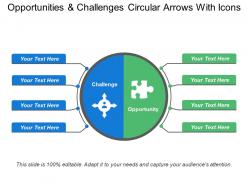
The image is a PowerPoint slide titled "Opportunities & Challenges Circular Arrows With Icons," designed to help presenters articulate and visualize the opportunities and challenges within a business context or project framework. The slide is divided into two halves by a vertical line, with one side labeled "Challenge" and the other "Opportunity," each accompanied by a corresponding icon – a puzzle piece for opportunity and a directional compass for challenge, suggesting navigation through difficulties.
Use Cases:
This slide format can be applied across various industries:
1. Healthcare:
Use: Discussing the challenges and opportunities in patient care innovation.
Presenter: Healthcare Administrator
Audience: Medical staff, hospital board
2. Technology:
Use: Exploring the difficulties and potential of adopting new technologies.
Presenter: CTO
Audience: Tech team, stakeholders
3. Education:
Use: Balancing educational resource limitations with new teaching methods.
Presenter: School Principal
Audience: Teachers, education board
4. Real Estate:
Use: Identifying market trends and economic obstacles in property development.
Presenter: Real Estate Developer
Audience: Investors, city planners
5. Retail:
Use: Addressing competitive market pressures and consumer behavior shifts.
Presenter: Retail Manager
Audience: Marketing team, sales associates
6. Finance:
Use: Navigating regulatory challenges and fintech opportunities.
Presenter: Financial Analyst
Audience: Compliance officers, investment managers
7. Environmental Services:
Use: Weighing environmental impact against sustainable growth initiatives.
Presenter: Environmental Consultant
Audience: Corporate clients, policy makers
Opportunities and challenges circular arrows with icons with all 5 slides:
Our Opportunities And Challenges Circular Arrows With Icons are authentic to the core. They will furnish the audience with facts.
FAQs for Opportunities and challenges circular
So circular economy basically flips our whole "buy it, use it, trash it" mentality. There are three core ideas: cut out waste, keep stuff circulating instead of dumping it, and actually help nature recover. It's like how forests work - dead leaves become soil, nothing's really "garbage." Design things to last and be fixable, not disposable. Honestly, it makes way more sense than our current system. Before buying anything now, I always think "what happens to this when I'm done?" Sometimes it stops me from getting random stuff I don't really need anyway.
Honestly, ditch the whole "make stuff break so people buy more" mentality first. Look at what you're throwing away and see if it can become someone else's raw materials - kind of like supply chain Tetris, which sounds nerdy but actually works. Partner with other companies since this stuff's way easier when you're not doing it alone. Don't go crazy trying to fix everything at once though. Pick one product line to test it out. Oh, and you'll need different success metrics - track how much waste you're cutting, not just profits. That mindset shift is probably the hardest part tbh.
Honestly, design and innovation are everything for circular economy. Without them, you're basically just playing recycling theater. Start by rethinking one product line - instead of "cheap and functional," ask "how do we keep these materials cycling forever?" Build for durability and easy repair from day one. Innovation unlocks the cool stuff like product-as-a-service models and materials that don't degrade. Plus better disassembly tech (which sounds boring but isn't). The recycling-will-save-us mentality? Yeah, that's not working. You need products designed for their next life, not their grave.
Honestly, just start with buying less crap in the first place. When something breaks, hit up YouTube before you toss it - I've fixed so many things I never thought I could. Get weird with reusing stuff too - old jars become storage, beat-up furniture gets a second life. Thrift stores are your friend for finding things you actually need. I know everyone's obsessed with recycling, but it's actually the worst option since most stuff doesn't get properly recycled anyway. Pick one category like clothes or gadgets and completely flip how you think about it. The whole mindset shift from "broken = trash" to "how do I make this last longer" is everything.
Check out Patagonia's repair/resale thing - they're keeping clothes out of dumps while customers love them for it. Interface does something smart with carpet tiles, designing them so they can actually take them apart and reuse the pieces later. Dell's pretty much recycling their own electronics into new products, which seems obvious but most companies don't bother. Oh, and Unilever's doing refillable packaging now. The cool part? These aren't just PR moves - they're actually making money from it. I'd say find whichever one matches your space and dig into how they pulled it off.
So basically, circular economy totally changes how we think about waste - instead of tossing stuff in landfills, everything gets recovered and reused. Your waste becomes someone else's raw materials, which honestly makes way more sense when you think about it. Companies start designing products to avoid waste from the get-go. Better sorting and processing means more stuff gets remanufactured instead of trashed. Oh, and manufacturers are increasingly taking back their own products when you're done with them. First step? Look at what you're currently throwing away - bet half of it could be repurposed somewhere else.
Honestly, the money part hits first - redesigning stuff for circularity costs a ton upfront. Getting suppliers to actually change how they do things is like pulling teeth, trust me. Your teams need retraining, plus you're basically flipping your whole business model. Oh and the regulations? Total mess right now since policies are all over the place. But here's what actually works - don't go crazy trying to fix everything. Just pick one product line to test it out on. Way less painful that way, and you can figure out what breaks before committing to the whole thing.
So governments can really push circular economy stuff forward through smart policies. Tax breaks for companies using recycled materials work great. Extended producer responsibility laws force businesses to think about their products' whole lifecycle - pretty clever actually. Right to repair legislation is gaining traction too, which I love. Waste reduction targets, plastic bans, and funding for recycling infrastructure all help. Public procurement is huge since governments buy so much stuff - they can create real demand for circular products. Honestly, if you're in this field, watch what policies are coming down the pipeline in your area. That's usually where you'll spot the next big opportunities before everyone else catches on.
Think of digital tech as the brain that makes circular economy actually work. IoT sensors track products from birth to death, while blockchain traces materials through messy supply chains. AI's pretty sick at predicting repairs before things break completely. Apps like Too Good To Go are crushing it with food waste - honestly such a simple but genius idea. These platforms basically play matchmaker between companies so one's trash becomes another's treasure. But here's the thing - you gotta measure your material flows first. Can't fix what you can't see, right?
Huge waste reduction is probably the biggest win you'll get. Companies stop that whole take-make-throw away thing and actually keep materials cycling through reuse and recycling. Landfills get way less crap, emissions drop, and we're not constantly mining new stuff from the ground. Production gets cleaner too since everything's designed to last and come apart easily later. Oh and it genuinely feels like we're finally working *with* the planet instead of against it. I'd start by mapping out your own operations first - see where you can close those material loops.
Honestly, just start by figuring out where all your waste goes - that's your goldmine right there. Instead of the whole "make it, use it, toss it" thing, think about how stuff can circle back. Find suppliers who'll actually take products back when they're done (good luck with that one, but they exist). Design things so they come apart easily. Set up return systems. Your trash becomes someone else's treasure, basically. Don't try to overhaul everything at once - pick one product line and test it out. Even small changes add up over time, and you'll learn what actually works vs. what sounds good on paper.
Track material flow stuff and business metrics. Material circularity rate shows how much you're keeping in use - plus waste diversion and resource productivity. Water/energy efficiency numbers are honestly shocking when you first see them. Business-wise, measure cost savings from buying less new materials, revenue from circular products, and how customers respond to take-back programs. Don't go crazy though - pick 2-3 metrics that match your main initiatives. I made the mistake of trying to track everything at first and it was overwhelming.
Honestly, most companies end up making more money once they get through the initial setup costs. Material costs drop when you're reusing stuff, waste disposal gets cheaper, and sometimes you can even sell what used to be trash. The upfront investment for changing your processes can hurt though - not gonna lie about that. But your efficiency gets way better over time, plus customers are really into sustainable brands now. You're also less screwed when supply chains get messy. I'd start small - look at your biggest waste streams and see what you can repurpose internally.
Fashion's probably the worst offender - they literally design clothes to go out of style. Electronics are insane too, like your phone works perfectly fine but suddenly it's "outdated" after 18 months. Construction's another goldmine since they tear down buildings that could easily be renovated. Oh and food waste is absolutely massive, plus all that packaging nonsense. Honestly, just look for industries with the shortest product cycles or the biggest dumpsters behind their buildings. That's where you'll find the most potential for circular models. Those sectors are practically begging for disruption.
Look, education is literally the only way circular economy stuff actually works in practice. Most people think it's just recycling (which drives me nuts because that's like... step 50 of the process). You've got to start wherever people are - kids learning about waste, professionals figuring out sustainable design, whatever. The trick is making it connect to their actual life. Show them repair, reuse, rethinking how they buy things. It's gotta feel relevant or they'll just zone out. Pick one spot in your org and start there - don't overthink it.
-
The Designed Graphic are very professional and classic.
-
Use of icon with content is very relateable, informative and appealing.