


Evolution History Of DevOps Software Development Implementing DevOps Lifecycle Stages For Higher Development




Try Before you Buy Download Free Sample Product
 Impress Your
 Audience
 100%
100% Editable
 Save Hours
 of Time


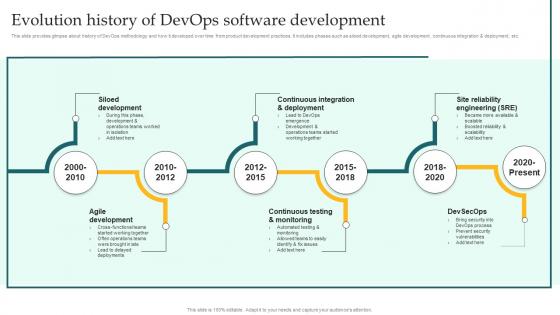
This slide provides glimpse about history of DevOps methodology and how it developed over time from product development practices. It includes phases such as siloed development, agile development, continuous integration And deployment, etc.
People who downloaded this PowerPoint presentation also viewed the following :
Evolution History Of DevOps Software Development Implementing DevOps Lifecycle Stages For Higher Development with all 6 slides:
Use our Evolution History Of DevOps Software Development Implementing DevOps Lifecycle Stages For Higher Development to effectively help you save your valuable time. They are readymade to fit into any presentation structure.





FAQs for Evolution History Of DevOps Software Development Implementing DevOps Lifecycle Stages
So DevOps basically tears down those old walls between dev and ops teams. No more throwing code over the fence and hoping it works! You get everyone collaborating from day one. The whole game changes - instead of massive releases, you're doing continuous integration and automated testing. Infrastructure becomes actual code you can version (which is honestly pretty slick). Everything gets measured so you can pivot fast when something's off. My advice? Start automating one small thing in your current setup, then slowly get your dev and ops people talking more.
Dude, automation just cuts out all that tedious crap - deployments, testing, setting up servers. Why spend hours manually pushing code when you can set up pipelines that trigger automatically? Once you get it dialed in, it's honestly incredible. Bugs get caught way faster with automated tests running constantly. Your devs can actually focus on building cool stuff instead of deployment babysitting (which nobody enjoys anyway). Deployments become way less stressful too since everything's consistent. I'd start with just automating your build process first - don't try to do everything at once or you'll go crazy.
So CI/CD automates your whole build-test-deploy process instead of doing everything manually (trust me, manual deployments are the worst). You push code, pipelines automatically handle the rest. Catches bugs way earlier and lets you ship updates constantly without breaking stuff. Honestly, it's what makes DevOps actually work - no more throwing code over the wall to ops. I'd start with just automating your tests first, then work up to deployment once everyone's used to it. Way less stressful than the old days.
Honestly, start with the DORA metrics - deployment frequency, lead time, recovery time, and failure rate. They're basically the industry standard for a reason. But don't stop there because faster deploys mean nothing if your customers are miserable, you know? Track satisfaction scores and revenue impact too. Oh, and this might sound obvious but measure how your team's actually doing. Burnout is real and kills productivity faster than any technical debt. I'd say pick maybe 2-3 metrics that hit your biggest problems first. You can always add more later once you've got a baseline going.
Oh man, the cultural stuff will drive you nuts - people get so territorial about their processes and hate change. Legacy systems are another nightmare since they barely work with modern CI/CD tools. Plus half your team probably doesn't know automation or cloud stuff yet. Start with small pilot projects first, they're way less scary. Get the executives on board early or you're screwed. Training is huge too. Cross-functional teams help break down those stupid departmental walls. Honestly, don't go for some massive transformation - I've seen those crash and burn. Small wins actually stick.
So basically, DevOps is about getting your dev and ops people to actually work together instead of just tossing projects back and forth. Have them share responsibility for the whole app lifecycle - developers need to care when stuff breaks in production, and ops should jump in during development. Joint retrospectives are a good starting point, honestly. Cross-functional teams and shared on-call rotations help too. The real breakthrough happens when both sides realize they're tackling the same problems. Oh, and make sure everyone's working toward the same metrics - that's huge for getting people aligned.
Honestly, cloud stuff makes DevOps so much easier. Instead of waiting forever for hardware, you can spin up infrastructure instantly with Terraform or CloudFormation. Your CI/CD gets crazy powerful too - GitHub Actions and AWS CodePipeline can run builds across multiple regions at once. The monitoring and security tools are already there, which saves you tons of setup time. Here's the best part though: you can mess around and experiment without worrying about costs since everything's disposable. I'd start by moving just one pipeline to see how much faster your deployments get.
Dude, don't just slap security on at the end - that's a nightmare to fix later. Build it into every step from the start. Get automated vulnerability scanning running in your CI/CD pipeline and use proper secrets management instead of hardcoding passwords (I've seen that disaster too many times). Container scanning is huge if you're doing Docker stuff. Set up infrastructure as code with security baked in, plus continuous monitoring for when things go sideways. The whole trick is making it automatic so your team doesn't skip it when they're rushing to deploy.
Honestly, DevOps is a game-changer for getting stuff out faster. Your CI/CD pipeline automates all the tedious deployment work, so instead of waiting weeks you're pushing updates in hours. The best part? It catches bugs before customers see them - trust me, you don't want those angry support emails flooding in. Breaking down those walls between dev and ops teams makes everything smoother too. I've seen teams go from monthly releases to daily ones just by setting this up right. Automated testing keeps an eye on everything so problems get spotted early. You'll ship better software way quicker.
So for DevOps you'll want Git for version control obviously. Then grab a CI/CD tool - Jenkins, GitLab CI, or GitHub Actions work great for automated deployments. Infrastructure as Code is huge, so look into Terraform or Ansible to keep your environments from becoming a mess. Docker and Kubernetes are basically expected at this point. Oh and monitoring! Prometheus, Grafana, or the ELK stack will literally save you when everything breaks at 2am (trust me on this one). Honestly though, just pick tools your team won't hate using and stick with them long enough to actually see results.
Dude, microservices are perfect for DevOps teams. Each team owns their stuff from start to finish - development all the way to production. You can deploy and scale each service separately, so releases happen way faster. Less chance of one bad update nuking your entire system too. Teams pick their own tech stack and work at whatever speed makes sense, though honestly that can turn into chaos if you don't have some ground rules. The whole point is breaking down those annoying walls between developers and operations people. I'd definitely start with just one or two services first - test your deployment process before you go crazy with it.
Honestly, don't try to flip everything overnight - that's a recipe for chaos. Pick a couple small teams from different departments and let them figure it out together first. The trick is giving them goals they literally can't hit without working together. Automate those annoying handoff processes where stuff always gets stuck between teams. Get everyone using the same tools so they're not constantly translating between systems. Oh, and those retrospective meetings? Actually useful if people can speak up without worrying about office politics. When something works, make noise about it. Skeptics need proof this isn't just another fad.
Git is seriously a lifesaver for team projects. No more worrying about overwriting someone else's work - everyone can branch off and do their thing. The merge process becomes way smoother once you're not all fighting over the same files. Branching took me forever to understand at first, but now I actually think it's pretty clever. You can track exactly who broke what (lol), which makes debugging so much easier. Just make sure your whole team agrees on how you'll name branches and stuff upfront. Trust me on that one.
Honestly, DevOps is a game changer for catching bugs early. Automated testing grabs issues before they hit production, which is huge. Instead of those massive quarterly releases that break everything, you're doing smaller updates way more often - so much easier to debug when something goes wrong. The monitoring stuff helps you catch performance problems before your users start complaining too. Oh, and the continuous feedback loops keep everything running smoother. If you're just getting started, I'd focus on automated testing and CI/CD first. That's where you'll see the biggest quality boost right away.
Honestly, you gotta standardize stuff first before letting teams run wild. Create some reusable templates and automated pipelines that everyone can actually use. Don't try controlling everything from the top though - learned that the hard way at my last place. Set up clear guidelines but let teams tweak things within those boundaries. A platform team helps maintain the shared tools while other teams handle their own deployments. Document what you're doing now even if it feels messy (trust me on this one). It's all about finding that balance between keeping things consistent and not micromanaging every little decision.
-
Their products can save your time, effort and money. What else you need. All in one package for presentation needs!
-
This design is not only aesthetically pleasing but it has many uses making the cost worthwhile. The graphics look stunning, and you can edit them as per your needs.