


Facility Management Company Profile Facilities Management Dashboard With Repair Services




Try Before you Buy Download Free Sample Product
 Impress Your
 Audience
 100%
100% Editable
 Save Hours
 of Time


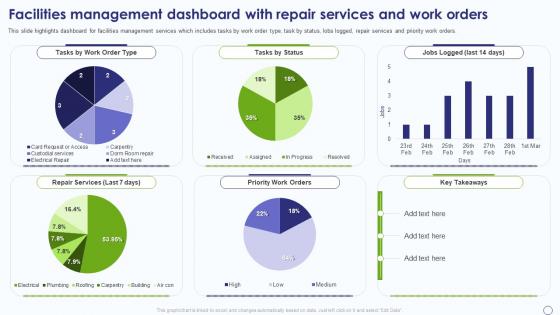
This slide highlights dashboard for facilities management services which includes tasks by work order type, task by status, lobs logged, repair services and priority work orders.
People who downloaded this PowerPoint presentation also viewed the following :
Facility Management Company Profile Facilities Management Dashboard With Repair Services with all 7 slides:
Use our Facility Management Company Profile Facilities Management Dashboard With Repair Services to effectively help you save your valuable time. They are readymade to fit into any presentation structure.





FAQs for Facility Management Company Profile Facilities Management Dashboard
An effective facility management dashboard should include occupancy rates, energy consumption patterns, maintenance schedules and costs, space utilization metrics, and environmental controls like temperature and air quality. These metrics streamline operations by enabling predictive maintenance, optimizing resource allocation, and reducing operational costs, with many organizations finding that comprehensive dashboards ultimately deliver enhanced tenant satisfaction and significant cost savings.
Facility management dashboards enhance operational efficiency by centralizing real-time data on space utilization, energy consumption, maintenance schedules, and asset performance into unified visual interfaces. Through automated monitoring and predictive analytics, organizations streamline resource allocation, reduce operational costs, and accelerate response times to facility issues, ultimately delivering improved workplace experiences and strategic cost optimization across their entire facility portfolio.
Data visualization transforms complex facility metrics into intuitive charts, graphs, heat maps, and real-time displays that enable quick decision-making and pattern recognition. Through visual dashboards, facility managers can instantly identify maintenance trends, space utilization inefficiencies, and energy consumption patterns, while stakeholders across organizations gain immediate insights into operational performance, ultimately streamlining resource allocation and enhancing strategic facility planning.
Real-time data integration enhances facility management dashboards by providing instant visibility into equipment performance, energy consumption, occupancy levels, and maintenance schedules, enabling proactive decision-making. Through connected IoT sensors and automated systems, facility managers streamline operations, reduce emergency repairs, and optimize resource allocation, ultimately delivering cost savings and improved building performance across commercial properties.
Best practices for designing user-friendly facility management dashboards include intuitive navigation, real-time data visualization, customizable widgets, mobile responsiveness, and role-based access controls. These design principles enhance operational efficiency by streamlining maintenance workflows, reducing response times, and improving asset visibility, with many facility managers finding that well-designed dashboards ultimately deliver faster decision-making and improved resource allocation across their organizations.
Facility management dashboards can be tailored through role-based access controls, customizable widgets, and stakeholder-specific KPIs that align with each user's responsibilities and decision-making needs. Executives might view cost summaries and strategic metrics, while maintenance teams access work order details and asset performance data, ultimately delivering targeted insights that enhance operational efficiency and enable faster, more informed decisions across all organizational levels.
**INPUT**: What software tools are most effective for creating facility management dashboards? **OUTPUT**: Effective facility management dashboard tools include Power BI, Tableau, IBM TRIRIGA, Archibus, and FM:Systems, along with integrated platforms like ServiceNow and Maximo. These solutions streamline operations by automating work orders, tracking space utilization, and monitoring equipment performance, with many organizations finding that real-time visibility ultimately delivers reduced operational costs and enhanced tenant experiences.
Facility management dashboards contribute to sustainability by tracking energy consumption, waste generation, water usage, and carbon emissions in real-time, enabling data-driven optimization strategies. These systems help organizations reduce operational costs, minimize environmental impact, and achieve sustainability goals through automated monitoring and predictive analytics, with many facilities finding significant improvements in resource efficiency and regulatory compliance.
Common challenges include data integration from multiple systems, user adoption resistance, customization complexity, training requirements, and ongoing maintenance costs. While these obstacles can initially slow implementation, many organizations find that strategic planning, phased rollouts, and comprehensive staff training ultimately deliver streamlined operations, improved transparency, and significant competitive advantages in facility management efficiency.
Mobile accessibility transforms facility management dashboards by enabling real-time issue reporting, instant work order updates, and on-the-go asset monitoring from any location. Facility managers can respond to maintenance requests immediately, track technician progress remotely, and access critical building data during site visits, ultimately streamlining operations and reducing response times significantly.
Data sources for facility management dashboards include IoT sensors, HVAC systems, energy meters, security systems, maintenance records, occupancy tracking, and asset management platforms. These integrated sources streamline operations by delivering real-time monitoring, predictive maintenance alerts, and resource optimization insights, with many organizations finding that comprehensive data integration ultimately reduces costs while enhancing building performance and tenant satisfaction.
Facility management dashboards enable predictive maintenance planning by analyzing equipment performance data, monitoring sensor readings, tracking maintenance histories, and identifying failure patterns before breakdowns occur. Through real-time analytics and automated alerts, facilities managers can schedule maintenance proactively, reduce unexpected downtime, and optimize resource allocation, with many organizations finding that predictive approaches deliver significantly lower operational costs.
Security considerations when sharing facility management dashboard data include access controls, data encryption, user authentication, audit trails, and compliance protocols. These measures protect sensitive operational information by restricting viewing permissions, securing data transmission, and monitoring user activity, with many organizations finding that layered security approaches ultimately deliver both transparency and protection in facility operations.
Benchmarking data can be effectively included through comparative metrics widgets, industry standard overlays, peer performance rankings, and variance analysis charts that highlight gaps between current and target performance. These visualization elements enable facility managers to quickly identify underperforming areas, track improvement progress against competitors, and make data-driven decisions that ultimately drive operational efficiency and cost optimization across their facilities.
Employee feedback significantly influences facility management dashboard design by identifying pain points, workflow inefficiencies, and critical data visualization needs that enhance daily operations. Through user surveys and usability testing, facility managers can prioritize features like maintenance request tracking, space utilization analytics, and environmental controls, ultimately delivering more intuitive interfaces and streamlined processes that improve workplace satisfaction and operational efficiency.
-
Appreciate the research and its presentable format.
-
Designs have enough space to add content.