

Fast Food Restaurant Detailed Porters Five Forces Analysis For Fast Food Business BP SS




Try Before you Buy Download Free Sample Product
 Impress Your
Audience
 100%
Editable
 Save Hours
of Time


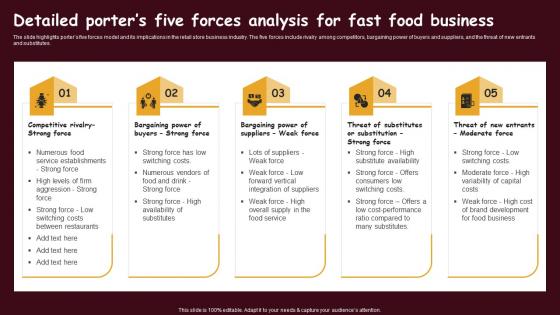
The slide highlights porters five forces model and its implications in the retail store business industry. The five forces include rivalry among competitors, bargaining power of buyers and suppliers, and the threat of new entrants and substitutes.
People who downloaded this PowerPoint presentation also viewed the following :
Fast Food Restaurant Detailed Porters Five Forces Analysis For Fast Food Business BP SS with all 9 slides:
Use our Fast Food Restaurant Detailed Porters Five Forces Analysis For Fast Food Business BP SS to effectively help you save your valuable time. They are readymade to fit into any presentation structure.









FAQs for Fast Food Restaurant Detailed Porters Five Forces Analysis For Fast Food
Key factors driving fast food industry growth include convenience demand, urbanization trends, technological integration, menu diversification, and delivery service expansion. These drivers enable restaurants to streamline operations, enhance customer experiences, and capture broader market segments, with many chains finding that digital ordering platforms and strategic location expansion ultimately deliver competitive advantage in increasingly fast-paced consumer environments.
Consumer health consciousness has significantly transformed fast food menus through the introduction of salads, grilled options, plant-based alternatives, reduced sodium items, and transparent calorie labeling. Major chains like McDonald's, Subway, and Taco Bell have responded by expanding healthier selections, reformulating existing products, and partnering with health-focused brands, ultimately delivering competitive differentiation while meeting evolving customer expectations.
Technology has revolutionized fast food operational efficiency through automated ordering systems, AI-powered inventory management, kitchen automation, predictive analytics, and mobile integration platforms. These innovations streamline workflow by reducing wait times, minimizing food waste, and optimizing staff allocation, with major chains finding that digital transformation ultimately delivers faster service and significantly lower operational costs.
Traditional fast food brands emphasize speed, convenience, value pricing, and indulgent flavors through mass advertising and promotional deals, while health-focused chains prioritize ingredient transparency, nutritional benefits, sustainability messaging, and premium positioning. These differing approaches reflect evolving consumer demands, with traditional brands increasingly adapting healthier options and emerging chains leveraging digital marketing to reach health-conscious demographics, ultimately delivering distinct competitive advantages in an increasingly diverse marketplace.
Sustainability drives fast food industry growth through waste reduction, eco-friendly packaging, sustainable sourcing, energy-efficient operations, and carbon footprint minimization. These initiatives enhance brand reputation, attract environmentally conscious consumers, reduce operational costs, and ensure regulatory compliance, with many chains finding that sustainable practices ultimately deliver competitive advantage and long-term profitability.
Social media trends have significantly transformed fast food perceptions by amplifying health consciousness, sustainability concerns, and visual food presentation standards. Platforms like Instagram and TikTok drive demand for photogenic meals, transparent sourcing, and plant-based options, with many chains finding that viral marketing campaigns and influencer partnerships now directly impact customer loyalty and purchasing decisions more than traditional advertising methods.
International fast food franchise expansion presents both significant challenges and lucrative opportunities, including cultural adaptation, regulatory compliance, supply chain logistics, local competition, and market penetration strategies. While franchises face hurdles with menu localization, operational standards, and brand consistency, many successful chains find that strategic partnerships, technology integration, and localized marketing ultimately deliver substantial revenue growth and competitive advantage in increasingly globalized markets.
Fast food chains address cultural preferences by localizing menus through ingredient substitutions, culturally relevant flavors, and region-specific dishes that align with local tastes and dietary restrictions. These strategic adaptations enable brands like McDonald's, KFC, and Pizza Hut to enhance customer acceptance, streamline market penetration, and deliver culturally resonant experiences, ultimately building stronger regional loyalty and competitive advantage.
Labor laws and wages significantly impact the fast food industry through increased operational costs, modified staffing strategies, and accelerated automation adoption. Many chains respond by streamlining operations, implementing self-service kiosks, and optimizing scheduling systems, while others find that competitive wages enhance employee retention and service quality, ultimately delivering improved customer experiences and operational efficiency.
The fast food industry is rapidly incorporating plant-based options through menu diversification, partnerships with companies like Beyond Meat and Impossible Foods, and dedicated vegetarian sections. Major chains including McDonald's, Burger King, and KFC are expanding these offerings by targeting health-conscious consumers, reducing environmental impact, and capturing the growing flexitarian market, ultimately delivering competitive advantage in an increasingly diet-diverse landscape.
Key metrics for fast food franchise performance include same-store sales growth, average transaction value, customer traffic counts, labor cost percentages, food cost ratios, and franchise fee compliance rates. These metrics enable franchisors to streamline operations, identify underperforming locations, and enhance profitability across their networks, with many restaurant chains finding that consistent monitoring ultimately delivers improved customer experiences and competitive advantage.
The COVID-19 pandemic has fundamentally reshaped the fast food landscape through accelerated digital transformation, expanded delivery services, contactless ordering systems, enhanced drive-thru operations, and reimagined restaurant layouts prioritizing safety protocols. These strategic adaptations have enabled chains like McDonald's, Domino's, and Starbucks to streamline customer experiences, minimize operational disruptions, and ultimately deliver competitive advantages in an increasingly health-conscious market environment.
Fast food companies are adopting biodegradable containers, smart packaging with temperature sensors, edible wrapping materials, recyclable multi-compartment designs, and antimicrobial coatings for food safety. These innovations streamline operations by reducing waste disposal costs, enhancing customer experience through freshness indicators, and meeting sustainability demands, with many chains finding that eco-friendly packaging significantly boosts brand loyalty while delivering competitive advantage.
Consumer loyalty programs significantly boost repeat business in fast food by offering rewards, personalized offers, exclusive deals, and points-based incentives that encourage frequent visits. These programs enhance customer retention through mobile apps and targeted promotions, with chains like McDonald's and Starbucks finding that members visit 20-30% more frequently, ultimately delivering increased revenue and competitive advantage.
Ethical sourcing considerations include fair labor practices, sustainable farming methods, animal welfare standards, environmental impact reduction, and supply chain transparency. These practices enhance brand reputation and consumer trust while addressing concerns about worker exploitation, pesticide use, and factory farming, with many fast food chains finding that ethical sourcing ultimately delivers competitive differentiation and operational sustainability.
-
Great designs, Easily Editable.
-
Great designs, Easily Editable.