


Porters Five Forces Analysis For Supermarket Grocery Store Business Plan BP SS




Try Before you Buy Download Free Sample Product
 Impress Your
 Audience
 100%
100% Editable
 Save Hours
 of Time


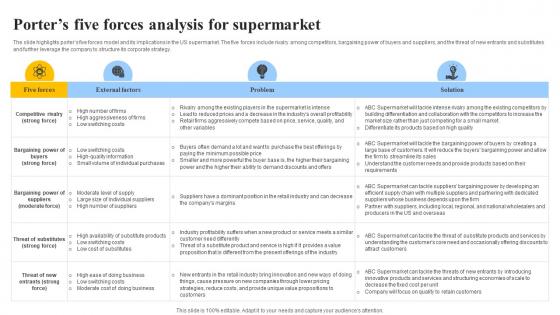
The slide highlights porters five forces model and its implications in the US supermarket. The five forces include rivalry among competitors, bargaining power of buyers and suppliers, and the threat of new entrants and substitutes and further leverage the company to structure its corporate strategy.
People who downloaded this PowerPoint presentation also viewed the following :
Porters Five Forces Analysis For Supermarket Grocery Store Business Plan BP SS with all 9 slides:
Use our Porters Five Forces Analysis For Supermarket Grocery Store Business Plan BP SS to effectively help you save your valuable time. They are readymade to fit into any presentation structure.








FAQs for Porters Five Forces Analysis For Supermarket Grocery Store Business
So Porter's five forces are competitive rivalry, supplier power, buyer power, threat of substitutes, and threat of new entrants. Here's the thing though - they all mess with each other. High supplier power jacks up your costs, making you way more vulnerable to substitutes. Competitive rivalry can actually help you out by scaring off new players (nobody wants to dive into a brutal price war). But then buyer power just makes that rivalry worse. I always think it's wild how one shift can domino through everything else. You've got to track how these changes play out in your specific industry so you can catch opportunities your competitors miss.
Porter's Five Forces is actually pretty solid for this. Start by rating each area - supplier power, buyer power, new competitors entering your space, substitutes that could replace you, and how cutthroat your existing competition is. Honestly, laying it all out can be a bit of a reality check. You'll probably spot some vulnerabilities you hadn't thought about before. The suppliers one always gets me - like, can they just decide to squeeze your margins whenever they feel like it? Once you've got everything mapped out, focus on whatever's your biggest threat first. Don't try to fix everything at once.
So basically, new competitors can totally wreck your profit margins. More players = more competition = prices get driven down. It's pretty brutal honestly. Low barriers make it super easy for companies to jump in and steal your customers. Then everyone's stuck in price wars and nobody makes decent money (except customers I guess, they love it). But if there are high barriers - like you need tons of capital or there's crazy regulations - you're way more protected. Really depends on your industry though. Just think about how easy it'd be for someone to waltz in tomorrow and compete with you.
Dude, when suppliers hold all the cards, they'll totally screw with your margins. They jack up prices, demand faster payments, or give you crappier stuff for the same money. If you've only got a couple options and switching is expensive? You're screwed. Your costs shoot up and now you're stuck - either eat the loss or bump your prices and risk losing customers. Honestly, I learned this the hard way once. You gotta spread your bets early. Get multiple suppliers lined up so no one can hold you hostage.
Ugh, buyer power is such a pain to deal with. Your customers basically control everything when they can easily jump to competitors - they'll demand lower prices and better deals constantly. You've got two main options: make your product different enough that switching becomes a huge hassle for them, or just accept you're gonna have smaller profit margins. I learned this the hard way with my last side business actually. Short sentences help here. Figure out how much control they really have over you, then build your whole approach around either weakening that control or living with thinner profits.
Look way past your obvious competitors - what else could solve your customers' main problem? Map out their core need first. Then brainstorm every other way they might handle it: different tech, services, or honestly just ignoring the problem completely. Talk to customers because they'll spill about random workarounds they've tried. Patent searches help too, plus keep tabs on adjacent industries creeping into your space. Here's the scary part though - the real threats come from nowhere. Remember how phones basically murdered standalone cameras? That's the stuff that'll blindside you. I'd build some kind of threat matrix ranking alternatives by likelihood and potential damage.
Okay so rivalry gets intense based on a few things. Slow industry growth is the big one - companies start clawing at each other for market share when there's no new pie to grab. Having tons of similar-sized competitors makes it worse. High fixed costs? That pushes everyone into volume wars nobody wins. Commodity products are brutal too since you can't really differentiate. Oh, and exit barriers - like if you've got expensive equipment you can't just dump. Sometimes CEOs just hate each other, which is honestly kind of entertaining to watch from the outside. Just map these out for your industry and you'll see how ugly things might get.
So basically, when an industry's growing fast, companies aren't trying to kill each other because there's enough business for everyone. Think renewable energy right now - tons of opportunity. But once growth slows down? That's when the gloves come off. Airlines are a perfect example - they're stuck fighting over the same customers since the market's pretty maxed out. Price wars, aggressive moves, the whole thing. It's honestly brutal to watch sometimes. Check the growth rate first when you're looking at any industry because it'll tell you how nasty the competition's gonna be.
Honestly, the key is making it super expensive or difficult for new companies to even get started. Look at pharma - those R&D costs are absolutely brutal, plus you're waiting years for FDA approval. That's a natural moat right there. You want to build up things like brand loyalty, lock down distribution channels, or get so big that your economies of scale can't be touched. Some barriers already exist in most industries. The trick is spotting them and then doubling down. Maybe it's proprietary tech, maybe it's regulatory stuff - but find what makes it hard for someone to copy what you're doing and lean into that.
Look, Porter's Five Forces is basically your cheat sheet for figuring out if you're walking into a bloodbath or not. It shows you who's gonna be your biggest pain - existing competitors, new guys entering the market, customers with crazy negotiating power, whatever. Honestly, it's like scoping out the scene before jumping in. You'll spot the weak areas where you can actually make some moves and the danger zones where you'd probably get demolished. Smart move is positioning yourself where the competition isn't totally brutal and avoiding those markets that'll chew you up.
Oh totally! Airlines are probably the best example - crazy competition between carriers, plus Boeing and Airbus basically control the whole supplier game. Customers will jump ship for like $20 savings too. Then you've got smartphones where Apple and Samsung are constantly going at it, but they're still stuck dealing with chip suppliers who have all the power. Actually, the app store thing is pretty wild when you think about it. Once you start noticing these patterns, they're literally everywhere. Just pick your industry and start with who you're competing against, then work through the other stuff.
When customer preferences shift, it messes with your whole competitive landscape. Buyers might suddenly care more about price or demand fancy new features - that changes their power dynamics with you. Companies start fighting harder to adapt (look how the whole sustainability craze forced everyone to reinvent themselves). Startups can swoop in easier if they "get" what customers want now. Plus consumers might jump to totally different alternatives. Honestly, the companies that track this stuff through regular customer research usually spot the changes first. You don't want to be playing catch-up while competitors are already pivoting.
Definitely go with SWOT analysis alongside Porter's - gives you the internal view while Porter's handles competitive stuff. PESTLE is solid for macro trends (political, economic, social factors etc) that Porter's misses. Value chain analysis digs into operational advantages too. Honestly? I'd start with Porter's for competitive dynamics, then add SWOT for your internal strengths and weaknesses. PESTLE comes in handy when you need that bigger picture perspective. Using all three can feel like a lot sometimes, but you get way more complete insights. Though maybe don't overwhelm yourself if you're just starting out.
Regulations totally flip Porter's Five Forces on their head. New rules usually make it harder for companies to enter markets - compliance costs are brutal. But here's the thing: existing players end up fighting harder for what's left of the market. Look at healthcare or fintech - one new policy and everything changes overnight. Supplier relationships shift, buyer power moves around, and sometimes whole substitute products just disappear (or pop up). I'd honestly map out a few "what if" scenarios now. That way you won't be scrambling when regulators actually make their move.
Porter's Five Forces gives you a decent snapshot, but honestly it's kinda outdated for today's mess of an economy. The thing doesn't factor in government regulations or tech disruptions that can flip entire industries. Also assumes clear industry boundaries - good luck with that when companies are constantly pivoting into random sectors. It's super static too, like taking a photo when you need a video. I'd definitely start there but throw in PESTLE analysis or scenario planning on top. Don't rely on just one framework when everything's changing this fast.
-
I was really impressed with the presentation I created with their templates. I’ll be using their services moving forward.
-
Been using SlideTeam for some time now…can’t imagine why I wasted all that time in front of the screen trying to make the perfect presentation.