


Retail Grocery Store SWOT Assessment Matrix




Try Before you Buy Download Free Sample Product
 Impress Your
 Audience
 100%
100% Editable
 Save Hours
 of Time


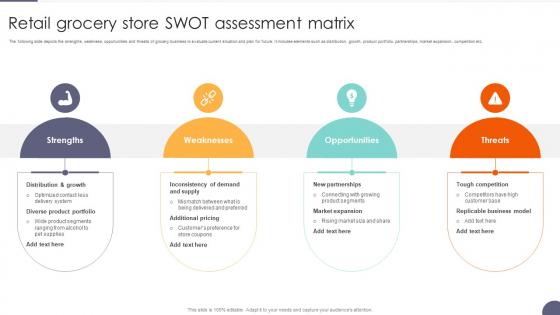
The following slide depicts the strengths, weakness, opportunities and threats of grocery business to evaluate current situation and plan for future. It includes elements such as distribution, growth, product portfolio, partnerships, market expansion, competition etc.
People who downloaded this PowerPoint presentation also viewed the following :
Retail Grocery Store SWOT Assessment Matrix with all 6 slides:
Use our Retail Grocery Store SWOT Assessment Matrix to effectively help you save your valuable time. They are readymade to fit into any presentation structure.





FAQs for Retail Grocery Store
**INPUT**: What strengths differentiating a retail grocery store from its competitors in a specific market? **OUTPUT**: Key differentiating strengths include strategic location accessibility, diverse product selection, competitive pricing strategies, exceptional customer service, and strong supplier relationships. These competitive advantages enable grocery retailers to capture market share by enhancing customer loyalty, streamlining operational efficiency, and delivering superior shopping experiences, with many successful chains finding that combining convenience with quality ultimately drives sustainable growth. *Word count: 58 words*
A retail grocery store can leverage location through strategic positioning near residential areas, high foot traffic zones, or business districts, while maximizing visibility and accessibility. Successful grocers enhance location advantages by offering convenient services like extended hours, drive-through pickup, and delivery zones, ultimately capturing market share and building customer loyalty in their immediate community.
Common weaknesses inhibiting grocery store growth include limited product differentiation, thin profit margins, high operational costs, inventory management challenges, and intense price competition from larger chains. These limitations often restrict expansion capabilities, reduce marketing budgets, and limit technology investments, with many independent grocers finding that supply chain inefficiencies and staffing constraints ultimately compromise customer service quality and competitive positioning.
Retail grocery stores can enhance customer service through staff training programs, expanded product knowledge resources, streamlined checkout processes, personalized shopping assistance, and responsive feedback systems. These improvements enable faster service delivery, reduce wait times, and create more engaging customer interactions, with many retailers finding that strategic service investments ultimately drive customer loyalty and competitive differentiation in increasingly crowded markets.
Significant opportunities in retail grocery include e-commerce expansion, health-conscious consumer trends, sustainable product demand, meal kit services, and technology integration for personalized shopping experiences. These trends enable retailers to diversify revenue streams, attract new customer segments, and enhance operational efficiency, with many chains finding that strategic combinations of digital platforms and wellness-focused offerings ultimately deliver competitive advantages in an increasingly dynamic marketplace.
Economic trends significantly reshape retail grocery SWOT analyses by influencing consumer spending patterns, supply chain costs, labor expenses, and competitive positioning across multiple market segments. During inflationary periods, grocery stores face increased operational costs while consumers shift toward value-oriented purchasing, ultimately requiring strategic pivots in pricing, product mix, and market positioning to maintain competitive advantage.
Online grocery services pose threats including customer migration to convenient delivery platforms, reduced foot traffic affecting impulse purchases, price competition from digital-native retailers, and pressure to invest heavily in omnichannel capabilities. However, these challenges create opportunities for traditional stores to enhance their digital presence, leverage physical locations for hybrid services, and differentiate through personalized in-store experiences, with many retailers finding success through strategic integration of online and offline operations.
Grocery stores can leverage technology to transform weaknesses into strengths through automated inventory management systems, self-checkout solutions, mobile apps with personalized offers, AI-powered demand forecasting, and contactless payment options. These technologies streamline operations by reducing labor costs, minimizing stockouts, and enhancing customer convenience, with many retailers finding that strategic technology adoption ultimately delivers improved margins and competitive differentiation.
Supply chain management significantly impacts all four SWOT quadrants, serving as a strength when efficient, a weakness when disrupted, an opportunity for cost reduction and sustainability initiatives, and a threat during global disruptions. Grocery retailers increasingly find that robust supply chain strategies enable competitive pricing, reduce food waste, ensure product availability, and enhance customer satisfaction, while supply chain vulnerabilities can expose stores to inventory shortages and operational inefficiencies.
Grocery stores can capitalize on health trends by expanding organic produce sections, partnering with local farms, offering meal prep services, creating wellness-focused private labels, and implementing nutrition consultation programs. These strategic initiatives enable retailers to attract health-conscious consumers, command premium pricing, and differentiate from competitors, with many stores finding that wellness positioning significantly enhances customer loyalty and drives sustainable revenue growth.
Retail grocery stores should consider health consciousness and organic demand, digital shopping preferences, sustainability concerns, convenience-focused lifestyles, and demographic shifts toward urban density. These social trends significantly impact consumer behavior, with many retailers finding that adapting to wellness trends, environmental values, and time-pressed shopping habits ultimately delivers competitive advantage and enhanced customer loyalty.
Seasonal changes significantly impact grocery store inventory by creating fluctuating demand patterns, requiring strategic stock adjustments, temperature-controlled storage needs, and flexible supplier relationships. These seasonal shifts enable stores to capitalize on peak periods like holiday baking or summer grilling, while also presenting challenges in managing perishable goods rotation and storage costs, ultimately delivering competitive advantage through responsive inventory management and enhanced customer satisfaction.
Potential risks include inventory management complexities, increased storage costs, supplier relationship challenges, customer confusion from overwhelming choices, and potential cannibalization of existing profitable products. While expansion can drive revenue growth, grocery retailers must carefully balance product diversification with operational efficiency, with many finding that strategic category additions in high-margin areas like prepared foods or specialty items deliver better outcomes than broad expansion.
Customer loyalty significantly strengthens a retail grocery store's competitive position by reducing customer acquisition costs, increasing average transaction values, and providing predictable revenue streams that enhance financial stability. Strong loyalty programs and customer retention become key strengths in SWOT analysis, while weak loyalty represents a critical vulnerability, with many grocery chains finding that loyal customers ultimately deliver higher lifetime value and create sustainable competitive advantages against new market entrants.
Retail grocery stores can mitigate competitive threats by enhancing customer loyalty programs, diversifying product offerings with local and organic options, investing in omnichannel experiences, and optimizing supply chain efficiency. These strategies enable stores to differentiate through personalized service, unique inventory, seamless online-offline integration, and competitive pricing, with many retailers finding that combining digital innovation with community-focused initiatives ultimately delivers sustainable competitive advantage in an increasingly crowded marketplace.
-
Amazing product with appealing content and design.
-
Presentation Design is very nice, good work with the content as well.