


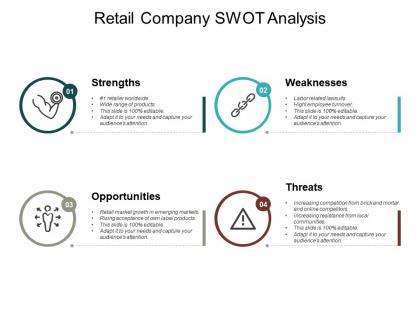
Retail company swot analysis





Try Before you Buy Download Free Sample Product
 Impress Your
 Audience
 100%
100% Editable
 Save Hours
 of Time


Enlarge the group that appreciates your ideas with our Retail Company SWOT Analysis. Extend the impact of your influence.
People who downloaded this PowerPoint presentation also viewed the following :
Retail company swot analysis with all 5 slides:
Folks give credit to your influence due to our Retail Company SWOT Analysis. They appreciate your effort in ensuring good conclusions.



FAQs for Retail
Key retail brand strengths include strong brand recognition, exceptional customer service, strategic locations, diverse product offerings, and robust supply chain management. These differentiators enable retailers to build customer loyalty, optimize inventory turnover, and maintain competitive pricing, with many successful brands finding that combining digital innovation with personalized shopping experiences ultimately delivers sustained market advantage.
Weaknesses in retail operations directly impact business performance by reducing customer satisfaction, increasing operational costs, and limiting competitive positioning. Poor inventory management, inadequate staff training, and inefficient supply chains create cascading effects across sales, profitability, and brand reputation, with many retailers finding that operational weaknesses ultimately drive customers to competitors and erode market share.
Technology advancements are creating opportunities through e-commerce expansion, artificial intelligence-driven personalization, omnichannel integration, augmented reality experiences, and automated supply chain management. These innovations enable retailers to enhance customer engagement, streamline operations, and reduce costs, with many organizations finding that strategic technology adoption delivers competitive advantage in an increasingly digital marketplace.
Customer behavior significantly influences retail threats through shifting preferences toward online shopping, increased price sensitivity, demand for instant gratification, and higher service expectations. These behavioral changes create competitive pressures from e-commerce platforms, margin erosion from price comparisons, inventory challenges from unpredictable demand patterns, and operational strain from omnichannel requirements, ultimately forcing retailers to adapt or risk losing market share.
SWOT analysis helps retail organizations identify internal strengths and weaknesses alongside external opportunities and threats, enabling data-driven strategic decisions around market positioning, resource allocation, and competitive differentiation. Through systematic evaluation, retailers can capitalize on emerging trends, address operational vulnerabilities, and develop targeted growth strategies, ultimately delivering enhanced customer experiences and sustainable competitive advantage in an increasingly dynamic marketplace.
Retailers can leverage their strengths by aligning core competencies with emerging trends, utilizing established customer relationships for personalized experiences, and deploying existing infrastructure to support omnichannel strategies. Through strategic positioning, retailers with strong brand loyalty can introduce sustainable products, enhance digital touchpoints, and expand into experiential retail, ultimately delivering competitive advantage and capturing new revenue streams in an increasingly dynamic marketplace.
Supply chain management reveals retail weaknesses through inventory shortages, delivery delays, vendor relationship issues, cost inefficiencies, and quality control gaps. Through comprehensive supply chain analysis, retailers identify bottlenecks in procurement, distribution, and logistics operations, while assessing supplier dependencies and operational vulnerabilities, ultimately enabling strategic improvements that enhance customer satisfaction and competitive positioning.
Social media presents both significant opportunities and challenges for retail brands by enabling direct customer engagement, targeted advertising, and real-time feedback, while simultaneously exposing brands to negative reviews, viral criticism, and increased competition. Through strategic social media management, retailers can enhance brand visibility, drive sales, and build customer loyalty, though they must also navigate potential reputation risks and maintain consistent brand messaging across multiple platforms.
Retailers can mitigate SWOT-identified threats through diversification strategies, enhanced digital presence, supply chain optimization, competitive pricing models, and strategic partnerships with technology providers. By implementing omnichannel approaches, investing in data analytics for customer insights, and developing agile inventory management systems, retailers strengthen market position while reducing vulnerabilities to economic downturns, competitor actions, and changing consumer preferences, ultimately delivering sustained competitive advantage.
Economic fluctuations significantly reshape retail operations by impacting consumer spending power, supply chain costs, and market demand patterns. During downturns, retailers with strong financial reserves and diverse product portfolios often strengthen their market position, while those dependent on discretionary spending face heightened vulnerabilities, ultimately separating resilient operators from less adaptable competitors.
Brick-and-mortar retailers face unique challenges including higher operational costs, limited geographic reach, inventory management complexities, staffing requirements, and physical space constraints that online retailers typically avoid. These challenges manifest through higher overhead expenses, reduced flexibility in scaling operations, and dependency on foot traffic, while online competitors benefit from lower infrastructure costs, global accessibility, and streamlined logistics, ultimately requiring physical retailers to leverage experiential advantages.
Customer feedback integration transforms retail SWOT analysis by identifying service gaps as weaknesses, popular products as strengths, emerging market demands as opportunities, and competitive disadvantages as threats. Through systematic feedback collection via surveys, reviews, and social media monitoring, retailers can continuously update their strategic assessments, ultimately delivering enhanced customer experiences and maintaining competitive advantage in dynamic market conditions.
Environmental factors for retail SWOT analysis include economic conditions, consumer behavior trends, technological advancements, regulatory changes, and competitive landscape shifts. These external elements significantly impact retail operations by influencing customer purchasing power, digital transformation requirements, and market positioning strategies, with many retailers finding that proactive environmental assessment enables strategic adaptation and sustainable competitive advantage in increasingly dynamic markets.
Small retail businesses can utilize SWOT analysis by identifying unique strengths like personalized service, local market knowledge, and agile decision-making, while addressing weaknesses in inventory management and technology adoption. This strategic assessment enables targeted competitive positioning through enhanced customer experiences, niche market focus, and operational efficiency improvements, ultimately delivering sustainable competitive advantages against larger retailers.
Partnerships enhance retail brand strengths by expanding market reach, leveraging complementary expertise, sharing resources and costs, accessing new customer segments, and strengthening supply chain capabilities. Through strategic alliances with technology companies, logistics providers, or complementary brands, retailers can amplify their core competencies, reduce operational burdens, and deliver enhanced customer experiences while maintaining competitive positioning in increasingly complex markets.
No Reviews