


Strategic Group Analysis Of Fast Food Chains




Try Before you Buy Download Free Sample Product
 Impress Your
 Audience
 100%
100% Editable
 Save Hours
 of Time


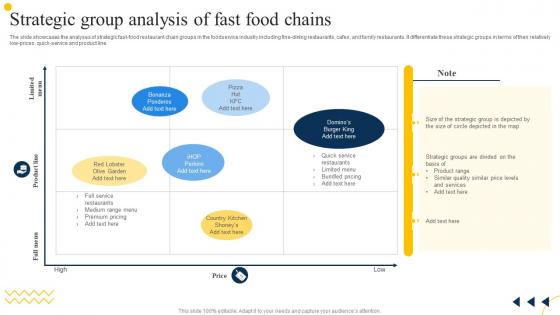
The slide showcases the analyses of strategic fast-food restaurant chain groups in the foodservice industry including fine dining restaurants, cafes, and family restaurants. It differentiate these strategic groups in terms of their relatively low prices, quick-service and product line.
People who downloaded this PowerPoint presentation also viewed the following :
Strategic Group Analysis Of Fast Food Chains with all 6 slides:
Use our Strategic Group Analysis Of Fast Food Chains to effectively help you save your valuable time. They are readymade to fit into any presentation structure.





FAQs for Strategic Group Analysis Of
So basically you're sorting your competitors into groups based on how they actually operate - like pricing, where they sell stuff, who they're targeting. Picture it as putting similar players in the same bucket instead of treating everyone like the same threat. Some companies might be going after your exact customers while others are honestly in a totally different game. Once you see these clusters, you'll spot gaps you can jump into and figure out who you really need to worry about. Then just focus your research energy on the groups that could actually mess with your business. Way more efficient than trying to track everyone.
So basically, strategic groups are companies in the same industry that compete in similar ways. Think about retail - you've got your luxury brands, discount stores, and mid-range players. They're all selling stuff but targeting totally different customers with different pricing and quality levels. It's actually pretty fascinating how they carve out their own lanes. Companies pick different distribution channels, geographic areas, that sort of thing. Here's the thing though - map out these groups first when you're analyzing competition. The companies in your exact strategic group? Those are the ones that'll keep you up at night.
Honestly, start with the obvious stuff first - pricing and who they're actually selling to. Geographic reach matters too, plus how they distribute their products. Think airlines: some go dirt cheap, others sell luxury. Pick maybe 2-3 things that actually make a difference in your space, not just random features. Brand positioning is huge - are they the premium option or the budget choice? Once you plot companies on these different axes, you'll see clear groups pop up. Some will be fighting tooth and nail for the same customers, while others are basically in different games entirely.
So it's really about market share and how you spend your money. Companies that have similar market positions and throw cash at the same stuff end up competing in the same space - like how BMW, Mercedes, and Lexus all basically fight over the same wealthy customers. Where you put your R&D and marketing dollars decides which group you're playing in. Your market share just shows if you're winning or losing against those specific competitors. The tricky part? You can jump between groups by shifting your spending, but you've got to go all-in. Half-measures will leave you stuck between worlds, which honestly sucks for everyone.
Think of strategic groups as your competitive roadmap - way better than flying blind. You'll spot gaps in the market other companies aren't filling, plus figure out who you're actually competing against (sometimes it's not who you'd expect). The analysis shows mobility barriers too, which is fancy talk for what it costs to jump between different positions in your industry. Honestly, this stuff reveals acquisition targets and partnership opportunities you'd probably miss otherwise. Use it to either dig deeper where you are now or plan a smart move to a more attractive spot. Pretty useful for avoiding nasty surprises.
So strategic group analysis is basically plotting out all your competitors to see where the gaps are. Look for price points or customer segments that aren't totally packed - that's where you might squeeze in. Also keep an eye on which groups are tanking because those could be exit opportunities. The tricky part is figuring out mobility barriers though, like how realistic it actually is to jump between groups. Honestly the visual mapping part makes this way clearer than just thinking about it. Plot everyone first, then hunt for white space where you can actually win.
So customer segmentation is actually a really solid way to figure out strategic groups. Think about it - if two companies are both chasing premium customers with that high-touch service approach, they're probably in the same strategic group. Doesn't matter if they're in totally different cities or have different product features. I'd start by mapping out who's going after the same customer types as you - that's honestly where you'll spot the strategic similarities that aren't super obvious at first. It's like... way clearer than trying to analyze every little operational detail. Makes the whole competitive landscape thing less overwhelming too.
So basically you map out companies that have similar strategies and resources - they usually move in pretty predictable ways. Track what your direct competitors did when they faced pricing pressure or new players entering the market. I'd also watch the early movers in related groups since your competitors might follow their lead later. Honestly, it's kind of like watching chess players at the same skill level - you start recognizing patterns after a while. Companies in the same strategic group react similarly because they're dealing with the same constraints. Update your analysis quarterly and you'll get good at spotting what's coming next.
Mobility barriers are huge for figuring out how cutthroat your industry gets. High barriers? Companies stay in their lane and mostly fight with similar competitors. Low barriers though - total chaos. Everyone can jump into each other's space, which makes competition brutal everywhere. Your pricing power and margins take a hit when that happens. Honestly, I think most people underestimate this part. Map out what it'd actually cost your main competitors to switch groups. That shows you where the real threats are coming from, not just who looks similar on paper right now.
Dude, forget treating those strategic group maps like they're set in stone. In fast-moving industries, you've gotta refresh them every 3-6 months because everything shifts so quickly. Tech companies especially - they can blow up traditional barriers overnight. Watch for new players creating completely fresh groups. Companies jumping between positions on your key dimensions? That's where the gold is. I learned this the hard way at my last job, honestly. Set up regular tracking of your main metrics. When the data shows groups are reshuffling, redraw those boundaries immediately. The whole point is catching these movements before everyone else does.
Strategic group mapping is your best bet - just plot competitors on a grid using stuff like price vs quality or market scope. Super visual and you'll instantly see who's actually competing with who. Porter's Five Forces is solid backup for understanding the dynamics in each group. If you've got decent data, cluster analysis works too (though it gets pretty nerdy). Honestly, start with the mapping thing first since it's so intuitive. You'll spot the white spaces right away. Value network analysis helps in messy industries but don't overthink it initially.
Okay so here's what I'd do - run your PESTEL analysis first to get the big picture stuff. Then map out your strategic groups to see who's actually competing with you (not just everyone in your industry, but companies doing similar things). This gives you way better insight into your real threats. When you get to SWOT, you'll have much clearer external analysis since you know which competitors actually matter. Honestly, most people skip the strategic group mapping part which is weird because it makes everything else so much sharper. Try it before your next SWOT - you'll see what I mean.
Oh totally! You just can't think about profit like usual. Group other nonprofits by their funding - government grants vs individual donors, who they serve, how they deliver services. I did this once and it was actually pretty revealing. Map out maybe 8-10 orgs in your area using two factors that really matter for your mission. You'll spot who you're actually competing with for donors and see gaps nobody's filling. Plus you can steal... I mean, learn from what similar organizations are doing strategy-wise. Worth trying for sure.
Here's the thing - strategic groups in the same industry compete totally differently because they're dealing with different cost pressures and customer types. Take luxury brands versus budget ones. Rolex focuses on prestige and premium materials, while Timex just wants to be the cheapest reliable watch out there. They barely compete against each other directly because of these mobility barriers (fancy term but it's real). What's crazy is how the same market can have such opposite success factors. Don't try copying what works for other groups - figure out what actually drives wins in yours specifically.
Yeah, strategic group analysis is pretty decent for understanding where competitors sit right now, but it falls apart when you're trying to predict the future. Industries change constantly - new tech pops up, business models get flipped upside down. Remember when Netflix basically wiped out Blockbuster's entire strategic group? The whole thing assumes those barriers between competitor groups will stay put, but disruptors are literally designed to smash through them. You'll also probably miss new players who don't fit your existing categories at all. Honestly, I'd start with strategic groups but then add scenario planning on top. Maybe some tech roadmapping too - that combo gives you way better long-term insight.
-
SlideTeam is my go-to resource for professional PPT templates. They have an exhaustive library, giving you the option to download the best slide!
-
I can always count on your designs for my professional needs. I believe I found a one-stop-shop for PPTs.