


Swot analysis for fast food restaurant business ppt powerpoint aids




Try Before you Buy Download Free Sample Product
 Impress Your
 Audience
 100%
100% Editable
 Save Hours
 of Time


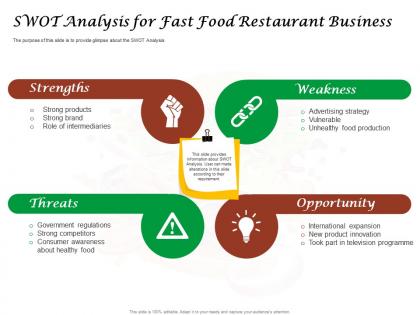
The purpose of this slide is to provide glimpse about the SWOT Analysis
People who downloaded this PowerPoint presentation also viewed the following :
Swot analysis for fast food restaurant business ppt powerpoint aids with all 2 slides:
Use our Swot Analysis For Fast Food Restaurant Business Ppt Powerpoint Aids to effectively help you save your valuable time. They are readymade to fit into any presentation structure.
FAQs for Swot analysis for fast food restaurant business
Key strengths that differentiate fast food restaurants include brand recognition, operational efficiency, strategic location placement, menu innovation, and customer loyalty programs. These competitive advantages enable restaurants to streamline service delivery, reduce wait times, and enhance customer experiences, with many establishments finding that combining technology integration with consistent quality ultimately delivers market differentiation and sustainable growth.
Location significantly impacts fast food competitive advantage through foot traffic accessibility, visibility to target demographics, proximity to competitors, and operational cost considerations like rent and labor availability. Prime locations near offices, schools, or transportation hubs enable higher sales volumes, faster customer acquisition, and market penetration, while strategic positioning ultimately delivers sustained revenue growth and operational efficiency.
Common weaknesses include intense price competition, customer retention challenges, rising operational costs, limited differentiation opportunities, and shrinking profit margins. These pressures force many restaurants to compromise on quality or service standards while struggling to maintain brand loyalty, with successful chains finding that strategic menu innovation, technology integration, and operational efficiency become critical for sustainable competitive advantage.
A fast food restaurant can leverage strong brand reputation by expanding into new markets, launching premium menu items, and commanding higher pricing power than competitors. This brand strength enables faster customer acquisition, enhanced investor confidence, and strategic partnerships with suppliers, ultimately delivering increased market share and operational efficiency in an increasingly competitive landscape.
Fast food restaurants can innovate through plant-based alternatives, global fusion cuisines, customizable meal options, health-conscious ingredients, and technology-driven personalization features. These strategic menu expansions enable brands to capture emerging demographics, respond to dietary trends, and differentiate themselves in increasingly competitive markets, with many establishments finding that innovative offerings drive customer loyalty and revenue growth.
Economic trends significantly impact fast food viability through consumer spending patterns, inflation rates, labor costs, and market demand shifts. During economic downturns, many restaurants benefit from increased demand for affordable dining options, while inflationary periods challenge profitability through rising ingredient and operational costs, ultimately requiring strategic pricing adjustments and operational efficiency improvements.
Fast food restaurants face external threats including rising health consciousness, stringent government regulations on nutrition labeling, increased competition from healthy fast-casual chains, negative media coverage of processed foods, and shifting consumer preferences toward organic and locally-sourced options. These challenges, while significant, present opportunities for menu innovation and strategic repositioning, with many restaurants finding that transparent ingredient sourcing and healthier alternatives ultimately deliver competitive advantage in an increasingly health-focused marketplace.
Customer service significantly impacts all four SWOT quadrants for fast food restaurants, serving as a key differentiator in competitive markets through faster order processing, accurate fulfillment, and positive customer interactions. Excellent service becomes a major strength that drives customer loyalty and repeat business, while poor service creates vulnerabilities that competitors can exploit, ultimately determining long-term profitability and market positioning.
Technology enhances fast food restaurant strengths by streamlining operations through mobile ordering apps, automated kitchen equipment, digital menu boards, and AI-powered inventory management systems. These innovations accelerate service delivery, reduce labor costs, and improve order accuracy, with many establishments finding that integrated technology platforms ultimately deliver faster customer experiences and significant competitive advantages in increasingly crowded markets.
Fast food restaurants can address weaknesses by enhancing menu quality through healthier options, improving operational efficiency with better staff training and technology integration, and strengthening brand reputation via customer service excellence. Through strategic menu diversification, streamlined processes, and consistent service delivery, establishments like McDonald's and Subway have successfully transformed perceived weaknesses into competitive advantages, ultimately boosting customer loyalty and market share.
Environmental threats in fast food SWOT analysis include stricter health regulations, sustainability mandates, supply chain disruptions from climate change, rising minimum wage laws, and increased food safety compliance requirements. These factors significantly impact operational costs, menu adaptations, and sourcing strategies, with many restaurant chains finding that proactive environmental planning delivers competitive advantage through reduced regulatory risks and enhanced brand reputation.
Social media enhances fast food marketing through targeted advertising, real-time customer engagement, influencer partnerships, and viral content campaigns that build brand awareness. Platforms like Instagram and TikTok enable brands to showcase menu items visually, respond to customer feedback instantly, and leverage user-generated content, ultimately delivering broader reach and stronger customer loyalty.
Fast food restaurants can mitigate fast-casual threats by enhancing menu quality with healthier options, improving customer experience through digital ordering and faster service, and implementing competitive pricing strategies. These approaches enable traditional chains to retain customers while adapting to evolving preferences, with many establishments finding that strategic menu diversification and operational efficiency ultimately deliver sustained competitive advantage in an increasingly crowded marketplace.
Changing consumer behavior directly reshapes fast food SWOT analysis by transforming previous strengths into potential weaknesses and revealing new competitive advantages. Health-conscious trends, digital ordering preferences, and sustainability demands require restaurants to reassess their operational efficiency, menu offerings, and brand positioning, with many chains finding that adaptability to shifting preferences ultimately determines their market resilience and growth potential.
Collaborative partnerships in fast food include delivery platform integrations, technology vendor alliances, supplier chain collaborations, ghost kitchen partnerships, and co-branding initiatives with complementary brands. These strategic combinations streamline operations, expand market reach, and enhance customer experiences, with many restaurants finding that partnerships with meal kit services, grocery chains, and entertainment venues ultimately deliver increased revenue streams and competitive differentiation.
-
Professional and unique presentations.
-
Qualitative and comprehensive slides.
-
Awesome use of colors and designs in product templates.