


Swot Analysis Related To The Coffee Shop Restaurant Cafe Business Idea Ppt Inspiration




Try Before you Buy Download Free Sample Product
 Impress Your
 Audience
 100%
100% Editable
 Save Hours
 of Time


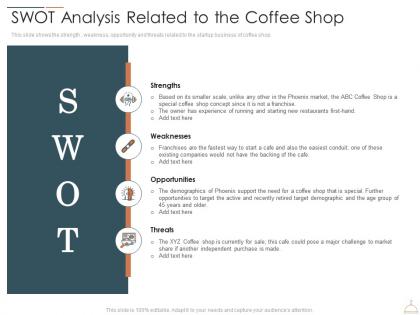
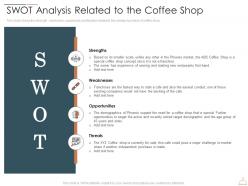
This slide shows the strength , weakness, opportunity and threats related to the startup business of coffee shop.
People who downloaded this PowerPoint presentation also viewed the following :
Swot Analysis Related To The Coffee Shop Restaurant Cafe Business Idea Ppt Inspiration with all 2 slides:
Use our SWOT Analysis Related To The Coffee Shop Restaurant Cafe Business Idea Ppt Inspiration to effectively help you save your valuable time. They are readymade to fit into any presentation structure.
FAQs for Swot Analysis Related To The Coffee Shop Restaurant Cafe Business
SWOT analysis comprises four key components: Strengths (internal advantages), Weaknesses (internal limitations), Opportunities (external favorable conditions), and Threats (external challenges or risks). These components enhance strategic planning by enabling organizations to leverage internal capabilities, address operational gaps, and capitalize on market opportunities, while simultaneously developing contingency plans for potential threats, ultimately delivering comprehensive strategic frameworks that drive competitive advantage and informed decision-making.
SWOT analysis helps identify growth opportunities by systematically evaluating internal strengths and external market trends, revealing untapped potential in new markets, product development, and strategic partnerships. Through comprehensive assessment, businesses can leverage their competitive advantages while addressing market gaps, ultimately enabling strategic expansion, resource optimization, and enhanced market positioning in an increasingly competitive landscape.
Organizations should avoid surface-level analysis, focusing only on obvious factors, conducting SWOT in isolation without stakeholder input, and failing to prioritize identified elements by strategic importance. Many companies also mistake outdated information for current realities, overlook interconnections between strengths and opportunities, and neglect to translate insights into actionable strategies, ultimately limiting competitive advantage.
SWOT analysis integrates effectively with strategic planning tools like Porter's Five Forces, balanced scorecards, scenario planning, and competitive analysis frameworks to create comprehensive strategic insights. This strategic combination enables organizations to cross-validate findings, identify strategic gaps, and develop more robust action plans, with many businesses finding that integrated approaches deliver enhanced decision-making and sustainable competitive advantages.
External factors significantly influence SWOT analysis by shaping opportunity identification, threat assessment, competitive positioning, and strategic priority setting across all four quadrants. Market trends like digital transformation, consumer behavior shifts, and regulatory changes help organizations in retail, healthcare, and financial services reframe their strengths as competitive advantages while uncovering new market opportunities, ultimately delivering more dynamic strategic planning.
Small businesses can leverage SWOT analysis by identifying unique strengths like agility, personalized service, and niche expertise that larger competitors often lack. Through strategic assessment of market opportunities and competitive weaknesses, smaller organizations can streamline operations, enhance customer relationships, and accelerate decision-making processes, ultimately delivering more responsive services and competitive positioning in targeted market segments.
Stakeholder input provides diverse perspectives, industry insights, operational knowledge, and market intelligence that enhance SWOT analysis accuracy and completeness. Through interviews, surveys, and collaborative workshops, organizations capture internal expertise from employees, external viewpoints from customers and partners, and competitive intelligence, ultimately delivering more strategic decision-making capabilities and comprehensive business understanding.
Teams ensure unbiased SWOT analysis by incorporating diverse perspectives, using external data validation, and implementing structured evaluation processes that separate fact from opinion. Through cross-functional collaboration, third-party assessments, and systematic evidence gathering, organizations minimize personal biases and groupthink, while regular reviews and external benchmarking help validate findings, ultimately delivering more accurate strategic insights and reliable decision-making frameworks.
Effective SWOT presentation methods include visual matrices with color-coded quadrants, interactive workshops with collaborative discussions, executive dashboards highlighting key insights, storytelling approaches that connect findings to strategic narratives, and action-oriented summaries with prioritized recommendations. These presentation techniques enhance stakeholder engagement by transforming raw analysis into compelling strategic conversations, with many organizations finding that visual formats and interactive sessions deliver clearer understanding and faster decision-making.
Technology and data analytics enhance SWOT analysis by automating data collection, providing real-time market intelligence, and delivering predictive insights through AI-powered pattern recognition. These tools enable organizations to identify competitive threats faster, uncover hidden opportunities through customer behavior analysis, and validate strategic assumptions with quantitative evidence, ultimately delivering more accurate assessments and data-driven decision-making capabilities.
Companies typically conduct regular SWOT analyses during strategic planning cycles, major market shifts, product launches, competitive threats, and organizational changes like mergers or leadership transitions. This systematic evaluation enables businesses to maintain strategic alignment, identify emerging opportunities in sectors like technology and healthcare, and proactively address weaknesses, ultimately delivering sustained competitive advantage.
Organizations adapt their SWOT analysis framework by customizing evaluation criteria, metrics, and focus areas specific to industry dynamics, regulatory environments, and competitive landscapes. Financial services might emphasize compliance strengths and cybersecurity threats, while manufacturing focuses on supply chain weaknesses and automation opportunities, with many finding that industry-tailored frameworks deliver more actionable strategic insights.
Best practices for documenting SWOT-derived action items include creating structured templates with clear ownership assignments, establishing measurable timelines and success metrics, categorizing initiatives by strategic priority, and implementing regular review cycles. These approaches streamline accountability by linking specific actions to SWOT insights, tracking progress through dashboard systems, and enabling course corrections, with many organizations finding that systematic documentation ultimately delivers enhanced strategic execution and competitive advantage.
SWOT analysis guides new product development by evaluating internal strengths and weaknesses against external opportunities and threats, enabling strategic positioning and resource allocation. Through systematic assessment, companies can leverage core capabilities, address market gaps, and mitigate competitive risks, with many organizations finding that this approach streamlines development timelines while enhancing market fit and commercial viability.
**INPUT**: What metrics can be used to measure the effectiveness of strategies developed from a SWOT analysis? **OUTPUT**: Effectiveness metrics include revenue growth, market share expansion, customer acquisition rates, operational efficiency improvements, and competitive positioning indicators. These measurements enable organizations to track strategic progress by monitoring financial performance, operational streamlines, and market penetration, with many companies finding that combining quantitative data with qualitative assessments ultimately delivers comprehensive insights into strategic success.
-
Design layout is very impressive.
-
Best Representation of topics, really appreciable.