


Swot Analysis Related To The Coffee Shop Business Plan For Opening A Cafe Ppt Powerpoint Model




Try Before you Buy Download Free Sample Product
 Impress Your
 Audience
 100%
100% Editable
 Save Hours
 of Time


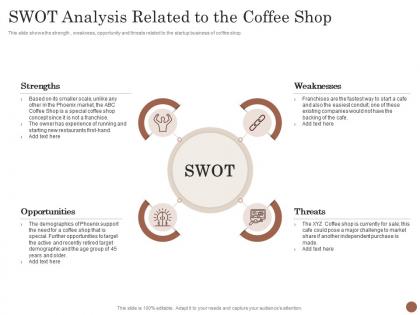
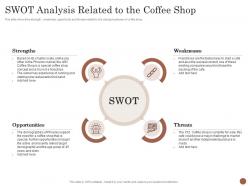
This slide shows the strength , weakness, opportunity and threats related to the startup business of coffee shop.
People who downloaded this PowerPoint presentation also viewed the following :
Swot Analysis Related To The Coffee Shop Business Plan For Opening A Cafe Ppt Powerpoint Model with all 2 slides:
Use our SWOT Analysis Related To The Coffee Shop Business Plan For Opening A Cafe Ppt Powerpoint Model to effectively help you save your valuable time. They are readymade to fit into any presentation structure.
FAQs for Swot Analysis Related To The Coffee Shop Business Plan For Opening A Cafe
So a SWOT has four parts: Strengths and Weaknesses (stuff inside your company), plus Opportunities and Threats (outside factors). Just use a simple 2x2 table - don't overthink the design. Each section should have 3-5 specific bullet points, not generic fluff like "we have great people." Short explanations help too. Oh, and definitely get different people involved when you're brainstorming this. You'll miss obvious things if it's just you or your usual team. I've seen way too many SWOTs where they completely ignored major threats because nobody wanted to bring up the uncomfortable stuff.
So you'll want to tailor your SWOT categories to whatever industry you're actually in. Healthcare companies should look at stuff like regulatory compliance, patient outcomes, maybe specialized equipment - while threats might be policy changes or staffing issues. Tech is completely different though - think IP portfolios, how well you can scale, competition from new platforms. Honestly, I'd start by checking out some competitor analyses or industry reports first. That way you're not just guessing at what matters. Each sector has its own weird benchmarks and challenges, so do a bit of homework before diving in.
Just go with a simple 2x2 grid - different colors for each section so people can scan it quickly. Honestly, I'd throw in some basic icons too (like shields for strengths, maybe warning signs for threats). Don't overthink the design though. I've watched people absolutely murder SWOT analyses with crazy graphics that nobody can read. Stick to bullet points instead of paragraphs, and make your font sizes match. If something's really critical, bold it or highlight it. The whole point is making sure your team can grab the main ideas without having to decode some designer's fever dream.
Hit the high-impact stuff first - whatever actually moves the needle on your goals. Quick wins from your existing strengths are gold. Meanwhile, don't sleep on threats that could really mess you up. I'm obsessed with those simple 2x2 grids plotting impact vs how realistic something actually is right now. Some opportunities look shiny but you'd never pull them off with current resources. Pick maybe 3-5 things max - seriously, that's it. You'll spread yourself too thin otherwise. Map out who's doing what and when for your top picks. The rest can wait.
Don't get too generic with it - like saying "good reputation" tells you nothing useful. Dig into specifics that actually connect to what you're trying to accomplish. I've sat through sessions that turned into total brainstorming chaos where people just threw out random stuff for an hour. Honestly, what a waste of time. Keep everyone focused on things that'll genuinely impact your goals. Oh, and here's what really matters - you've got to actually DO something with those insights afterward. Can't just stick them in a folder somewhere and forget about them.
Look for where your strengths line up with outside opportunities - that's your goldmine right there. New opportunities might also fix your current weaknesses (like if better software could solve those workflow headaches). Here's something most people miss: threats aren't always bad news. Sometimes they show you market gaps nobody's filling yet. Map out these connections and start brainstorming "what if we tried..." scenarios. Oh, and update your SWOT every few months since things change crazy fast these days.
Honestly, just pick your top 2-3 competitors and run them through each SWOT section. What are you crushing them at? That's your strengths. Where they're kicking your ass? Weaknesses right there. Look for markets they're completely ignoring - that's where opportunities get interesting. Their big advantages become your threats, obviously. I'd skip the whole "industry analysis" thing and get super specific about actual companies. Way more useful when you can point to real examples instead of talking in generalities. Makes the whole exercise actually actionable instead of just... theoretical nonsense.
So here's what I'd do - start by figuring out what you're actually best at. Your tech team? Brand recognition? Whatever it is, write it down. Then look at the opportunities out there and see where those strengths give you a real shot at winning. Don't chase every shiny new thing (trust me on this one). Make a quick grid - your top strengths on one side, biggest opportunities on the other. The spots where they overlap? That's where you focus first. It's honestly just common sense, but most people skip this step and wonder why they're spinning their wheels.
You really need other people's opinions for this - otherwise you're just talking to yourself. Different groups see stuff you can't. Like customers might notice weaknesses your team totally missed, or suppliers could point out market opportunities you haven't thought about. Board members are great for the big picture view. I'd probably hit up 3-4 different groups through interviews or whatever works. Actually, workshops can be pretty effective too. The trick is asking pointed questions about where they think you beat competitors and where you're vulnerable. Don't just ask vague stuff.
Honestly, templates are a lifesaver for team stuff. Everyone contributes in the same format instead of having random sticky notes everywhere. You can split up sections - like one person handles strengths, another does weaknesses, whatever. Remote teams especially benefit since people aren't talking over each other constantly. The structure keeps things focused and gives you actual usable data at the end. Oh and definitely go digital where everyone can edit at once - saves so much back-and-forth. Way better than those messy brainstorming sessions that go absolutely nowhere.
Oh totally! Apple did this when they were basically broke in the late 90s - they figured out their design was killer but admitted their market position sucked, which led to the whole iPod thing. Starbucks pulled the same move going international, knowing their brand was strong but local coffee shops could be tricky competition. And Southwest? Their entire no-frills model came from SWOT analysis - they literally turned what other airlines saw as "cheap" into their biggest selling point. Pretty genius if you ask me. Best time to use it is when you're stuck and need to see the bigger picture clearly.
Honestly, I'd say once a year minimum, but that's kinda cutting it close. Most big companies do theirs every 6-12 months or when something major happens - new competitors, economic weirdness, internal shake-ups, you know? Tech companies probably need quarterly updates since everything moves so damn fast there. Don't get too hung up on a strict schedule though. Set some reminders but stay flexible. If your industry suddenly gets turned upside down, that's when you drop everything and reassess. Better to be reactive than outdated.
Skip the boring quadrant-by-quadrant walkthrough and hit them with your biggest insights first. Nobody wants to sit through "here are our strengths, here are our weaknesses..." Trust me, their attention span won't last. Make it visual so patterns jump out immediately. Look for where categories overlap - that's where the real gold is. Connect everything back to actual decisions they need to make, not just theoretical business speak. Oh, and definitely end with 2-3 specific actions they can take. Otherwise you'll get that awkward "so... what now?" silence when you're done presenting.
Look at each part of your SWOT and you'll find risks lurking everywhere. Weaknesses are the obvious ones - those need solid backup plans. Threats from outside definitely require some "what if" scenarios ready to go. But here's what's interesting - your strengths can actually shield you from risks way better than your competitors. Opportunities are sneaky though, they come with hidden downsides that blindside people all the time. I'd grab the top 3 risks from each section, then rank them by how likely they are and how much damage they'd cause. Boom, you've got yourself a proper risk list to tackle.
Honestly, nonprofit SWOT is way more interesting than regular business ones. Don't focus on just financial stuff - look at your volunteer network, community trust, and how much influence you actually have. The opportunities section gets really cool when you think about partnering with other nonprofits or new grants opening up. Threats aren't just competition either. Donor fatigue is real, and public priorities shift all the time (just look at how funding trends change). Start by figuring out what makes you special - maybe it's your volunteers' expertise or deep community connections. Then build around maximizing your social impact instead of profits.
-
Innovative and Colorful designs.