

 0 Comment
 Customer Reviews

With low startup costs and high demand, the tea business is currently one of the most appealing and profitable business options. The oldest beverage in the world has a market size of more than 260 billion dollars, and more than five billion cups of tea are consumed every day.
Because of these encouraging numbers, a significant number of tea businesses start their operations regularly. Some go on to make a name for themselves, while others perish. There could be many reasons behind success and failure.
Lack of Market Research: While tea is the second most consumed beverage after water, a successful tea business still needs to identify its potential market. Countries like the Netherlands prefer coffee, while Mexico consumes more cola than any other drink. Setting up your tea business in such geographical landscapes could be troublesome unless trends change in the upcoming year. You also need to choose the best locations to produce tea, as the weather plays a critical role in the quality of tea production.
Staying behind the trends: The tea market has evolved, and there are now more variants of tea than ever. It can be a big mistake to fail to fulfil the diverse demands and cater only to the traditional tea-serving market.
Poor Marketing: Since starting a tea business is so easy, efficient marketing is the only way to reach a broader audience than your competitor. Not adhering to a good marketing strategy will set your startup up for failure.
There could be other reasons, but our tea business plan eliminates most of them. Our templates cover the factors below that are essential for your business's growth.
Table of Contents
- Company Analysis and Overview
- Industry Analysis
- Customer Analysis
- Competitor Analysis
- Exploring the tea industry through SWOT analysis
- Porter’s five forces analysis for the tea business
- Marketing Plan
- Operational Plan
- Financial Plan
- Management Summary
Once you download our tea business plan, you get premium access to the 62-page document, which is available in XLS, PDF, and Doc Files, making it easier for you to customize.
1. Company Analysis and Overview
This section provides a detailed summary of the existing tea market situation and attempts to extract future opportunities through market analysis. It is a strong culmination of both facts and possibilities that helps you size your target audience and settle on some achievable goals. Not to forget, a tea business thrives on tea varieties. It acknowledges this fact and includes the likes of wellness tea, bubble tea, herbal tea, and other variants while conducting comprehensive industry research. Grab this to formulate an all-round business strategy and create a strong impression during the presentation.
In our company analysis and overview section, you will get:
1.1 Executive summary – description of the tea business: Provides a thin account of the existing tea firms and how they make money. It utilizes facts and data for the narrative summarization and helps you build a strong foundation for the tea business plan.
1.2 Quick pitch for understanding the tea business: Describes the potential of the tea industry to help you decide the best prices for your tea products.
1.3 Mission and vision statement associated with the tea business: This statement briefly covers necessary information, such as the firm's name, location, and target market, and supplements it with where the company wants to see itself in the future.
1.4 Start-up cost summary of tea business: This summary breaks down the initial startup costs according to their nature and utility.
1.5 Goals and objectives for tea business: Strengthen your business by setting process—and result-oriented goals for the coming period.

2. Industry Analysis
An impactful industry analysis presents several challenges, including data visualization during a presentation. While your research and analysis team may put intense effort into tea market analysis, presenting and contextualizing the statistics in front of the stakeholders remains a mission. This section, however, addresses this difficulty by offering diagrams and bar graphs to represent the global and regional key numbers in a way that is easy to comprehend. It also lists major market trends that a tea shop business plan must consider.
Reasons to download our industry analysis plan:
2.1 Global tea industry market overview: Offers insights into the current and anticipated worldwide tea generation and consumption numbers.
2.2 Analyzing tea industry regional outlook: This section compares the major tea-producing countries worldwide and draws significant interpretations from the comparison.
2.3 Key market trends shaping tea industry: Mentions market trends, such as rising tea cocktail demands or eco-friendly packaging to capitalize upon.
2.4 Exploring growth drivers for tea business: Introduces diverse tea products, accessories, and other sustainable factors responsible for the growth of a tea business model.
2.5 Overcoming challenges faced by the tea industry: Any business plan expects to encounter obstacles in the long run, and therefore, this template predicts the nature of the challenge and lists strategies to counter it.

3. Customer Analysis
A competent tea product strategy thoroughly determines to whom it will sell its products. However, your tea business cannot grow in countries such as Finland and Brazil, which consume more coffee than tea. This is where the customer analysis strategy comes into effect. It not only informs you about the geographical locations of tea consumers but also breaks them down according to their ages, interests, and other factors. Get this to size up your target market with precision.
3.1 Target customer profile for tea business: This profile divides tea consumers into different categories based on their age, tea preference, and passion for consuming tea. It helps create inclusive marketing strategies for each category.
3.2 Tea sector market analysis using TAM SAM and SOM: This analyzes the size of your target market in relation to its global market and the market size your company aims to penetrate.

If you also plan to serve other beverages like coffee along with tea, make sure to check our cafe business plan templates.
4. Competitor Analysis
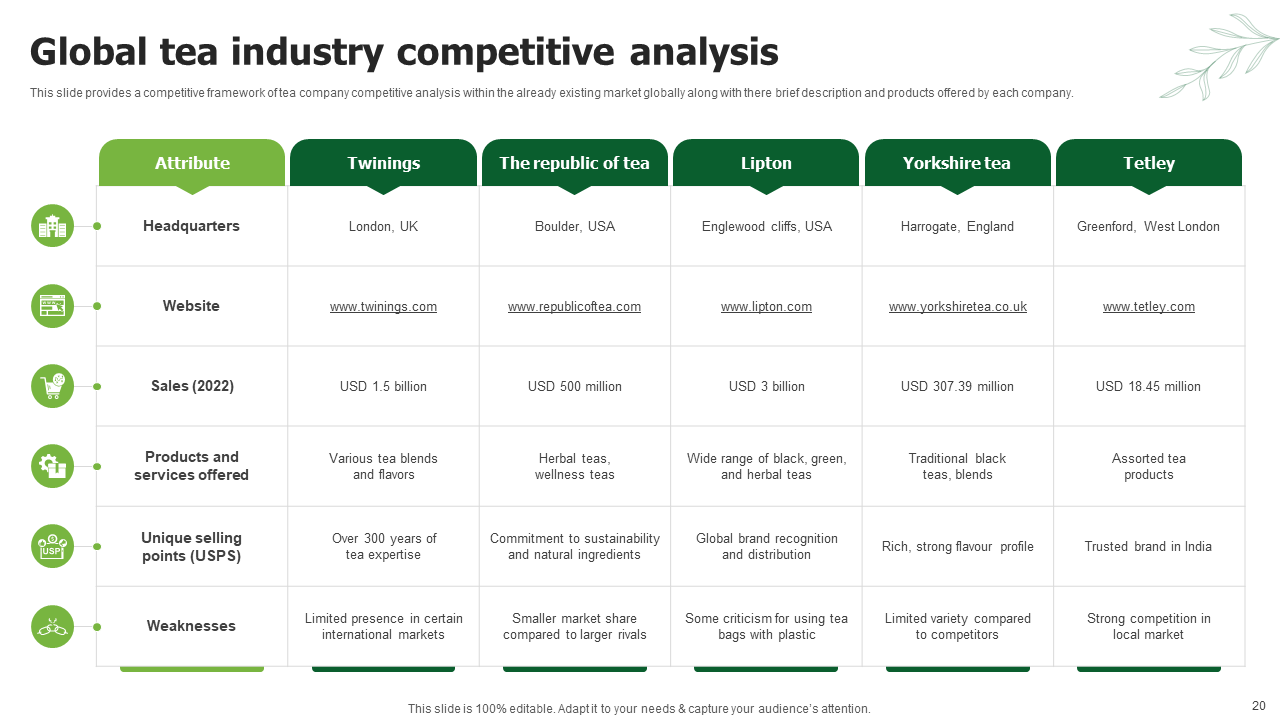
This template takes certain attributes of the leading tea-selling companies in the industry and ranks them on the basis of their performances. These attributes are relevant and play an important role in the ease of doing business. The companies include the likes of Lipton, Yorkshire Tea, Twinings and Tetley. Our competitor analysis presents their annual sale in 2022, unique selling points such as expertise and brand loyalty, and weaknesses like limited presence and strong market competition in a listicle format. This slide helps you with exhaustive competitor research, choosing the best, and eliminating their negative parts in advance.
5. Exploring the tea industry through SWOT analysis
The strength of a tea product lies in its orientation toward rich flavors without compromising the consumer's health. Its weakness, obviously, lies in the constant changes in weather, which are responsible for declining tea quality. Your tea brand development plan must thoroughly cover these elements to exploit the opportunities and mitigate the threats that lie ahead. Our SWOT analysis covers this entire range and magnifies your process of inspecting the tea industry. Grab it now!

6. Porter’s five forces analysis for the tea business
This template concerns itself with a more nuanced analysis of the upcoming threats and challenges to establishing your tea business start-up. It recognizes potential threats such as competition from alternate beverage options like coffee, multiple supply chains, and customer loyalty to certain specific rival brands and elaborates on their severity. This severity matrix helps you prioritize the upcoming challenges and proceed with strategies to respond to them. Awareness of these factors makes you proactive and consolidates your business model.

7. Marketing Plan
Your sales revenue is directly connected to your reach among customers. The more you show up, the more you sell. This section acknowledges this fact and discusses making plans to boost your revenue and presence, primarily online. It divides your marketing plan into sales strategy and marketing strategy to focus on both complex areas. The plan encourages the use of social media marketing and influencer marketing and the provision of exciting customer loyalty programs to reach new audiences and retain them.
While offers and rewards are attractive, the audience appreciates the product's delivery to customers at the fairest price through multiple distribution channels and the automation of the whole sales process. Our strategy ensures that we cater to and tick all the required boxes.
In our marketing plan, you will get:
7.1 Tea business go-to-market strategy: Combines most common methods, such as diversifying your product portfolio and collaborating with the distributors to sell more products.
7.2 Tea business customer journey through sales funnel: Understand the different stages of the customer journey, from awareness and generating interest in the brand to making repeated tea purchases. This understanding helps the business focus on the process instead of the results.

Has your food business witnessed reduced footfall? Penetrate a bigger market strategically with these food marketing strategy templates.
8. Operational Plan
This part of the plan focuses on achieving multiple plans throughout the year in a systematic manner. It segregates key pre-launch, after-launch, and milestones to ensure sustained growth over the different quarters in the first year of the product launch. Some of these major milestones include developing a brand identity in the first quarter, staff training in the following quarter, and targeting new markets in the second semester for business expansion. Use this slide as a checklist to evaluate the timely operations of your tea business model. Ticking these boxes means your business stays on the planned route.

9. Financial Plan
The financial success of a tea shop start-up relies strongly on three variables. One is effective revenue streams, followed by projected profit and loss and consolidated cash flow. Once you build a sound revenue generation model that fixes all the loopholes, it becomes easier for your financial experts to make accurate financial projections. Using our financial plan templates, you can make informed assumptions about your future cash flow, operational expenses, balance sheet, and even inflation. This section also leaves room for the best and worst-case scenarios so that you can prepare your firm to stand the test of time in advance.
Reasons to adopt our financial plan:
9.1 Key financial assumptions for tea start-up: Helps predict the expenses, charges, and taxes that your business will incur in the coming years.
9.2 Effective revenue generation model for tea start-up: Forecasts the amount of revenue your business is expected to generate from different sources, such as retail sales of tea or tea accessories over the next five years.
9.3 Effective break even analysis for understanding the tea business: Analyzes multiple financial attributes like revenue and variable costs to reach a point where the company no longer incurs losses.
9.4 Projected profit and loss account statement analysis for tea business: Calculates and anticipates various sources of profits and losses in your business.
9.5 Cash flow statement analysis for tea business: Forecasts the amount of cash generated and spent through multiple business operations.
9.6 Comparative balance sheet statement for tea start-up: Compares the asset values and liability costs of your startup business for 5 years to present a clearer picture of its financial position at any given point.
9.7 Scenario analysis with optimistic, pessimistic, and realistic cases: This template anticipates cases where the company’s future performance deviates from the expected norm. It predicts the financial numbers for best-case, worst-case, and expected-case situations.
9.8 Discounted cash flow valuation for tea start-up: Considers the change in the values of money in relation to time and, therefore, tells the real cash value earned by the firm in the upcoming time.

10. Management Summary
Clarity is the most salient feature of any implementable tea market strategy. Blending and tasting are the only ways to add multiple tea products with diverse flavors, and this allows expert tea tasters and blenders to be recruited. When a marketing department is clear about its responsibilities, it conducts excellent market research and produces high-performing marketing strategies. A CEO must know how to lead with impact. Our management summary templates ensure your employees know what is expected of them so that they can focus on giving back the maximum return to their employers.
Reasons to download our management summary:
10.1 Deploying an efficient organizational structure for smooth operations: Creates a structural hierarchy by separating different departments of your firm. It helps with smooth operations as each department works well within its territory to ensure maximum combined productivity.
10.2 Job roles and responsibilities of key personnel in tea business: Defines transparent job roles and responsibilities from the most basic level of a tea taster to the general manager or the CEO of the company to ensure optimum efficiency and time management.

Final Thoughts
“ Where there’s tea, there’s hope. “ - Sir Arthur Wing Pinero, English playwright.
Like tea, a tea business symbolizes hope. It stands for making the most of available resources and for living according to popular culture. In the current setting, setting up a tea shop undoubtedly fascinates even the most experienced business professionals. This is why this blog attempts to construct the most feasible tea shop business plan that anyone must explore and implement in their business.
Before you go, check out our business plan templates, which cover the general requirements of any business regardless of its nature.