

 0 Comment
 Customer Reviews

Did you know that over 3 billion cups of tea are consumed every single day around the world? Tea production has witnessed remarkable growth since the pandemic, when wellness and immunity became key focus areas. But behind every steaming cup lies an intricate production plan that guides every aspect of production, from cultivation, tea rolling techniques, and processing through packaging and distribution.
As markets change and evolve, having a thorough tea production plan is no longer optional--it is necessary! When starting a new tea business, expanding existing operations, or seeking investors, having a strong presentation can make all the difference between being taken seriously and being disregarded. A tea production PowerPoint does more than just present your idea--it builds confidence, conveys your vision, and unifies teams around its message.
To assist with starting or refining your current strategy, SlideTeam has curated the Top 10 Tea Production PPT Templates--complete with examples and ready-to-use slides--as a resource. Our frameworks are easy to edit and user-friendly, making them accessible for everyone. Whether it be to illustrate supply chains, forecast growth projections or break down sustainable tea cultivation, withering process, and production phases, these templates are guaranteed to impress!
Browse these expertly designed tools and take the first step toward launching a thriving tea business with SlideTeam by your side.
Why do you need a Tea Production business plan?
Evaluate Feasibility and Viability: A detailed business plan will provide clarity on whether or not your tea processing venture is feasible and viable before you expend so much time and resources.
Get Funding and Investments: You won’t get a windfall without a concrete plan to show investors or banks. A well–detailed tea production business plan gives you credibility with your banker, investors, friends, and manager.
Plan Strategic Growth: Whether your business involves sourcing raw leaves or final packaging and distribution, a business plan is your roadmap to success, helping you develop achievable goals and timeframes.
Go-To-Market Strategy: Entering a saturated market like tea, be it local or international, necessitates drawing up a solid GTM strategy that includes your USPs, target audience, and pricing strategy. All of this is written into your business plan.
Direct Product or Service Launch: Whether you are launching a new range of herbal blends or are ready to set up a processing plant, a business plan ensures that your launch is based on research, planning, and risk assessment.
Assess operational requirements: This covers your resource needs, staffing considerations, and volume of production. It helps you ensure you’re ready for demand while avoiding overinvestment.
A Quick Overview Of Our Tea Production Business Plan
Here is what you will get within our business plan:
Table of Contents
- Executive Summary
- Company Overview
- Industry Analysis
- Customer Analysis
- Competitor Analysis
- SWOT Analysis & Porter’s Framework
- Marketing Plan
- Operational Plan
- Financial Plan
- Management Summary
-
Executive Summary
It gives potential investors a brief but informative overview of your business plan so they can get an immediate grasp of your tea brand and its future plans.
It showcases what you offer, so people can understand what you will provide to your customers. It analyses the dominant marketplace trends and opportunities to secure the potential of your brand.
This model also contains a summary of the US organic tea farming and potential market growth. It also alludes to how online tea sales spiked during the pandemic, revealing a promising shift in consumer behavior that your company can capitalize on.

-
Company Overview
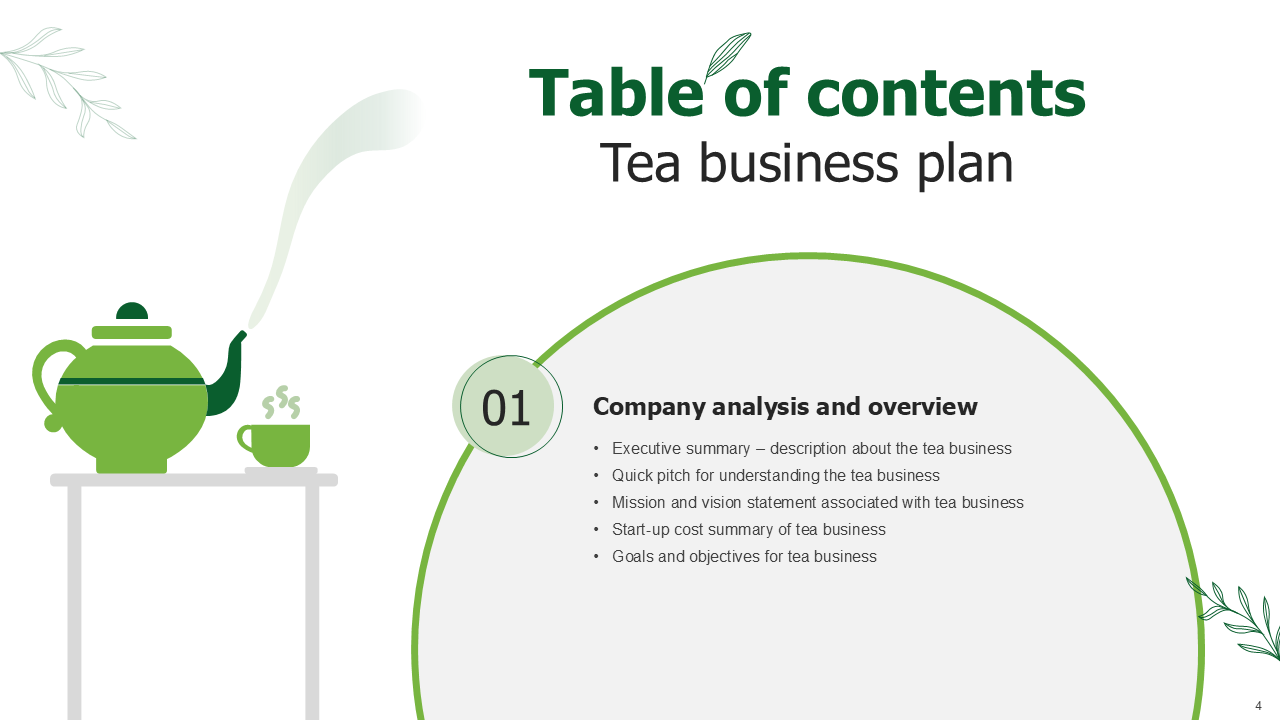
This slide provides a comprehensive company analysis and a statement of your tea fermentation business plan. It enables readers to comprehend the underlying nature of your tea business with a short-form business pitch.
It features the mission and vision statements, enabling you to articulate your brand’s greater purpose and long-term vision.
The template also provides the startup summary, including clear goals and objectives, presenting your financial planning and business strategies.
-
Industry Analysis
This slide offers the overall situation of the tea market your business has occupied. It provides data on trends and developments and focuses on markets and materials, capacities and technologies, and the changing structure of industry.
It allows interested parties to understand the dynamics that affect your business's future profitability. It also shows a global market-sense overview of the tea grading industry in terms of size, demand, and projected growth.
It also examines the innovations and developments within the industry, from the rise in health-oriented tea drinking to the challenges your business could face.

-
Customer Analysis
Customer analysis is an essential part of understanding your audience and the best ways to contact them. This template allows businesses in the tea industry to better understand the preferences, actions, and wants of their prospective customers and cater to the market's needs.
It concentrates on getting expanded customer descriptions for the tea industry. It highlights details such as demographics, purchasing patterns, and product preferences, which in turn feed into marketing decisions.
It enables the prospective entrepreneur to develop insights into the market by using TAM, SAM, and SOM frameworks.

-
Competitor Analysis
This template is critical for providing a comprehensive overview of how your tea business operates compared to others.
It comprises information about the other players’ headquarters, websites, sales numbers, product range, and other services.
The template aids companies in assessing competitors' relative strengths and weaknesses to make decisions about differentiation and strategic focus.
Check out our blog on Top 10 Hospitality Management Templates to help you analyze the industry trends and make informed decisions to improve hotel and restaurant operations.

-
SWOT Analysis Porter’s Framework
This template serves as an important tool for analyzing a company's strategic business position. It assists in recognizing internal strengths and weaknesses and also helps identify opportunities and external threats that must be considered to realize the market's trends.
This slide enables businesses to gauge potential risks and the market sentiment more broadly.
The template features an in-depth SWOT analysis as well as Porter's framework, providing a graphic structure to discuss competitive forces, market barriers and key strategic advantages.

-
Marketing Plan
A good marketing plan is a part of your business plan. This slide concentrates on creating go-to-market tactics that will enable companies to scale sales and revenues.
It covers go-to-market plans and in-depth analysis of the customer journey along a sales funnel to enhance lead generation and conversion rates.
It offers structure for developing and implementing your marketing plans that can be used to attract, engage, and retain customers steadily.

-
Operational Plan
This slide is necessary to turn business goals into action.It ensures that short-term activities and long-term goals support the business development foundations for a milk tea company.
It lays out, with specifics, the steps that must be taken to achieve all those milestones and establishes accountability and clarity across every department.
The template acts as a compass, guiding teams to keep their eyes on the prize and make informed decisions for sustainable growth.

-
Financial Plan
This slide assists you in predicting revenue, regulating expenses, and evaluating profitability. It also helps ensure that resources are managed wisely from the start.
It helps to better understand fixed and variable costs, break-even points, and possible profit levels. It’s a critical element of attracting investors and sustaining financial health.
The slide contains financial assumptions, revenue models, P&L, Cash flows, Balance sheets, comparable and scenario analysis, valuation summaries and other necessary financial information.

-
Management Summary
This slide provides a plan for running the business, including who handles the key tasks and which party (if any) is accountable.
With an organized structure and clear division of labor, the business runs smoothly, and staff members are closer to the team. It also helps to have clarity on reporting lines and the power to make decisions.
It covers non-verbal details of employee roles and job descriptions, including top human resources, to ensure good management.

Ending Notes
A good business plan is the foundation of your tea harvesting and production business. It enables you to take all the thoughts swirling around in your head and visualize them as a set of influential factors and consequences. It organizes everything in a way that is easy to understand and act upon. The good news? You don’t need to begin again. Our collection features creative templates containing everything from competitor analysis to financial plans, tea packaging methods, processes, and more.
Do the smart thing for your herbal tea production business right now. Go ahead and download the pack and see for yourself how you can turn your planning process into a strategic advantage with SlideTeam by your side!
FAQs
-
What are the main stages of tea production?
The different tea processing stages are:
Plucking: Picking the tender leaves and buds from the tea plant.
Withering: Drying the leaves to make them softer.
Rolling: Cracking the leaf cells to release natural juices that aid the flavor process.
Oxidation: Exposing the rolled leaves to air to induce chemical reactions that change the color and flavor.
Drying (or firing): The application of heat to arrest oxidation and remove the remaining moisture.
Classification: Resting leaves are selected based on size and quality, gathered together, and packed.
-
How does oxidation affect different types of tea?
Oxidation has a huge impact on the color, taste and flavor of tea. Here’s how it affects different varieties:
Green Tea : Oxidation level- a tiny bit. The leaves are lightly steamed or pan-fired to keep their emerald green color and fresh, grassy flavor.
Oolong Tea: Partial oxidation (10–80%). Provides a complex flavor, ranging from floral and fruity to toasty, depending on levels of oxidation.
Black Tea: Fully oxidized. The leaves become dark brown or black and take on strong, full flavors with malty or spicy overtones.
White Tea: Slightly oxidized. Its taste is light and subtle with very delicate, as a result of very little processing.
-
What is the difference between CTC and orthodox tea processing?
Main differences between CTC vs. orthodox tea are:
CTC Processing:
Mechanized and faster method.
Leaves are crushed, torn, and curled into tiny pellets.
Makes a strong, quick cup of tea – great for teabags and ‘builder’s tea’.
Orthodox Processing:
Conventional (and mostly manual or semi-mechanised system).
Leaves are rolled and not cut, sothe whole leaf structure is maintained.
It produces the best in full flavor and quality and works well with premium loose leaf teas.
CTC is all about efficiency and strength, while orthodoxy is all about maintaining the leaf's integrity and complexity.
-
How is quality maintained in tea production?
Here are the steps of quality control in tea production
Picking Standards: Usually, only the top two leaves and a bud are picked for high-quality tea.
Processed Under Control: A disciplined approach to monitor the process is followed to ensure no over-oxidation or under-drying.
Cleanliness: Ensures your tea is free of harmful chemicals, etc.
Taste and Grade: Degustation experts taste for flavor, scent, and appearance to categorize and standardize.
Storage: Finished teas are stored under cool, dry conditions to maintain freshness and avoid spoilage.