


Swot Analysis For Food And Beverage Industry




Try Before you Buy Download Free Sample Product
 Impress Your
 Audience
 100%
100% Editable
 Save Hours
 of Time


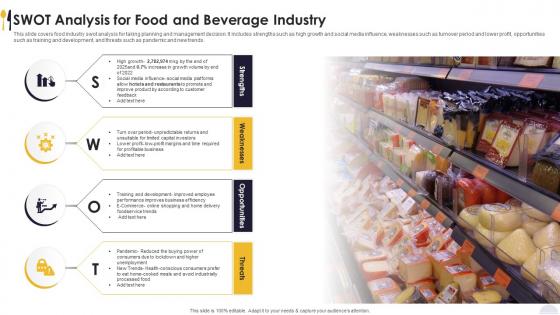
This slide covers food industry swot analysis for taking planning and management decision. It includes strengths such as high growth and social media influence, weaknesses such as turnover period and lower profit, opportunities such as training and development, and threats such as pandemic and new trends.
People who downloaded this PowerPoint presentation also viewed the following :
Content of this Powerpoint Presentation
Food and Beverage is an industry that has given the world and several major national economies something to chew on whenever it has been in trouble. For instance, it was one of the Essential Services sectors during the pandemic and continued to serve customers, though not in restaurants or any kind of public consumption of food or Beverage.
Travel and high-class food and beverage are closely linked to each other in popular imagination. Find the SWOT Analysis of a Travel Agency Company Profile here.
Yet, the sector with over $8 trillion needs a reality check, too, to ensure companies and businesses do not enter it merely to make profits. A proper Food and Beverage Industry SWOT analysis is a must before a new business wants to enter the sector. Without it, enterprises and individuals find that they missed a critical strength or ignored a weakness while setting up a base in the sector.
Funds are always needed in business. Find a SWOT Analysis on a company raising seed funding from investors here.
Another important matter that entrepreneurs tend to gloss over is how to conduct a SWOT analysis. Most do it only in their minds or in oral discussions. What is needed, however, is a written-down, clear version of the SWOT with each point in black and white. In doing this, businesses may face the pain point of not having the design or format in which to execute the SWOT.
At SlideTeam, we have the complete and the most elegant resolution to this practical problem. We have curated clutter-free, content-ready templates on business topics to help top managers present and make their points.
In this case, we have curated multiple templates on the food and beverage industry SWOT, one of which is displayed and explained below. Each template is 100% editable and customizable, giving you the structure, a starting point, and the capability to alter each template to the audience profile.
Let’s explore!
Template 1 SWOT Analysis for Food & Beverage Industry PPT Template
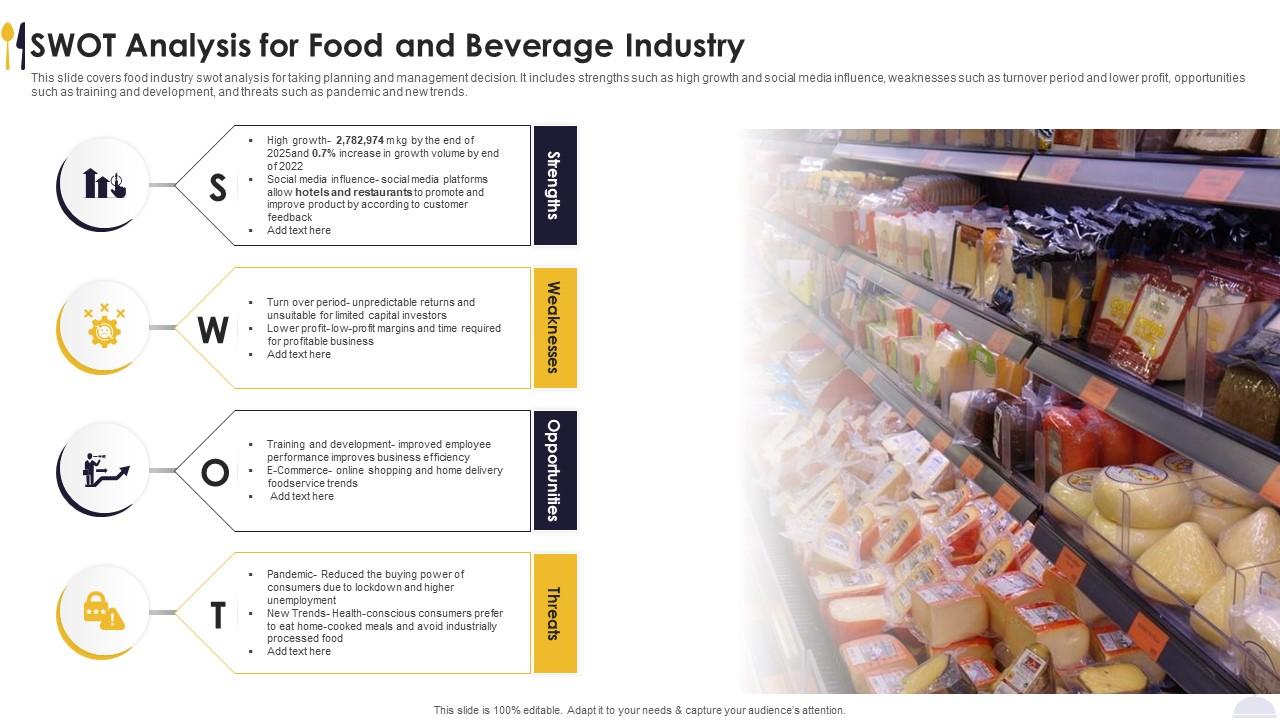
Food and beverage is a seductive and risky but highly profitable business. It requires discipline and passion to make this a success, but you must understand the ins and outs of business. This PPT Template is here to clearly delineate the Strengths, Weaknesses, Opportunities, and Threats (SWOT) analysis that one should take before taking the plunge. This slide covers the food industry SWOT analysis for planning and management decisions. It includes strengths, such as high growth and social media influence; weaknesses, such as turnover period and lower profit; opportunities, such as training and development; and threats, such as pandemics and new trends.
The template is also a godsend for people who tend to look at one aspect of a business and fall for it. In the slide, you find a detailed outlook on the entire SWOT spectrum in writing. Users will find in the slide a weakness of the domain and unpredictable returns. The strength matching this weakness is the relatively cheaper channel that social media has opened for promotion and home delivery of food.
Use this template now to get a complete, comprehensive view of the food and beverage business after a thorough SWOT analysis.
FOOD FOR THOUGHT
Jumping into the food and beverage business without a formal SWOT Analysis is akin to professional hara-kiri. A SWOT is necessary, as it clears up the entrepreneur's thoughts, warns against the pitfalls, and discusses the opportunities as well. The PPP Templates from SlideTeam are the perfect resources for carrying out this SWOT. Get these templates now!
PS Find best-in-class SWOT Analysis Matrix on Competitor Business Comparative Assessment here.
Swot Analysis For Food And Beverage Industry with all 1 slides:
FAQs for Swot Analysis For Food
So SWOT is basically four boxes: Strengths (what you're good at), Weaknesses (stuff you need to work on), Opportunities (external things that could help), and Threats (outside risks). Here's the cool part though - you don't just fill them out and call it done. Look for connections between the boxes! Match your strengths with opportunities to spot your best moves. Or see where weaknesses overlap with threats so you know what to fix first. Honestly took me forever to realize that's where the real value is. Just dump everything into the four categories first, then start connecting the dots.
Figure out what you actually do better than your competitors - not the generic "we have a great team" BS that everyone claims. Compare yourself directly to 2-3 main rivals on stuff like pricing, speed, quality. Ask your customers why they picked you instead of the other guys. That's where the good intel is. You want strengths that customers really value but competitors can't just copy overnight. I'd probably survey maybe 10-15 customers if you can - sounds like work but it's worth it. Focus on capabilities that are genuinely hard to replicate quickly.
Your customers are basically your reality check for spotting weaknesses. They catch stuff you're totally blind to - like when your checkout process is a nightmare but you think it's fine. Support tickets are goldmines for this. Also check reviews and survey responses for patterns. We get way too attached to our own work sometimes, you know? Those recurring complaints in your feedback? That's where your real problems are hiding. Don't guess what's broken when customers are literally telling you. Mine through all that feedback and you'll find the gaps that actually matter.
Okay so basically you gotta match your SWOT opportunities with what you're actually good at. Like if remote work is booming and you've got solid tech infrastructure, build something around remote collaboration. Makes sense, right? Here's the thing though - don't get distracted by every cool opportunity that pops up. Pick 2-3 that have the best timing and that you can realistically pull off. I'd honestly rather see you nail a couple things than half-ass five different projects. Set up actual deadlines and ways to measure progress for whatever you choose. Market timing matters way more than people think.
Honestly, the worst thing you can do is be super vague - like writing "need more funding" without any specifics. That's useless. Get concrete about what's actually broken or working. Don't just ask your own team either; talk to customers and partners too. I see people load up on strengths while barely mentioning real problems, which is kind of missing the point? Short punchy weaknesses hit harder than sugar-coating everything. But here's what really bugs me - most people spend hours on these things then never look at them again. Actually use your SWOT to make decisions, otherwise you're just organizing your thoughts into neat little boxes for no reason.
Yeah, SWOT totally works for nonprofits! Just flip the focus from profit to mission impact. Strengths could be your volunteer network or community trust - stuff like that. Weaknesses? Usually funding issues and capacity limits (honestly, join the club). Opportunities are things like new partnerships, grants, or populations you haven't reached yet. Threats include donor fatigue and competing orgs. Oh, and regulatory changes - those can be brutal. The main difference is you're measuring success through who you help, not revenue. Start by mapping each section to your actual mission goals first. Makes it way more relevant.
Honestly, SWOT analysis is clutch for figuring out your digital marketing game. You map out what's working - maybe your content slaps or your Instagram engagement is fire. Then face the brutal stuff: trash mobile site, SEO that's basically nonexistent. Opportunities are where it gets exciting though. New platforms, keywords nobody's targeting yet, audiences you haven't touched. Threats? Algorithm updates that'll wreck you overnight, competitors swooping in, privacy laws messing with your tracking. The cool part is connecting the dots between all four areas. That's how you spot where to actually spend your money instead of just throwing it everywhere.
At minimum, do it once a year. But quarterly makes way more sense if you're in a fast-changing industry. Time it around big stuff - before you plan strategy, after the market goes crazy, or when launching something new. So many companies just do them because "it's March again" which is totally pointless. Instead, think of your SWOT like a Google doc you actually update when real changes happen in your space or internally. Set those calendar reminders for regular check-ins. And honestly? Don't hesitate to call an emergency SWOT meeting if something major hits your industry out of nowhere.
Definitely combine SWOT with customer interviews and lean validation - that way you're working with real data instead of just guessing. Most founders (myself included tbh) are way too optimistic about strengths, so the Build-Measure-Learn cycle helps keep you honest. When you find weaknesses, use "5 Whys" to actually dig into what's causing them. Monthly mini-SWOT sessions work better than annual ones since startups change direction constantly. Oh, and validate everything with customer feedback before making big moves based on your analysis. That's saved me from some pretty dumb decisions!
Give each team member a different SWOT section to prep ahead of time - stops one person from taking over the whole thing. Try specific questions like "What do competitors always say about us?" for strengths, or "What market stuff actually scares you?" for threats. I'd time-box each part, maybe 15-20 minutes so you don't get stuck arguing forever about one area. Let people throw out crazy ideas first before you narrow things down. Sometimes the weirdest suggestions end up being gold. Oh, and definitely have someone screen-share to capture everything - you'll lose the good stuff otherwise.
PowerPoint's probably your safest bet since everyone can open it without issues. Canva has some really nice SWOT templates if you want it to look more professional. For team brainstorming, Miro's great - people can just drag sticky notes around in real-time which is oddly satisfying. Lucidchart works too. Honestly? Sometimes I just throw it in Excel when I'm being lazy. Google Slides is fine but the templates are kind of meh. Whatever you pick, definitely use colors to make the different quadrants stand out - makes a huge difference when you're presenting.
Oh man, your SWOT analysis can get totally flipped depending on where you're doing business. Like that whole hierarchical decision-making thing? Asian markets might love it because authority matters there. But your US team's probably rolling their eyes thinking it kills innovation. Risk-taking, how direct people communicate, work-life balance stuff - it all hits different across cultures. Honestly blew my mind when I first realized this. You really gotta talk to your local teams in each region instead of just assuming what works at home will work everywhere else.
Honestly, most SWOT opportunities are way too vague to actually do anything with. Like "expand market share" - okay, but how? Break those down into real steps with deadlines and figure out what resources you'll need. Pick the ones that match your strengths and what you can actually pull off right now. Don't chase stuff that's unrealistic. Make sure someone owns each opportunity too, otherwise it just sits there. The whole point is turning those random bullet points into actual projects you can track and measure.
SWOT's like having a risk radar for your business. It helps you spot threats and weak spots you'd probably miss on your own. When you map out weaknesses next to external threats, boom - you can see exactly where you're most vulnerable. Don't ignore the strengths and opportunities parts though, they're actually pretty useful for showing what you've got to work with when fighting those risks. Say you find "supply chain issues" as a threat plus "relying on one supplier" as a weakness - now you know to find backup suppliers ASAP. Build real contingency plans around your biggest risk-weakness combinations.
Pick KPIs that actually connect to what your SWOT analysis found - otherwise you're just tracking random stuff. Say your analysis showed crappy customer retention? Track those retention rates every month. Found a new market opportunity? Measure revenue from that segment. Short sentences work better than long ones, honestly. The whole point is measuring whether you're fixing weak spots, using your strengths, or jumping on opportunities. Don't get caught up in metrics that just look impressive in meetings. Check progress every quarter and pivot if things aren't improving.
-
Like always a great experience with you guys. Always there on the drop of hat to help.
-
The templates you provide are great! They have saved me tons of time and made my presentations come alive. Thank you for this awesome product. Keep up the good work!