SWOT Analysis Matrix To Perform Competitor Business Comparative Assessment

Rating:
90%
SWOT Analysis Matrix To Perform Competitor Business Comparative Assessment
Slide 1 of 9
Favourites Favourites

Try Before you Buy Download Free Sample Product

Audience Impress Your
Audience
Editable 100%
Editable
Time Save Hours
of Time
The Biggest Sale is ending soon in
0
0
:
0
0
:
0
0
Rating:
90%
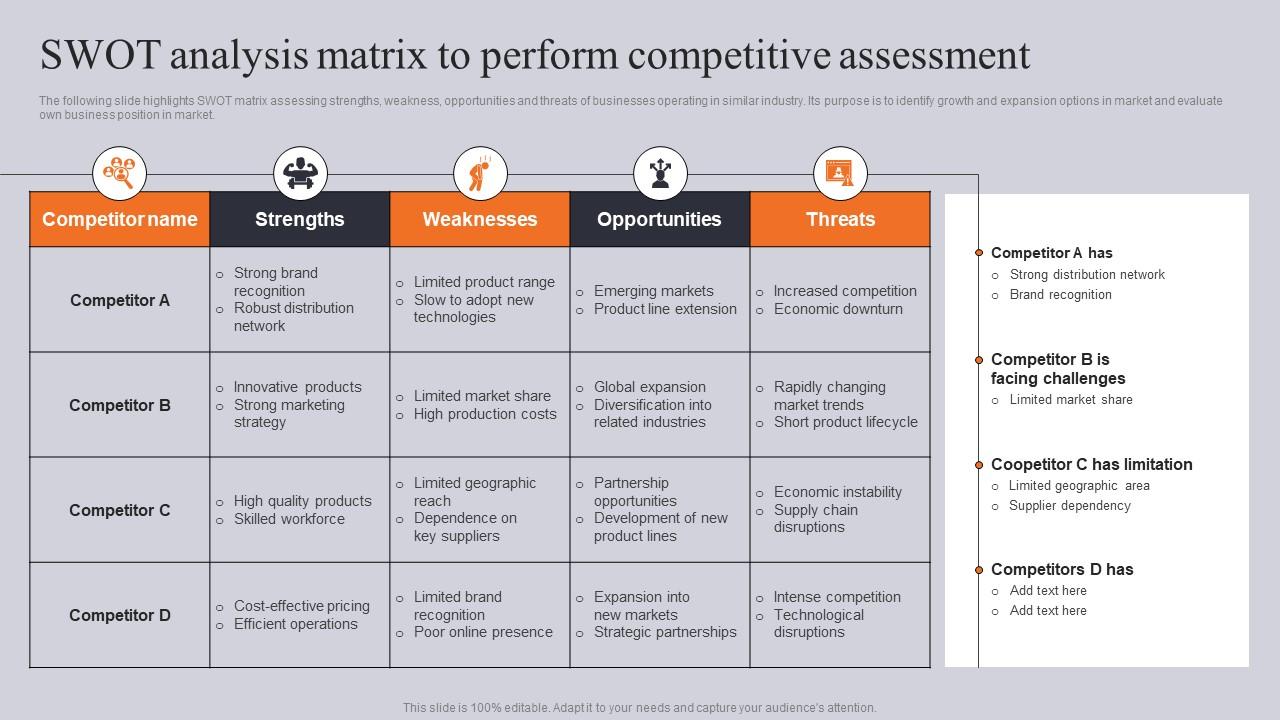
The following slide highlights SWOT matrix assessing strengths, weakness, opportunities and threats of businesses operating in similar industry. Its purpose is to identify growth and expansion options in market and evaluate own business position in market.Deliver an outstanding presentation on the topic using this SWOT Analysis Matrix To Perform Competitor Business Comparative Assessment. Dispense information and present a thorough explanation of Robust Distribution, Innovative Products, Limited Geographic using the slides given. This template can be altered and personalized to fit your needs. It is also available for immediate download. So grab it now.

FAQs for SWOT Analysis Matrix To Perform Competitor

So SWOT has four parts: Strengths (internal good stuff), Weaknesses (what sucks internally), Opportunities (external things you can grab), and Threats (outside risks). Go through each section one at a time - don't bounce around or you'll forget things. The weakness part is honestly where most teams fail because nobody wants to call out problems. After you map everything out, look for patterns between sections. Like, can your strengths help you snag those opportunities? Oh, and don't just write down obvious crap - make sure you can actually DO something with what you find.

Don't just make a list of what you're good at and call it a day. Figure out what you actually do better than your competitors, then go all-in on that stuff. Got killer customer service? Stop hiding it - make that your whole marketing angle. Strong at R&D? Use it to beat everyone else to market. Here's the thing though - you can't do everything at once or you'll spread yourself too thin. Pick maybe 2 or 3 things you're genuinely strongest at and build real action plans around them. Use those strengths to either fix your weak spots or grab new customers before your competition even knows what hit them.

Honestly, your weaknesses are basically a free strategy guide if you flip the script on them. Take whatever's broken and ask "what if we actually fixed this?" Boom - there's your roadmap. Bad online presence? That's your digital opportunity right there. Customer service sucks? Fix it before your competitors do and you're golden. Most companies probably have the same blind spots anyway, so whoever moves first wins. Just be real about what needs work, then get pumped about how much better things could be. Your weaknesses list? That's literally your to-do list for getting ahead.

Getting everyone involved in your SWOT analysis is a game changer, trust me. Different departments see totally different things - your frontline people know what customers actually complain about, while IT catches tech issues that executives don't even realize exist. It's kinda like that blind men and elephant thing, you know? Each group brings their own perspective on what's working and what's broken. Short surveys work great to start, then maybe do some focused meetings by team. The best part? People will actually pay attention to the results since they helped build them. Way better than some top-down analysis that sits on a shelf.

Don't be vague - nobody cares about "we have amazing people" fluff. Get specific or you'll waste everyone's time. Also, make sure different departments are involved, not just the C-suite echo chamber. I've watched these turn into complaint fests where people just dump on weaknesses for two hours. Set boundaries upfront about what counts as external vs internal factors (market trends are external, your broken processes aren't opportunities). Most importantly? Actually follow through afterward. Otherwise you just blew money on fancy sticky notes that'll sit in someone's drawer forever.

Do your SWOT analysis right at the beginning - seriously, don't skip this part. I've watched so many teams jump straight into planning and then get blindsided by stuff they should've seen coming. Get people from different departments involved because they'll spot things you missed. Your strengths help you go after opportunities, obviously. But the real value? Figuring out which weaknesses could totally derail you and what threats are actually worth worrying about. Once you've got everything mapped out, pick the biggest issues and build your action plans around those. It's way better than flying blind.

So basically, nonprofits do SWOT analysis differently because you're not chasing profits. Strengths usually mean things like community trust or your volunteer base - way different than typical business metrics. Funding constraints? That's probably your biggest weakness (and everyone knows it). Look for opportunities in grants, partnerships, or gaps in what your community actually needs. Policy changes can totally derail you, plus donor fatigue is real. Oh, and other nonprofits might be competing for the same funding pot. The trick is filtering everything through your mission instead of just looking at dollars.

Honestly, you can't do a decent SWOT without market research - it's like trying to navigate blindfolded. Customer feedback shows what you're actually crushing vs. what needs work. For opportunities and threats, you're basically guessing without real data on competitor moves and market trends. I learned this the hard way once! How else will you know if that "amazing opportunity" is legit or just you being optimistic? Short version: research first, then let the data guide your SWOT. Don't wing it.

So for your SWOT analysis, drop any tech you've built or can actually use into Strengths - your proprietary stuff, early platform adoption, whatever. Weaknesses are obvious gaps or outdated systems you're stuck with. Most founders I know totally bomb this part, honestly. Opportunities? Think new tech you could adopt or trends creating demand for your product. Threats are the scary ones - disruptive tech that could kill your business or competitors with way better systems. Just be real about where you actually stand tech-wise, not where you wish you were.

Make a proper template with real examples backing up each section - nobody wants to read "we have good leadership" without proof. Jot down who was there and what prompted the whole thing. Trust me, you'll forget the context in like 3 months. Set up actionable steps with owners if you can. Stick it somewhere everyone can actually find it later - shared drives work fine. The biggest thing though? Pick a date to revisit this stuff. Markets shift fast and your SWOT gets stale quick. Half the teams I know do this exercise once then never look at it again, which is basically pointless.

Okay so when your industry gets flipped upside down, pull out that SWOT analysis. Use your strengths to jump on whatever new opportunities pop up from the chaos. Figure out which weaknesses are gonna bite you hardest with all these changes happening. Most companies just freak out instead of thinking strategically - which honestly works in your favor. Look at your threats to see what's coming down the pipeline. The opportunities section? That's where you'll spot places others are struggling but you might actually do well. Don't just do this once though. Keep updating it as things change because disruption doesn't stop.

Do quarterly SWOT checks and split up who watches what - marketing tracks competitors, ops handles internal stuff. Honestly, just build it into your regular meetings or people will totally forget about it. Have departments flag big changes when they happen instead of waiting. Oh, and bring in outside voices sometimes - customers or industry people who'll catch things you're blind to. We did this at my last company and it actually worked way better than those painful annual strategy sessions. Make it routine, not something you scramble through once a year when the board wants an update.

Honestly, you'll get way better insights with people from different departments. Marketing spots brand opportunities that finance totally misses. Meanwhile, finance sees cash flow risks that would fly right over marketing's head. Sales knows what customers actually complain about - stuff product development never hears. It's kinda wild how each team has their own blind spots. When you mix these perspectives, they challenge each other's assumptions and call out wishful thinking. I'd grab reps from 3-4 different areas minimum. The overlap between their viewpoints is where you'll find the real gold.

Pick metrics that actually connect to your SWOT analysis. Track market share or customer retention for your strengths. Measure how you're fixing weak spots. New revenue streams show if you're hitting opportunities - that stuff's pretty straightforward. Most companies totally ignore the threats section though, which is dumb because early warning signs matter. Don't go crazy with data either. Just grab 2-3 solid KPIs per strategy and stick with what you can realistically track. Your current systems have to handle it or you'll just stress yourself out.

So here's the thing - what looks like a strength to you might actually be a red flag somewhere else. Take your company's quick innovation pace. In Silicon Valley? Total win. But try that same speed in a conservative market and suddenly you look reckless and unstable. Environmental stuff works the same way. You're crushing it with manufacturing efficiency until new regulations drop and boom - now you're scrambling to stay compliant. Honestly, you've gotta look at your SWOT from multiple angles, not just your own bubble. Different cultures and markets will see your capabilities completely differently than you do.

Ratings and Reviews

90% of 100
Review Form
Write a review
Most Relevant Reviews
  1. 100%

    by Don Hansen

    Spacious slides, just right to include text.  SlideTeam has also helped us focus on the most important points that need to be highlighted for our clients.
  2. 80%

    by Cruz Hayes

    Topic best represented with attractive design.

2 Item(s)

per page: