

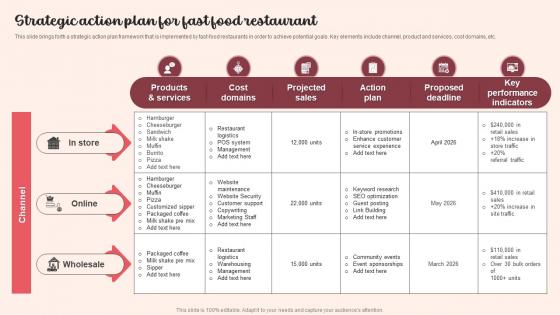
Strategic Action Plan For Fast Food Restaurant




Try Before you Buy Download Free Sample Product
 Impress Your
 Audience
 100%
100% Editable
 Save Hours
 of Time


This slide brings forth a strategic action plan framework that is implemented by fast food restaurants in order to achieve potential goals. Key elements include channel, product and services, cost domains, etc.
People who downloaded this PowerPoint presentation also viewed the following :
Strategic Action Plan For Fast Food Restaurant with all 6 slides:
Use our Strategic Action Plan For Fast Food Restaurant to effectively help you save your valuable time. They are readymade to fit into any presentation structure.





FAQs for Strategic Action Plan For
Okay so you'll want clear vision/mission stuff first. Then do that SWOT analysis thing - internal strengths/weaknesses, external opportunities/threats. Set specific goals you can actually measure. Build concrete action plans with real deadlines, not just "by Q3" nonsense. But honestly? Getting leadership buy-in is probably the most crucial part. I've watched so many gorgeous strategic plans just sit there because executives weren't truly committed. Build in review cycles too since everything changes constantly. The sweet spot is being ambitious enough that people get excited but realistic enough they don't roll their eyes at you.
Break your big goals into quarterly chunks, then monthly targets each team can actually hit. During team meetings, managers should constantly tie daily work back to those bigger objectives - otherwise your strategy just becomes another forgotten slideshow. Weekly check-ins are crucial for staying on track. Simple dashboards work way better than fancy ones nobody understands. Train your team leads to keep asking "how does this move us toward our main goal?" Honestly, most strategies fail because people lose sight of how their day-to-day connects to the vision. Don't let that happen to you.
You definitely need stakeholder input - can't plan in a bubble. They'll tell you what's actually doable and what roadblocks you're gonna hit. People are way more invested when they help create the plan vs. just getting it dropped on their desk. Bring them in early, not just for final approval (learned that one the hard way). Different departments will give you totally different perspectives too. Honestly, the finance team always sees stuff the marketing folks miss. Get voices from various levels - their insights will make your whole strategy way more solid and realistic.
Honestly, SWOT is like getting a reality check before making any big moves. You're mapping out what you're actually good at, what sucks, and what's coming your way - both good and bad. I know it sounds basic, but I've watched so many teams skip this and then wonder why their plans fell apart. The cool part is when you start connecting the dots - like matching your best skills with new opportunities. That's where the magic happens. Oh, and definitely do it as a group if you can. Different people see different things, plus everyone feels more bought in when they helped create it.
Definitely track both financial and operational stuff. Revenue, profit margins, ROI - the usual suspects. But here's the thing - those numbers are always playing catch-up to what's really going down. Customer satisfaction and employee engagement? Those tell you way earlier if things are working. Also watch market share, how efficient your processes are getting, whether you're actually hitting milestones. Oh, and I'd throw in some forward-looking metrics too like new partnerships or innovation pipeline strength. Keep it to maybe 5-7 metrics tops and check quarterly. Just make sure they actually connect to your strategic goals - otherwise you're just collecting random data.
Dude, strategic planning isn't that stiff annual meeting anymore. AI and analytics let you spot trends and test scenarios in real-time instead of just winging it with old reports. The data overload is real though - sometimes I feel like I'm drowning in spreadsheets. But decent tools help you filter out the garbage. Cloud platforms are game-changers too. Your whole team can actually work together instead of emailing PowerPoints back and forth like it's 2005. Pick one process that's annoying you right now and see what tech could fix it.
Honestly, the worst thing you can do is set vague goals that sound fancy but mean nothing when you actually try to measure them. Also avoid planning every tiny detail years out - waste of time. Too many cooks in the kitchen will kill your strategy, trust me on this one. Pick the right people, not ALL the people. Short planning cycles work way better than these massive year-long processes. And seriously, don't just write this beautiful plan then shove it in a drawer somewhere. Set up quarterly check-ins or you'll never actually follow through.
Honestly, you gotta bake flexibility right into your planning from day one. Check in quarterly - don't do that annual planning nonsense where everything's locked in stone. Market moves way too fast for that crap. Build out a few different scenarios so you're not caught off guard when things shift. Oh, and set up automatic triggers that force you to review stuff - like when competitors make big moves or your numbers start looking weird. Performance metrics falling outside your range? Time to reassess. Makes the whole adaptation thing systematic instead of you just reacting to whatever fires pop up.
Honestly, mix up your channels - don't rely on just one thing. Leadership cascades work well where execs brief their teams, then those managers do the same down the line. Town halls are solid for big picture stuff. Make some visual aids too because let's be real, nobody wants to read a 20-page strategy document. I'd probably skim it myself. Do regular check-ins and Q&As so people can ask questions before they get totally lost. Repetition is your friend here. Find 2-3 methods that actually fit how your company operates and just keep reinforcing the message.
Honestly, cultural stuff can completely mess up your strategic planning if you ignore it. Different places have totally different vibes about risk-taking, how decisions get made, timelines - all that matters. What crushes it in Silicon Valley could be a disaster in Japan or Germany, you know? Some cultures want lightning-fast choices while others need like months of team consensus. My advice? Get local teams involved super early in the process. Learn their business culture first - don't just assume your home strategy works everywhere. I've seen companies try the copy-paste approach and it never ends well.
Okay so scenario planning is basically making multiple game plans instead of just crossing your fingers and hoping for the best. You map out different "what if" situations - like worst case, best case, and some realistic stuff in between. Honestly sounds over-the-top until something weird actually hits your business. The cool part though? It makes you question your assumptions and spot early warning signs for each scenario. That way you're not totally scrambling when things shift - you can actually pivot quick instead of playing catch-up with everyone else.
Honestly, build flexibility right into how you plan things from day one. I'd do quarterly check-ins to review priorities and pivot when needed - we've all made a plan then totally ignored it, right? Try shorter cycles too, like 12-18 months instead of those crazy 5-year plans nobody follows. Focus on outcomes rather than getting super specific about methods. That way your team can actually adapt. The big thing though? Make sure changing direction feels smart, not like you failed. Oh, and just schedule that first quarterly review already - might as well start somewhere.
Honestly, leadership makes or breaks the whole thing. You've probably seen those strategic plans that end up forgotten in some drawer - that's what happens when nobody's actually driving the vision. Someone has to get everyone on the same page and keep them there. The tough calls about resources? That's on leadership. Accountability when things go sideways? Also leadership. They're basically translating all your strategic thinking into stuff that actually gets done. Oh, and make sure they're genuinely excited about the plan first - fake buy-in is worse than no buy-in.
Look, strategic planning templates are total lifesavers when you're staring at a blank document at 9pm. They give you the whole structure - vision, goals, SWOT analysis, all that stuff - so you can jump straight into the actual thinking part. No more wondering what comes next or forgetting something obvious. Your team won't waste time figuring out format either. I've seen people spin their wheels for hours just on structure alone, which is honestly ridiculous. Find one that matches your industry and tweak it. Way better than starting from scratch.
Mix people from different teams and levels into your planning committees - that cross-pollination thing really works. Town halls are great for getting broader input, plus anonymous surveys catch the stuff people won't say out loud. Strategy workshops with small groups tackling specific questions can be gold too. But here's the thing - if you don't actually use their ideas in the final plan, you're basically training them to ignore you next time. I've watched companies blow this so many times. Leadership has to visibly respond to what comes up, not just nod and file it away.
-
Helpful product design for delivering presentation.
-
Such amazing slides with easy editable options. A perfect time-saver.