


Strategic Group Example Map For Fast Food Chains Strategic Planning




Try Before you Buy Download Free Sample Product
 Impress Your
 Audience
 100%
100% Editable
 Save Hours
 of Time


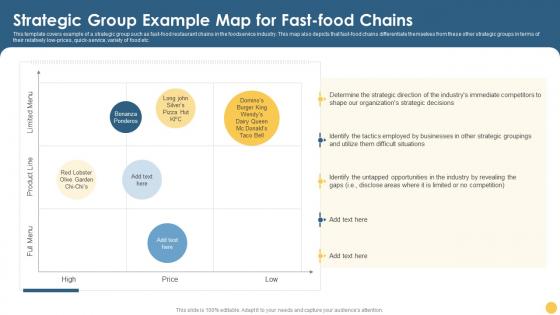
This template covers example of a strategic group such as fast food restaurant chains in the foodservice industry. This map also depicts that fast-food chains differentiate themselves from these other strategic groups in terms of their relatively low prices, quick-service, variety of food etc.
People who downloaded this PowerPoint presentation also viewed the following :
Strategic Group Example Map For Fast Food Chains Strategic Planning with all 6 slides:
Use our Strategic Group Example Map For Fast Food Chains Strategic Planning to effectively help you save your valuable time. They are readymade to fit into any presentation structure.





FAQs for Strategic Group Example Map For Fast Food
So a strategic group map is just a chart where you plot competitors using two key factors - like price vs quality or market reach vs product range. Pretty straightforward stuff. What makes it useful is you'll see which companies cluster together with similar strategies instead of just having a random competitor list. Honestly, the best part is spotting those empty spaces where nobody's competing yet - that's where opportunities hide. Or you might realize you're crammed into an overcrowded area with everyone else. Just pick your two most important competitive factors and start plotting. Works better than you'd think.
Pick two dimensions that actually separate competitors in your space - could be price vs quality, or maybe geographic reach vs how many products you offer. The hard part? Being brutally honest about where you actually stack up (we all like to think we're fancier than we are lol). Figure out what really makes companies different, not just the obvious stuff everyone mentions. Map yourself against the competition on both axes. You'll quickly see who you're really going head-to-head with. Plus you might spot some crowded areas to steer clear of or find gaps worth exploring.
Pick dimensions where companies actually made different strategic bets - like price positioning, geographic reach, or how broad their product lines are. Distribution channels work too. Don't go with something generic like "quality" because literally everyone says they're high quality lol. You want the stuff that creates real separation on your map. I'd start by brainstorming how all your competitors differ, then figure out which two variables spread them apart the most clearly. The best maps show genuine strategic choices companies made, not just marketing fluff they all claim.
So here's the thing - strategic group maps basically show you where all your competitors are hanging out. Plot your top 10-15 competitors on two key factors that matter in your industry. The magic happens when you spot the empty spaces. Like, maybe everyone's either super expensive with great service OR cheap and basic, but nobody's doing mid-price with premium features. Those gaps? That's where you might want to jump in. Established companies usually can't pivot easily from where they're already positioned, so you've got a real shot at those overlooked sweet spots. Pretty neat trick, honestly.
Here's the thing - you've gotta figure out your customer segments before you even think about mapping competitors. Different customer groups care about totally different stuff (price vs fancy features, local vs global reach, whatever). If you skip this step, you'll end up plotting random factors that don't actually matter for competition. I mean, customers are the ones picking winners anyway, right? So start there - identify your main customer segments first. Then use what THEY value most as your dimensions for grouping competitors. Makes the whole strategic group thing way more useful.
Think of strategic group maps as showing where all your competitors hang out - like clusters based on price vs quality or how specialized they are. Honestly, most companies don't realize they're crammed into the same crowded space with everyone else. The cool part? You can spot empty areas where nobody's competing yet. Plus you'll get a feel for how rivals might react to your moves since companies in similar positions usually do the same thing. I'd map out your top 5-7 competitors first. Look for those white spaces - that's where opportunities hide.
Hey! So strategic group maps are pretty useful but they've got some real blind spots. Companies get squeezed into just two dimensions when there's obviously way more going on. Those clean group boundaries? Total myth - firms jump around constantly and you'll miss it if you're not careful. Plus threats from outside your industry scope can blindside you completely (happened to Blockbuster, right?). The maps make everything look static when markets are anything but. Honestly, treat them like a rough sketch to get started, then dig way deeper from there.
Start by finding strategic dimensions that work across all your markets - yeah, it gets messy but worth doing. Map each region separately first, then look for the patterns. Which strategic groups show up everywhere vs. just locally? I'd create one master view using consistent criteria so you can actually compare things. The real value comes from seeing where strategies work universally and where you need different approaches for each market. Honestly, the regional variations often tell you more than the similarities. You'll spot which positions travel well and which don't.
Honestly? Just use whatever you've already got. Excel or Google Sheets are perfect for plotting competitors on basic X/Y charts - way easier than you'd think. PowerPoint works too if you're decent with shapes. Lucidchart and Miro have prettier templates if you want something that looks more polished, but I've seen brilliant strategic maps that looked like garbage made in Excel. The visual doesn't matter as much as picking smart dimensions to compare. Start simple first - you can always get fancy software later once you figure out what actually works for your analysis. Canva's another option if design matters to your boss or whatever.
So basically, strategic group maps plot companies based on things like pricing, distribution, product range - whatever matters most in that industry. You can see who's fighting directly against each other versus who found their own sweet spot. Southwest nailed this early on with cheap flights and no-frills service while everyone else was doing the hub-and-spoke thing. Companies sitting alone in those empty spaces usually have it made. Look for the gaps where you could move without getting into a bloody price war - that's where the money is.
So mobility barriers are what trap companies in their strategic groups - like the costs and hassles of jumping between them. A budget retailer can't just suddenly go luxury without dumping tons of cash into branding, new skills, different distribution. Takes forever. That's why companies stay clustered together for years (honestly, some never even try). Higher barriers mean those group boundaries stick around longer. When you're doing your mapping, figure out what's actually blocking movement between groups. Helps you guess competitive moves and spot who might realistically make the jump.
So basically you can see where there's room in the market and figure out how intense the competition is. Look at your direct competitors - they're all going after the same customers with similar prices and strategies. Sometimes it gets crazy crowded! But you'll also find those sweet spots where nobody's competing yet. The real trick is understanding mobility barriers - what keeps companies trapped in certain groups and what it'd take to jump between them. Oh, and you'll see what skills you actually need to keep up. Then decide: dominate where you are or make the leap somewhere else entirely.
Map your industry every 6-12 months - things shift fast these days. Netflix is a perfect example of how companies can jump between strategic groups and mess up everyone else's plans. When disruption hits, traditional boundaries get messy real quick. New players often bring totally different strategic dimensions that didn't matter before, like digital adoption or platform stuff. I'd honestly focus on spotting those early warning signs before your company gets stuck playing catch-up. The maps help you see where you might need to pivot.
Netflix nailed this back in the early 2000s - they mapped convenience vs. cost and spotted the gap that Blockbuster totally missed with mail-delivery rentals. Southwest did something similar, finding that sweet spot between full-service airlines and buses. Tesla's another good one, plotting luxury against sustainability to carve out the premium electric space. Banks do this all the time now, honestly it's pretty standard. Try it with your industry - pick your two biggest competitive factors and map them out. You'll probably spot some white spaces where you could position yourself differently. Works better than you'd think.
Strategic group maps are way more visual than regular market analysis - you're literally plotting competitors on key things like price vs quality or service vs reach. Traditional tools just give you spreadsheets of market share data (honestly pretty boring stuff). But these maps? You can actually see the competitive landscape laid out. Shows you who's really fighting for the same customers and where there might be gaps. It's like getting a bird's eye view instead of reading battle reports. Way easier to spot if there's an opening where your company could jump in and do something different.
-
The Designed Graphic are very professional and classic.
-
The customer care of SlideTeam is very responsive. I was having a payment issue and they fixed it for me in no time.