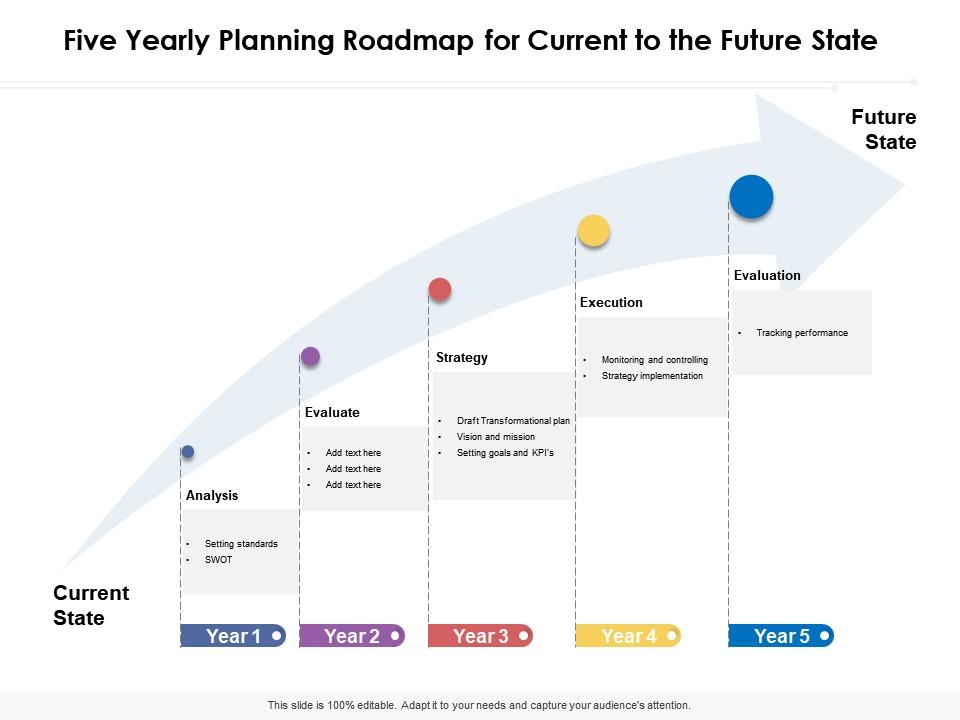
Five yearly planning roadmap for current to the future state

Five yearly planning roadmap for current to the future state
Slide 1 of 2

or

Favourites Favourites

Try Before you Buy Download Free Sample Product

Audience Impress Your
Audience
Editable 100%
Editable
Time Save Hours
of Time
The Biggest Sale is ending soon in
0
0
:
0
0
:
0
0
Presenting Five Yearly Planning Roadmap For Current To The Future State PowerPoint slide which is percent editable. You can change the color, font size, font type, and shapes of this PPT layout according to your needs. This PPT template is compatible with Google Slides and is available in both 4,3 and 16,9 aspect ratios. This ready to use PowerPoint presentation can be downloaded in various formats like PDF, JPG, and PNG.

FAQs for Five yearly planning roadmap for current to

Honestly, start with the obvious stuff - revenue growth, profit margins, cash flow. But customer acquisition costs and lifetime value are where you really see if growth is sustainable or just burning money. Market share matters big time if you're in a competitive space. Don't sleep on employee metrics either - retention and productivity drive everything else (learned this the hard way). Pick maybe 5-7 core metrics to review quarterly. More than that and you'll get overwhelmed trying to track everything instead of focusing on what actually matters for your business.

Honestly, I think about it like building a ladder - your big 5-year vision breaks into yearly chunks, then quarterly sprints. Each small win should actually connect to the bigger picture (not just random busy work that feels productive but goes nowhere). Every few months, I do a quick check: "does what I'm doing right now still point toward where I want to be?" Sometimes you'll pivot tactics while keeping the same end goal. Start simple - just map your current quarterly stuff against your main priorities and see what's missing. Works way better than I expected.

Honestly, market analysis is what keeps your five-year plan grounded in reality instead of wishful thinking. Look at where your industry's headed and what competitors are up to. Customer needs change fast - what works now might be dead in three years. I've watched so many good teams crash because they built strategies on old assumptions (painful to see). You really need both current conditions AND emerging trends that could mess with your space. Oh, and grab data on your top 3-5 competitors plus industry growth numbers. Trust me, it's way better than making expensive guesses.

SWOT analysis is your best friend here - do that first along with some scenario planning. Look at market volatility, competitive threats, regulatory stuff, and where your internal capabilities might be lacking. Those random worries that pop up at 2am? Write those down too, they're usually onto something. Map out your "what if" scenarios and revisit them every quarter. Get other departments involved because they'll catch things you completely miss. Build flexibility into whatever roadmap you create - things will definitely go sideways at some point, and you'll need room to pivot.

Honestly, the biggest mistake is waiting too long to loop people in. Map out everyone who'll be impacted - your team, customers, partners, whoever - then create touchpoints throughout the whole process. Don't just do one massive presentation at the end. I've watched so many plans crash because people felt completely blindsided. Nobody likes decisions being made without their input, you know? Regular check-ins beat information dumps every time. Actually listen to what they're saying and show how their feedback shaped things. Oh, and document everything! Share updates constantly. Treat them like partners, not people you need to sell to later.

Dude, forget those awful PowerPoint roadmaps that nobody ever updates. Tools like Asana or Monday let you actually track progress week by week instead of pretending everything's fine until quarterly reviews. Break your big goals into smaller chunks, set up dashboards so you catch problems early. When stuff inevitably changes (and it always does), you can pivot without rebuilding everything from scratch. Collaboration tools keep everyone on the same page too - which honestly saves so much drama. Just pick one platform and make your team update it weekly. Game changer.

Honestly, just chunk that five-year thing into quarters and actually stick to tracking them. You'll want hard numbers like revenue and users, but also those fuzzy goals that are harder to measure. Monthly check-ins work great - I literally just call mine "what worked vs. what didn't" sessions. Keeps you from lying to yourself about progress. Oh, and plan to potentially pivot at years 1, 2, and 3. That way changing direction feels strategic, not like you're screwing up. A basic spreadsheet beats some fancy system you'll never update. Consistency wins every time.

Dude, you've gotta bake flexibility right into that five-year plan from day one. Do quarterly check-ins and be ready to pivot annually - none of that "set it and forget it" nonsense. The companies that crash hardest? They're the ones obsessed with sticking to their original plan no matter what changes around them. Set up milestone checkpoints where you actually look at what's happening in the market and with customers. Oh, and do scenario planning so you're not scrambling when stuff shifts. My take: keep the big vision solid but break everything else into shorter chunks - like 18-month sprints. Way more manageable.

Okay so here's the thing - stuff *always* costs more than you think it will, especially over 5 years. Start with what you're spending now, then bump everything up 3-5% each year for inflation. Factor in salary increases for your team and when you'll need to replace equipment. Oh, and random big expenses that'll pop up because they always do. Be conservative with how much money you think you'll make, but realistic about costs going up. Honestly? Add like 20% on top of everything as a buffer, then check your numbers every year.

Honestly, your mission and vision should be like your north star for that five-year plan. Break your vision down into actual measurable stuff you want to hit, then work backwards from there. Set those annual milestones - I can't tell you how many teams I've seen just wing it and end up all over the place. Every big initiative needs to connect back to your core mission somehow. Oh, and do quarterly check-ins because priorities always shift. You'll want to make sure everything's still pointing in the right direction. It's way easier to course-correct early than realize you've been off track for months.

Honestly, most five-year plans fail because people set these crazy ambitious goals then panic when things don't go exactly as planned. I've done it too - you get excited in planning mode and forget about actual constraints. Build in checkpoints every 6-12 months where you can adjust course without it feeling like defeat. Think of your plan as more of a direction than rigid rules. Have backup scenarios ready because something will definitely go sideways. Oh, and get brutally honest feedback from people who aren't afraid to tell you your timeline is nuts. Way better than discovering it two years in.

Oh absolutely get your employees involved - they're the ones actually dealing with customers and seeing what's broken day-to-day. Leadership misses so much from up there. Your frontline people will catch unrealistic timelines and dumb ideas before you waste months on them. Honestly, people just care more about plans they helped build vs. something dumped on them from above. I'd do focus groups across departments, maybe some surveys too. Just make sure you actually use their input though - nobody likes feeling ignored after giving feedback.

Oh man, the worst thing you can do is be stupidly optimistic about what's actually possible. Like thinking you'll suddenly have twice the budget or perfect market conditions forever. Also, don't make your vision either super vague ("we'll dominate!") or insanely detailed that it's obsolete in six months. Here's what really gets me though - when leadership creates this whole plan without talking to the people who actually have to DO the work. Then you get this gorgeous strategy deck that just collects dust. Be brutally honest about what you can handle right now and leave room for when things inevitably go sideways.

Dude, getting other departments involved in your five-year planning is a game changer. Sales and operations will spot issues you'd never see coming from up top. Finance too, obviously. The best part? People actually buy into the plan when they help create it instead of just receiving some random PDF later. I learned this the hard way at my last job - we'd spend weeks on these beautiful strategic documents that nobody understood or cared about. Now I do quarterly check-ins with department heads. Takes more time upfront but your forecasts become so much more realistic. Different teams see opportunities and risks that leadership completely misses.

Set both hard numbers and softer metrics that actually tie back to your goals. Revenue targets, market share, customer acquisition - the usual suspects you can track with real data. But honestly, don't sleep on the qualitative stuff either. Brand recognition, how happy your team is, where you stand vs competitors. I've watched companies get so hung up on spreadsheets they miss what's really happening. Make your benchmarks specific with actual deadlines. Check in quarterly instead of waiting years to figure out you're headed in the wrong direction - trust me on that one.

Ratings and Reviews

0% of 100
Review Form
Write a review
Most Relevant Reviews

No Reviews