

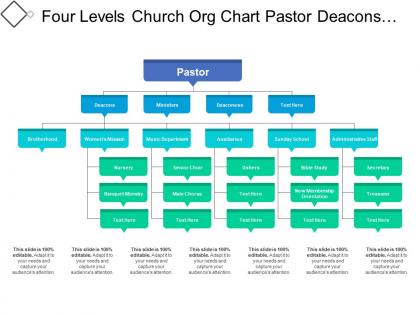
Four levels church org chart pastor deacons and ministers




Try Before you Buy Download Free Sample Product
 Impress Your
 Audience
 100%
100% Editable
 Save Hours
 of Time


Encourage better behavior with our Four Levels Church Org Chart Pastor Deacons And Ministers. Get everyone to act correctly.
People who downloaded this PowerPoint presentation also viewed the following :
Four levels church org chart pastor deacons and ministers with all 5 slides:
Forget frustrations with our Four Levels Church Org Chart Pastor Deacons And Ministers. Your dreams will come alive again.




FAQs for Four levels church org chart pastor
Most churches break down into a few key areas - you've got your governance piece (board or elders), then pastoral staff, admin people, and ministry teams. Financial oversight is huge too because honestly, church money drama is real. Worship teams, kids ministry, outreach - that stuff's pretty standard. Size matters a ton though. Small places? One person does like five jobs. Bigger churches get all departmentalized with fancy org charts. I'd probably start by sketching out what you already have going on, then see where things are either missing or weirdly overlapping.
Honestly, it's all about how many people you're trying to wrangle. Under 150? Keep it simple - pastor plus maybe a board and you're good. Once you hit that 150-800 range though, you'll need department heads and ministry coordinators because one person juggling everything is a recipe for burnout. Big churches over 800 basically turn into mini-corporations with executive pastors and tons of specialized departments. More people = more chaos without proper structure. My advice? Look at where you are now and plan just one step ahead. Don't go crazy with org charts too early - I've seen that backfire.
So basically the board handles all the big decisions - budgets, hiring, major stuff like that. Committees are more focused on specific things like worship planning or building maintenance. Honestly, it's pretty similar to any other organization except there's usually prayer before meetings lol. Your committee will do most of the actual work and research, then make recommendations to the board for final approval. Oh and don't think these are just show-up-and-vote positions - you'll actually need to contribute ideas and time. Monthly meetings are pretty standard. It's a good way to get more involved if you're looking for that!
Start with clear roles so nobody's stepping on toes. Weekly check-ins are clutch - keeps everyone looped in. Oh, and designate someone to handle the back-and-forth with church leadership, otherwise you'll get that telephone game thing happening. Shared calendars help too, nothing fancy needed. The thing is, when everyone actually remembers you're working toward the same goal, collaboration just clicks better. I learned this the hard way at my old place. Short version: define lanes, communicate regularly, and don't overthink the tools part.
Don't wait until your pastor drops the "I'm leaving" bomb to start thinking about this. Begin mentoring potential leaders from day one - give them real responsibilities and invest in their education. Most churches totally blow this by scrambling after the fact instead of planning ahead. Write down your succession process so everyone knows the game plan when it happens. Interim leadership can buy you breathing room too. Honestly, the churches that handle transitions well? They're the ones who started preparing years earlier, not months.
Honestly, you can't let one person run everything - that's asking for trouble. Multiple approvals for big spending decisions, board oversight for leadership, regular performance reviews. Too many churches fall into that "I'm called by God so don't question me" trap, which is ridiculous. Financial stuff needs to be transparent, key positions should have term limits, and you definitely want a grievance process set up beforehand. Oh, and don't wait until drama hits to create these systems - that's way too late. Build the guardrails now while everyone's still getting along.
Job descriptions are a lifesaver - they stop that whole "I thought you were doing it" mess that churches are famous for. Plus your youth pastor won't accidentally hijack the communications director's social media duties (awkward). They're also your friend during hiring because you'll actually know what you want instead of just winging it. Performance reviews become way less painful too. Oh, and there's the legal protection thing for both sides. Honestly, just start by listing what everyone's doing right now, then figure out what's falling through the cracks. You'll thank yourself later.
Here's what worked for us - get someone to actually own volunteer management, ideally reporting to pastoral staff so they have real authority. Otherwise you'll have people wandering around with zero direction (been there, it's chaos). Break things into specific ministry teams with their own leaders for recruiting and scheduling. The coordinator should still track everything centrally though - who's where, who needs a break, skills, all that stuff. Oh, and definitely start by figuring out who you currently have and what gaps exist. Makes everything way easier.
Start with how big your church is - that's gonna determine everything. Your denomination might have rules you can't get around, so check those first. Group your ministries logically and put department heads over related stuff. Nobody should manage more than 7-8 people directly (learned that the hard way). Volunteer coordination is huge since churches aren't like regular businesses. Build in some flexibility for growth. You don't want to redo this whole thing in two years when you've expanded. Honestly, just sketch it based on how work actually flows, not fancy titles that sound important.
Mix up your teams instead of keeping everyone in separate boxes - cross-functional groups work way better than rigid departments. Get feedback from your community regularly, like surveys or those town hall things. Don't let all decisions get stuck with one person at the top because honestly, who has time to wait through three meetings just to start helping people? Spread the decision-making around. Oh, and try seasonal roles that can change when your needs do - way more practical. Pick one area where you're being too strict right now and just... loosen up a bit. Your structure should actually help your mission, not slow it down.
Honestly, good communication can make or break your whole church setup. I've watched places fall apart because nobody talks to each other properly - staff gets confused, volunteers feel lost, and suddenly your ministries are all doing their own thing. You really need those regular check-ins between different leadership levels, plus systems that actually keep people in the loop when things change. Oh, and transparent decision-making helps too (people hate feeling left out). Start by figuring out where your communication breaks down right now. That's usually where the drama starts anyway.
Honestly, I'd start by asking your staff and volunteers how things are actually working. Are decisions taking forever? Does everyone know who handles what? Survey them about communication and decision-making speed. Check if some people are drowning while others have nothing to do - that's usually when you know structure is broken. Your growth might be the issue too. What worked at 100 members could be strangling you at 300. Get your department heads together for a feedback session. Focus on the biggest pain points first, then work from there.
Here's the thing - small churches are basically like big families where everyone's doing three different jobs. Your pastor's probably also the guy who fixes the broken toilet, you know? The real problem isn't that structure is bad, it's just that nobody wants to mess with what's been working. Plus finding someone who actually gets bylaws and legal stuff? Good luck with that. Most people think adding formal roles will ruin that cozy family vibe they love. Honestly though, you don't need to go crazy with it. Start with the bare minimum legally required stuff, write down who does what, then add more as you grow. Baby steps work better than trying to reorganize everything overnight.
Honestly, church management software is a game changer for member databases and volunteer scheduling. Automated giving platforms will save you so much time too. We used to do manual attendance tracking at my old church - what a nightmare that was! Financial software makes budgeting way less painful, and digital communication tools help departments actually talk to each other. Oh, and don't try to implement everything at once. Pick whatever's driving you crazy right now and start there. You can always add more later.
Honestly, shared leadership is way more effective than the old top-down stuff. Look at who's actually making decisions right now - probably not super diverse, right? Advisory councils that rotate leadership have been game-changers for churches I know. Multiple voices need real influence, not just token spots on committees. Short sentences work. Create actual pathways for underrepresented folks to step into leadership roles. Don't just hope it'll happen naturally because it won't. The systematic approach might feel awkward at first, but formal structures where different perspectives actually shape policy? That's where you'll see transformation happen.
No Reviews