


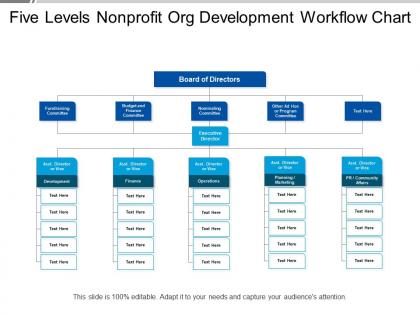
Five levels nonprofit org development workflow chart




Try Before you Buy Download Free Sample Product
 Impress Your
 Audience
 100%
100% Editable
 Save Hours
 of Time


Fashion an ending better than the beginning with our Five Levels Nonprofit Org Development Workflow Chart. Bring about a befitting culmination.
People who downloaded this PowerPoint presentation also viewed the following :
Five levels nonprofit org development workflow chart with all 5 slides:
Impress doubtful colleagues with our Five Levels Nonprofit Org Development Workflow Chart. They will accept that your ideas have a firm foundation.



FAQs for Five levels nonprofit org
Key components include strategic planning, board governance, staff development, fundraising diversification, and stakeholder engagement systems. These elements work together by establishing clear mission alignment, building organizational capacity, and creating sustainable revenue streams, with many nonprofits finding that strategic integration of these components ultimately delivers greater community impact and long-term operational stability.
Nonprofits can assess organizational structure through stakeholder feedback surveys, workflow analysis, performance metrics review, financial efficiency ratios, and mission alignment audits. These evaluation methods help organizations identify communication bottlenecks, resource allocation gaps, and operational redundancies, with many nonprofits finding that strategic restructuring enhances program delivery and ultimately maximizes their social impact.
Strategic planning serves as the foundation for nonprofit organizational development by establishing clear mission alignment, resource allocation priorities, stakeholder engagement strategies, and measurable impact goals. Through comprehensive strategic frameworks, nonprofits streamline operations, enhance donor relationships, and maximize program effectiveness, with many organizations finding that structured planning ultimately delivers greater community impact and long-term sustainability in an increasingly competitive funding landscape.
Nonprofits can foster continuous improvement through regular feedback sessions, skills development programs, performance metrics tracking, collaborative goal-setting, and recognition systems that celebrate innovation. By implementing structured review processes, cross-training opportunities, and open communication channels, organizations enhance team engagement, operational efficiency, and mission impact, with many nonprofits finding that empowered teams deliver significantly better community outcomes.
Best practices for nonprofit governance include establishing clear board roles and responsibilities, implementing transparent financial oversight, developing strategic planning processes, ensuring diverse board composition, and maintaining regular performance evaluations. These governance frameworks enhance organizational accountability, improve decision-making efficiency, and strengthen donor confidence, with many nonprofits finding that well-structured boards deliver better program outcomes and sustainable growth.
Nonprofits can measure organizational development through key performance indicators, staff retention rates, program effectiveness metrics, financial sustainability ratios, and stakeholder feedback assessments. These evaluation methods enable organizations to track capacity building progress, streamline resource allocation, and enhance service delivery, with many nonprofits finding that systematic measurement ultimately delivers improved donor confidence and greater community impact.
Effective engagement techniques include collaborative planning sessions, skills-based volunteer committees, cross-functional development teams, feedback surveys, and mentorship programs. These approaches streamline organizational growth by incorporating diverse perspectives, enhancing staff ownership, and leveraging volunteer expertise, with many nonprofits finding that inclusive development processes ultimately deliver stronger community impact and improved operational efficiency.
Stakeholder engagement significantly influences nonprofit organizational development by enhancing strategic planning, improving resource allocation, and strengthening community connections through collaborative decision-making processes. Through active stakeholder involvement, nonprofits streamline program effectiveness, build sustainable funding partnerships, and deliver more targeted community impact, with many organizations finding that engaged stakeholders ultimately provide invaluable insights for long-term growth.
Nonprofit organizational development funding sources include foundation grants, government funding, corporate partnerships, individual donor campaigns, and earned revenue streams. These financial strategies enhance capacity building by diversifying income sources, reducing dependency risks, and enabling sustainable growth, with many nonprofits finding that strategic combinations ultimately deliver greater programmatic impact and operational resilience.
Technology enhances nonprofit organizational development through donor management systems, volunteer coordination platforms, impact measurement tools, digital fundraising solutions, and cloud-based collaboration software. These tools streamline operations by automating administrative tasks, improving donor engagement, and enabling data-driven decision making, with many nonprofits finding that digital integration ultimately delivers greater mission impact and operational efficiency.
Nonprofits face scaling challenges including limited funding streams, volunteer management complexities, board governance issues, inadequate technology infrastructure, and difficulty measuring impact across expanded operations. These organizations overcome barriers by diversifying revenue sources, implementing robust volunteer training programs, and establishing clear governance frameworks, with many nonprofits finding that strategic partnerships and data-driven impact measurement ultimately deliver sustainable growth and enhanced community reach.
Nonprofits can integrate DEI by embedding inclusive practices into hiring processes, leadership development, board composition, program design, and community engagement strategies. These approaches enhance organizational effectiveness by expanding donor bases, strengthening community partnerships, improving program outcomes, and building cultural competency, with many organizations finding that diverse perspectives ultimately deliver more innovative solutions and sustainable impact.
Leadership development enhances nonprofit organizational capacity by strengthening strategic planning, stakeholder engagement, financial stewardship, and mission alignment across all organizational levels. Through targeted leadership training, nonprofits streamline board governance, improve donor relationships, and enhance program delivery, with many organizations finding that strong leadership ultimately drives sustainable growth and amplifies community impact.
Nonprofits can effectively communicate organizational development goals through transparent impact reporting, stakeholder newsletters, social media campaigns, donor presentations, and community forums. These approaches streamline messaging by showcasing measurable outcomes, highlighting strategic milestones, and demonstrating accountability, with many organizations finding that consistent, multi-channel communication ultimately enhances donor trust and community engagement.
Partnerships and collaborations enhance nonprofit organizational development by expanding resource access, sharing expertise, increasing community reach, and creating sustainable funding opportunities. Through strategic alliances with corporations, government agencies, and other nonprofits, organizations streamline operations, reduce costs, and deliver more comprehensive services, with many nonprofits finding that collaborative approaches ultimately multiply their impact and organizational capacity.
No Reviews