


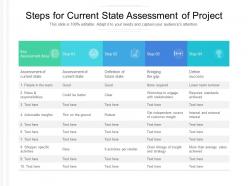
Steps for current state assessment of project





Try Before you Buy Download Free Sample Product
 Impress Your
 Audience
 100%
100% Editable
 Save Hours
 of Time


Gain from associating with our Steps For Current State Assessment Of Project. They will help define your brand.
People who downloaded this PowerPoint presentation also viewed the following :
Steps for current state assessment of project with all 2 slides:
Become a customer favorite with our Steps For Current State Assessment Of Project. Your brand will grow exponentially.
FAQs for Steps for current state
Honestly, I'd start with the boring stuff first - revenue, profit margins, cash flow. Are you actually making money or just staying busy? Customer retention and satisfaction scores matter way more than people think. Happy customers stick around, which is basically free money. Also track employee turnover because nothing kills a business faster than your best people leaving. Keep an eye on competitors too - what are they doing that you're not? Maybe throw together a simple dashboard so you're not blindsided when things go sideways. Way easier than playing catch-up later.
Honestly, stakeholder interviews are your best bet - people will tell you stuff you'd never figure out on your own. Mix that with process mapping sessions and document reviews. Surveys help if you've got tons of people to hear from. Here's the thing though - definitely watch processes actually happen, not just what people say happens. Trust me, there's always a gap! Get both the hard numbers and the stories behind them. Oh, and talk to folks at different levels. A manager's view is totally different from someone doing the actual work day-to-day.
Honestly, you need that stakeholder feedback - it's like your sanity check. All the data in the world won't tell you what's actually broken vs. what just looks messy on paper. The people doing the work daily? They'll give you the real story. Talk to different levels too, not just managers (they sometimes sugarcoat things). I'd do structured interviews or surveys to catch their pain points systematically. Plus, when you get their input early, they're way more likely to actually support whatever changes you end up making. It's kind of a win-win situation.
So quantitative data is basically the hard numbers - performance metrics, cycle times, error rates, that kind of stuff. You can crunch those statistically. Qualitative data is more like the story behind the numbers. Think interviews, observations, feedback sessions. For your assessment thing, you'll definitely need both. Numbers give you baselines and show what's happening. But honestly? The qualitative stuff often tells you *why* it's happening, which is usually way more useful. Like, your error rate might be high, but talking to employees could reveal it's because training sucks or the process is confusing. Can't get that from spreadsheets alone.
Honestly, the worst mistake is trying to document every single thing instead of zeroing in on what actually impacts your goals. You'll burn weeks mapping stuff that isn't even broken - total waste of time. Leadership interviews are overrated too since most execs are pretty disconnected from day-to-day reality. Go straight to the people actually doing the work, that's where the real problems live. Oh, and this one's hard but super important - don't start brainstorming solutions while you're still figuring out what's wrong. Keep discovery separate from fix-it mode or you'll muddy the whole process.
Honestly, tech makes current state analysis way less painful. Process mining tools show you how work actually happens (not the fantasy version people describe). Real-time dashboards give you solid performance data without constantly bugging everyone for updates. Survey platforms help you collect feedback from tons of people at once - super helpful when you're dealing with big organizations. Digital mapping beats those chaotic whiteboard sessions every time, though I'll admit those can be fun sometimes. Just don't go overboard with tools. Pick 2-3 that play nice together instead of creating a tech nightmare for yourself.
Honestly, I'd go with SWOT if you need a quick team alignment thing - yeah it's basic but everyone gets it. Business model canvas works great when you're questioning your whole strategy. McKinsey 7S is my favorite though, digs into whether your structure and culture actually mesh (spoiler: they usually don't). Oh and financial ratios are boring but you gotta do them for the money side. Just pick whatever matches your main problem. Don't try doing three frameworks at once - been there, it's a mess.
Look, a current state assessment just shows you what you're actually working with right now - your real resources, capabilities, all the gaps. Pretty straightforward stuff. You'd be shocked how many companies skip this and then wonder why their strategy falls flat. It stops you from chasing opportunities you can't handle or missing risks staring you in the face. Without it, you're basically flying blind and making decisions off old info that probably isn't even accurate anymore. Honestly, just start by comparing what you think you have versus reality.
Oh man, culture totally messes with assessment results if you don't watch out. Some people will be brutally honest about problems, others sugarcoat everything to avoid rocking the boat. Then you've got how different cultures view authority - like, are they gonna open up to the person running the assessment or just tell them what they think they want to hear? Plus time orientation is weird - I never really thought about this until recently, but some focus way more on traditions while others are all about future planning. Questions get interpreted differently too. Honestly, you gotta adjust your whole approach based on who you're dealing with, otherwise your data's gonna be pretty useless.
Tell a story with your data instead of just throwing charts at them. Start big - what's actually hurting their business? Then get specific with visuals that don't make people's eyes glaze over (seriously, nobody wants to stare at some nightmare flowchart). Keep asking questions so you know they're following along. Here's the key part though - come with your top 3 recommendations ranked by priority. Don't give them 15 different problems to solve. They need to walk out knowing exactly what to tackle first and why it'll actually move the needle for them.
So basically, you need to know where you're starting from before you can figure out where you're going. Current state assessments are like taking your organization's temperature - they show you what's actually happening vs what you think is happening. You'll uncover weird gaps and potential roadblocks you didn't even know existed. Honestly, skipping this step is how most change projects crash and burn. Map out your processes, see how people actually feel about change, figure out what resources you have. It's boring work but it saves you from walking into a disaster later.
So basically you gotta know where you're starting before you can fix anything, right? Map out how stuff actually happens day-to-day - not what the manual says should happen (because let's be real, those are totally different things). This gives you your baseline and shows you where the real problems are hiding. I learned this the hard way on a project last year. Short version: document everything first, then you'll actually know what needs fixing instead of just throwing random solutions at the wall. Otherwise you're basically playing pin the tail on the donkey with your business processes.
Honestly, I'd say every 6-9 months minimum these days. Things change so damn fast that annual reviews just don't cut it anymore - especially if you're in tech or retail where everything shifts constantly. Maybe do lighter quarterly check-ins on the big stuff like customer experience and how you stack up against competitors. Just don't make it this huge project every single time or your team will hate you for it. Pick your 3-4 most critical areas and rotate through them. That way you're staying on top of things without drowning everyone in endless analysis. Works way better than trying to assess everything at once.
Hey, so first things first - you've gotta get proper consent before collecting any data or doing interviews. People hate finding out their feedback ended up somewhere they didn't expect, so be super clear about who's gonna see what. Also think about how your findings might affect people's jobs if you're spotting inefficiencies and stuff. Power dynamics are tricky too when you're talking to regular employees vs the big bosses. Honestly, the whole thing can get messy fast if you don't plan it out. Document your approach early and make sure everyone's on board with how you'll handle the sensitive stuff.
Benchmarking stops you from operating blind - you'll actually know where you stand instead of just guessing. Like getting the answer key after a test, honestly. You can spot where you're crushing it versus where competitors are eating your lunch. The trick is picking benchmarks that actually fit your business model, not just random industry stats. This helps you figure out which problems to fix first and sets realistic improvement targets. Oh, and start with maybe 3-5 metrics that really matter in your space - don't go overboard trying to track everything at once.
No Reviews