


Steps for transition to desired future from current state




Try Before you Buy Download Free Sample Product
 Impress Your
 Audience
 100%
100% Editable
 Save Hours
 of Time


Our Steps For Transition To Desired Future From Current State are topically designed to provide an attractive backdrop to any subject. Use them to look like a presentation pro.
People who downloaded this PowerPoint presentation also viewed the following :
Content of this Powerpoint Presentation
Description:
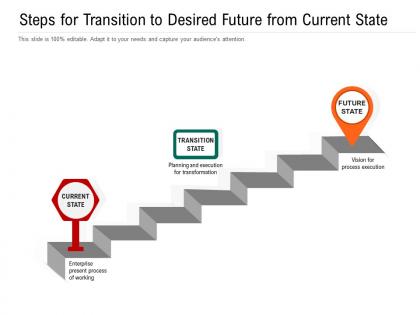
The image features a business presentation slide outlining the "Steps for Transition to Desired Future from Current State." It presents a roadmap or transformation model that illustrates the journey an organization undertakes to move from its "Current State" to a "Future State." The slide is divided into three main elements, each representing a distinct phase:
1. CURRENT STATE:
Symbolized by a stop sign and labeled as the "Enterprise present process of working," this phase represents the organization's status quo. It encompasses its existing processes, culture, and challenges.
2. TRANSITION STATE:
This section, accompanied by a rectangular sign, indicates "Planning and execution for transformation." It suggests that this phase involves strategizing and implementing the changes necessary to achieve the desired future.
3. FUTURE STATE:
Represented by a location marker, it signifies the "Vision for process execution." This phase points toward the end goal of the transformation process, where new processes, culture, and improved results are in place.
Use Cases:
Here are seven industries in which this slide can be utilized:
1. Consulting:
Use: Framework for client business transformation presentations.
Presenter: Management Consultant.
Audience: Client Executives.
2. Information Technology:
Use: Illustrating digital transformation milestones.
Presenter: IT Strategist.
Audience: Company Leadership and IT Department.
3. Manufacturing:
Use: Implementing new production methodologies.
Presenter: Operations Manager.
Audience: Production Team.
4. Healthcare:
Use: Transitioning to new healthcare protocols or systems.
Presenter: Healthcare Administrator.
Audience: Medical Staff and Hospital Management.
5. Education:
Use: Adoption of new educational technologies and teaching methods.
Presenter: Educational Consultant.
Audience: Institutional Leadership and Educators.
6. Retail:
Use: Revamping retail strategy for digital commerce.
Presenter: Retail Strategy Director.
Audience: Marketing and Operations Teams.
7. Financial Services:
Use: Deploying new financial products or regulatory compliance projects.
Presenter: Financial Planner or Compliance Officer.
Audience: Financial Advisors and Management Staff.
Steps for transition to desired future from current state with all 2 slides:
Use our Steps For Transition To Desired Future From Current State to effectively help you save your valuable time. They are readymade to fit into any presentation structure.

FAQs for Steps for transition to desired future
You need to lock down five main things: solid timelines with milestones, knowledge transfer docs, who's responsible for what, backup plans for when stuff goes wrong, and ways to measure if it worked. Documentation is honestly the worst part but you can't skip it - write down everything, even the random quirks only you deal with. I'd start by listing everything you do now, then count backwards from when you're leaving. Always add extra time because projects drag on forever. Oh, and get it all written down ASAP before you forget the important details.
Check three things: can they actually do it, do they want to, and what backup will they have? First, test their skills - maybe run some scenarios to see if they know their stuff. The emotional side matters just as much though. Reluctant people will sabotage everything, trust me on that one. Also look at what resources they'll get during the switch. I use red/yellow/green for each category. Green means good to go, yellow needs some work first, red means major issues to fix. It's pretty straightforward but catches the big gaps before you're stuck dealing with them later.
Honestly, stakeholder engagement can make or break everything. You really need people on board - from the big bosses down to whoever's actually using the system day-to-day. Without their buy-in, you're basically screwed because they'll just resist the whole thing. Getting everyone involved early helps you catch problems before they blow up. Plus, they know stuff about daily workflows that you'd never think of (learned that the hard way once). Map out who matters most and check in with them regularly. Trust me, skipping this step always comes back to bite you.
Dude, get everything digital first - that's honestly the biggest game changer. Project management tools help you track who's doing what during handoffs. Also set up some kind of knowledge base so when Bob from accounting finally retires, his weird invoice system doesn't die with him (learned that one the hard way). Automated workflows handle the boring repetitive stuff. Cloud systems are clutch too since everyone can access files remotely when things get messy. Seriously though, document your processes before you're scrambling mid-transition. Future you will be so grateful it's all mapped out already.
Honestly, the worst thing you can do is wait too long to start planning. I've watched so many handoffs completely crash because people weren't clear on who's doing what - like, seriously, write that stuff down! Knowledge transfer definitely won't just magically happen on its own (learned that one the hard way). Also? Don't rush the timeline. Everyone thinks they can cram everything into two weeks and then act surprised when it's a disaster. Get your key people involved from the beginning, document everything properly, and for the love of all that's holy, build in extra time. Trust me on this one.
Honestly, just stick to whatever metrics you planned from the start - adoption rates, performance stuff, error counts, timeline. Numbers don't tell the whole story though. Sometimes everything looks perfect on paper but users are secretly miserable, so definitely survey people too. Compare what actually happened vs what you expected. I'd set up check-ins for the first few weeks after launch - problems always pop up when you least expect them. Really comes down to whether you hit your goals on time and budget. Oh, and keep an eye on support tickets - they're usually the first sign something's off.
Dude, communication is literally everything during transitions. I can't stress this enough - it's what separates the wins from the disasters. You've gotta be upfront and consistent with everyone involved, or people start making up their own stories about what's happening. Regular updates are clutch because they stop those panic moments where someone's like "wait, are we still doing this?" Oh, and don't send the same message to your CEO that you send to the team doing the actual work - totally different audiences. Set up ways for people to give you feedback early on. That way when stuff inevitably goes sideways, you'll catch it fast. Honestly? Map out your communication plan first, before you touch anything else.
Okay so work backwards from your launch date first - you're gonna need way more buffer time than you think. Map out the big critical stuff, then figure out what depends on what between teams. Two-week sprints work pretty well for most of this since they keep things moving without being overwhelming. Don't just tell stakeholders what's happening - actually get them involved when you're setting deadlines or you'll regret it later. Here's the thing though: be honest about how long stuff really takes, not how long you wish it would take. I always tack on at least 20% extra time to whatever my gut says.
Honestly, figure out what's actually blocking each person first. Some need more training, others are freaking out about losing their jobs, and language barriers are real too. I totally bombed this last year trying to treat everyone the same way - huge mistake! Survey people upfront about their specific concerns. Then mix up your approach: videos for some, hands-on practice for others, maybe translation help. Smaller groups work way better since people actually ask questions instead of sitting there confused. Age and role definitely matter for how you frame things too.
First thing - figure out what absolutely can't go down during the switch. Then document everything for handovers and get people cross-trained on critical stuff. Running things in parallel costs more upfront but trust me, it's nothing compared to a total system failure. Always pad your timeline because I've literally never seen one of these go 100% smooth. Communication is huge - keep everyone looped in on what's happening and when. Oh, and don't try to change everything at once! Pilot approach saves your butt. Have backup plans ready too.
First thing - you need your core team sorted. Case managers, counselors, family advocates if that fits your situation. Documentation matters a ton here: transition plans, assessments, individual goals, all that paperwork stuff. But honestly? The community piece is what people always skip and it's so crucial. Build those connections with local providers, schools, employers who actually get transitions. Oh, and some kind of tech system helps coordinate everyone - trust me on this one. Map out your current support network first, then figure out what's missing.
Honestly, culture makes a huge difference in how transition planning plays out. What flies in New York will probably crash and burn in Tokyo or São Paulo - I've seen it happen. Some places want everything super direct and fast, others need months of relationship building first. Hierarchy stuff varies like crazy too. Get your local team leads involved from the start rather than trying to copy-paste the same approach everywhere. Oh, and build in flexibility early - way easier than scrambling to fix things later when you realize your timeline doesn't match how decisions actually get made there.
Honestly, one-on-ones are your goldmine here - people will actually tell you what they're thinking when it's just you two. Anonymous surveys help too, especially for the stuff people won't say out loud. During team meetings, I'll throw in quick "how's everyone feeling about this?" moments. The real tea though? Pay attention to Slack chatter and random conversations by the coffee machine - that's where you'll hear what's really going on. Oh, and don't save all your check-ins for the end. Space them out throughout the whole transition so you can actually fix things as they come up.
Definitely keep notes on what worked and what bombed after each transition! Make a basic template - timing screwups, communication fails, how stakeholders reacted, weird surprises that came up. Honestly, I've watched teams repeat the exact same mistakes because no one wrote anything down (so frustrating). After a few transitions, you'll spot patterns that show where your org consistently trips up. The trick is making these notes searchable and actually using them when planning the next one. Even a quick shared doc helps. Start with your last transition's biggest win and biggest disaster.
So first thing - map out what knowledge gaps you're dealing with, then build training around those instead of doing some cookie-cutter program. Your successor needs the technical stuff obviously, but also all those undocumented processes that somehow keep everything running. Set up shadowing time so they can pick up on office politics and unwritten rules (honestly this part's huge). Everyone else affected by the transition needs some change management help too. Oh, and don't skip communication training for people adapting to new workflows - it saves headaches later.
No Reviews