

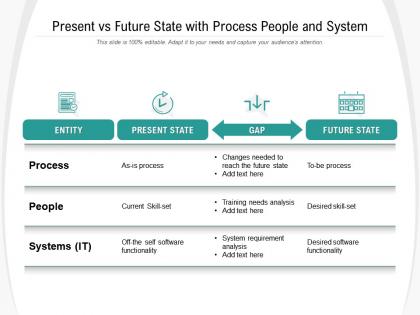
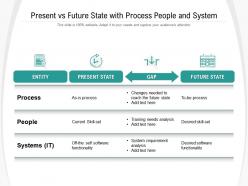
Present vs future state with process people and system




Try Before you Buy Download Free Sample Product
 Impress Your
 Audience
 100%
100% Editable
 Save Hours
 of Time


Our Present Vs Future State With Process People And System are topically designed to provide an attractive backdrop to any subject. Use them to look like a presentation pro.
People who downloaded this PowerPoint presentation also viewed the following :
Present vs future state with process people and system with all 2 slides:
Use our Present Vs Future State With Process People And System to effectively help you save your valuable time. They are readymade to fit into any presentation structure.
FAQs for Present vs future state with process
Key elements driving successful transformation include strong leadership commitment, clear strategic vision, employee engagement and communication, robust change management processes, and adequate resource allocation. These components work synergistically to overcome resistance, align organizational culture with new objectives, and maintain momentum throughout implementation phases, with many organizations finding that sustained executive sponsorship and comprehensive stakeholder involvement ultimately deliver measurable performance improvements and competitive advantage.
Visual storytelling enhances transformation presentations by converting complex change processes into compelling narratives through infographics, journey maps, before-and-after comparisons, and progress timelines. These visual elements help stakeholders better understand transformation roadmaps, reduce resistance to change, and build buy-in, with many organizations finding that visual narratives accelerate adoption and communicate transformation value more effectively than traditional text-heavy approaches.
Technology serves as the primary enabler of transformation processes by automating workflows, enhancing data analytics, streamlining communication, and accelerating decision-making across organizations. Through cloud platforms, AI-driven insights, and digital integration tools, companies in manufacturing, healthcare, and financial services minimize operational costs, improve customer experiences, and gain competitive advantages, ultimately delivering scalable growth and strategic positioning.
Leaders effectively communicate transformation vision through clear storytelling that connects organizational goals to individual roles, regular transparent updates about progress and challenges, and interactive sessions where team members can ask questions and provide feedback. By combining compelling narratives with consistent messaging across multiple channels, leaders ensure alignment while building trust and engagement, ultimately creating shared ownership of the transformation journey that drives sustainable organizational change.
Common transformation pitfalls include insufficient change management, lack of clear communication, inadequate stakeholder buy-in, unrealistic timelines, and poor resource allocation. Organizations often underestimate employee resistance and cultural barriers, with many finding that successful transformations require consistent leadership support, comprehensive training programs, and phased implementation strategies to minimize disruption while ensuring sustainable adoption.
Cultural shifts can significantly support transformation by fostering employee buy-in, encouraging innovation, and aligning behaviors with new strategic goals, while resistance to change, entrenched practices, and poor communication can create substantial barriers. Organizations in sectors like healthcare and financial services find that proactive cultural alignment through leadership engagement and transparent communication ultimately delivers smoother transitions and sustained competitive advantage.
Organizations can measure transformation success through key performance indicators like revenue growth, operational efficiency metrics, employee engagement scores, customer satisfaction ratings, and digital adoption rates. These measurements enable companies to track progress across financial, operational, and cultural dimensions, with many institutions finding that balanced scorecards combining quantitative data with qualitative insights ultimately deliver comprehensive visibility into transformation outcomes and competitive positioning.
**INPUT**: What strategies can help maintain employee engagement during periods of transformation? **OUTPUT**: Effective engagement strategies include transparent communication, regular feedback sessions, skills development programs, recognition initiatives, and involving employees in decision-making processes. These approaches streamline transitions by building trust, reducing uncertainty, and empowering teams to contribute meaningfully, with many organizations finding that engaged employees become transformation champions, ultimately delivering faster adoption and sustainable change outcomes. [Word count: 58 words]
Feedback loops can be incorporated through regular stakeholder surveys, performance metrics monitoring, milestone reviews, cross-functional team sessions, and real-time data analytics throughout transformation initiatives. These mechanisms enable organizations to identify bottlenecks, adjust strategies dynamically, and maintain alignment with objectives, with many companies finding that continuous feedback accelerates adoption and delivers more successful outcomes.
Psychological impacts of transformation include anxiety about job security, resistance to change, stress from learning new processes, fear of skill obsolescence, and uncertainty about future roles. Organizations can address these through transparent communication, comprehensive training programs, involving employees in planning processes, and providing psychological support services, ultimately building resilience while maintaining productivity during transitions.
Continuous improvement serves as the foundation for sustainable transformation by establishing incremental changes, fostering adaptive cultures, and building organizational resilience over time. This approach enables companies to navigate transformation more effectively than dramatic overhauls, with many manufacturing and financial services organizations finding that systematic improvements ultimately deliver lasting competitive advantage and operational excellence.
Netflix's shift from DVD rentals to streaming, Amazon's evolution from bookstore to cloud computing giant, and Microsoft's transition to cloud-first services exemplify successful transformation across industries. These organizations demonstrate how strategic pivots, technology adoption, and cultural change enable companies to reinvent business models, capture new markets, and maintain competitive advantage in increasingly dynamic landscapes.
Templates streamline transformation strategy presentations by providing structured frameworks for communicating change initiatives, standardizing visual elements across stakeholder communications, and ensuring consistent messaging throughout implementation phases. These presentation tools enhance executive buy-in by clearly articulating transformation roadmaps, timelines, and expected outcomes, while enabling organizations to accelerate decision-making processes and maintain strategic alignment across all transformation workstreams.
Creating compelling transformation roadmaps requires clear vision articulation, stakeholder alignment, phased milestone mapping, realistic timeline establishment, and comprehensive risk assessment. These practices streamline organizational change by defining measurable objectives, establishing accountability frameworks, and maintaining transparent communication channels, with many enterprises finding that structured roadmaps accelerate implementation while minimizing resistance and ultimately delivering sustainable competitive advantage.
Organizations ensure long-term sustainability by embedding new processes into company culture, establishing continuous monitoring systems, and maintaining leadership commitment to change initiatives. Through regular performance reviews, employee training programs, and adaptive feedback mechanisms, companies like manufacturing firms and financial institutions sustain transformation gains while building resilience for future market shifts, ultimately delivering competitive advantage.
No Reviews