


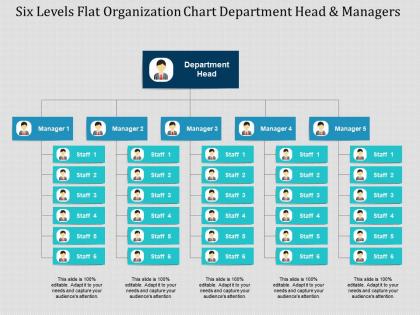
Six levels flat organization chart department head and managers




Try Before you Buy Download Free Sample Product
 Impress Your
 Audience
 100%
100% Editable
 Save Hours
 of Time


Having a strong organizational structure is paramount to the success of any business. Pick our six levels flat organizational chart department head and managers PowerPoint template and make professional PPT slide. Our six levels flat organizational chart department head and managers Presentation slideshow consists of a hierarchy of business operations which explain the importance of creating org charts in an organization. You can include the order in which your managers supervise along with the titles and job descriptions of the team. Review this chart and determine whether your employees know their exact duties, who they supervise, and whether they are being used to their maximum potential. Whether it is human resources, accounting, operations or marketing department, all can be represented with the help of six levels flat organizational chart department head and managers PPT design. Grab this opportunity to design awesome PowerPoint Presentations with our amazing PPT slide templates. Bond with the folks with our Six Levels Flat Organization Chart Department Head And Managers. Cement the attraction they feel for you.
People who downloaded this PowerPoint presentation also viewed the following :
Six levels flat organization chart department head and managers with all 5 slides:
Our Six Levels Flat Organization Chart Department Head And Managers discourage discrimination. Everyone is guaranteed every facility.


FAQs for Six levels flat organization chart department
Honestly, the biggest win is how fast you can make decisions without dealing with endless approval chains. Communication gets so much better too. Your team feels way more engaged since they actually have autonomy and can talk to leadership directly. Running costs drop big time - you're not paying a bunch of middle managers, which is honestly refreshing for the budget. When stuff changes (and it always does), you can pivot super quickly. People take more ownership of their work. You just gotta make sure your communication systems are solid since you can't rely on the old hierarchy to keep everyone on the same page.
Flat orgs are great for speed - no more waiting around for your boss's boss to approve stuff. People actually talk to each other directly instead of playing telephone through management layers. Decision-making gets way faster too. But honestly? It can turn into a bit of a free-for-all sometimes. Without clear reporting lines, nobody knows who's really in charge of what. My take: figure out your communication rules early or you'll end up with total chaos. Also helps if everyone's actually good at making decisions on their own.
Honestly, flat orgs are pretty great for engagement. You get way more autonomy and can actually talk to the people making decisions - no more dealing with like 5 layers of middle management hell. Your ideas don't disappear into some void, which is refreshing. Decision-making happens faster, and you'll really own your projects instead of just being a cog. Teams collaborate more too since everyone's basically on the same level. Just heads up though - you're gonna have way more responsibility dumped on you, so make sure you can handle that pressure.
Honestly? You're gonna hit role confusion hard - nobody knows who does what anymore. Decision-making gets totally messy since there's no clear chain for things to flow through. Communication becomes a nightmare without proper reporting lines. Some managers will fight tooth and nail to keep their power (obviously), while others just feel completely lost. Your star employees will probably thrive with the freedom, but people who need structure? They'll hate it. Oh, and decisions that used to move up the ladder just... sit there forever. Define roles and decision processes first - like, actually map them out before you flatten anything.
Yeah, so flat structures definitely speed things up since you're not waiting for approvals from like five different managers. You can actually talk to the people making decisions, which beats dealing with corporate red tape any day. But here's the thing - it gets messy when nobody knows who's really in charge of what. I've seen meetings where the loudest person just takes over because everyone's technically on the same level. You really need clear rules about who decides what, even in a flat setup. Otherwise it's chaos. My old company tried this and it was... interesting.
Honestly, leadership becomes way more important in flat orgs, not less. Without all those management layers, you can't just bark orders and expect things to happen. Your leaders need to actually inspire people and facilitate stuff rather than just command everyone around. The communication piece is huge too - information flows weird when there's no clear chain of command, so leaders better be good at keeping everyone in the loop. Oh, and they've got to trust their teams completely. No micromanaging allowed. If you're thinking about going flat, seriously work on building those collaborative leadership skills first.
Honestly, flat structures can work at bigger companies but it gets tricky fast. Once you're past like 150 people, everything becomes a mess - decisions take forever and nobody knows who's actually in charge of what. Companies like Buffer pull it off by basically creating mini-teams that run themselves. Pretty smart approach, actually. But you need people who don't freak out when things aren't super defined, plus rock-solid communication systems. My advice? Test it with a smaller group first and see how info actually moves around before you go all-in.
Honestly, just pick a good chat app first - Slack or Teams work great for keeping everyone in the loop. Project management wise, Asana or Trello are solid choices (I'm partial to Trello's simplicity but whatever). The key thing is getting people to actually stick with whatever you choose. Don't go crazy with tons of tools right away. Maybe add some shared dashboards later for tracking goals - even basic Google Sheets can work if you're not ready for something fancy like Tableau. Start small and build from there.
Yeah, flat structures are great for innovation - ideas hit decision-makers super fast instead of dying in bureaucracy hell. Teams get more freedom to experiment when they're not buried under management layers. People actually speak up with crazy ideas because they can talk directly to leadership. The tricky part is sometimes everyone having equal say creates total chaos (learned that one the hard way). But honestly? You'll see way more creative solutions because there's less distance between "hey what if we tried this" and actually doing it. Document those wins as they happen!
Tech startups crush it with flat structures - no surprise there. Software companies especially, since devs need to bounce ideas off each other constantly without some middle manager getting in the way. Creative agencies do great too. Quick decisions beat endless approval chains every time. Consulting firms that focus on innovation over tradition? They're all over this approach. Basically any knowledge work where you need to pivot fast. I'd honestly just test it with one team first though - see how it goes before restructuring your whole company.
Look, flat org charts are game-changers because they eliminate all those approval bottlenecks. Your team can actually react to market shifts without waiting for five different managers to weigh in. Direct communication between frontline staff and leadership? That's where the magic happens - real influence on strategy instead of ideas dying in committee hell. Quick feedback, faster solutions, way less red tape. Honestly, I've seen companies transform just by cutting decision layers in half. Everyone feels empowered to act, which makes your whole org more responsive. If you're stuck with slow market response times, count how many people need to sign off on decisions.
Oh man, flat orgs are such a pain for reviews! You lose those obvious boss-employee lines, so nobody knows who's actually accountable for what. Some people totally game this system too - they'll jump on every win but vanish when things go wrong. Plus who's even supposed to evaluate who when everyone's basically peers? I'd say set up peer reviews and make individual responsibilities crystal clear from day one. Otherwise you'll have five people claiming they led that successful project while the failure sits there with zero ownership. Short sentences help here. But seriously, being specific about roles saves so much drama later.
Dude, you gotta get comfortable with chaos because there's literally no boss to run to when things get weird. Communication becomes everything - you're basically texting, calling, and meeting with everyone constantly. The politics? Ugh, way messier than you'd think without clear hierarchy. Being decisive is non-negotiable since no one's gonna hand you a priority list. Adaptability matters too because your role shifts like every month. Oh, and start working on that "influence without authority" thing now - it's basically your survival skill. Honestly, flat orgs sound cool in theory but they're definitely not for everyone.
Honestly, you've gotta nail down who does what from day one. Document everything - like who owns which processes and decisions. RACI matrices are actually pretty helpful for mapping out responsibility vs accountability (sounds boring but trust me). The biggest disaster I've seen? Teams assuming someone else has it covered. Short regular check-ins prevent that mess. Since everyone's wearing multiple hats in flat orgs, over-communicate until people get their lanes. Oh, and start simple - pick your top 10 decisions or processes and assign clear owners for each.
Spotify's squad model is probably the most famous - they let small teams run like mini startups. Buffer's crazy transparent about everything (you can actually see their whole org chart online). Valve went full anarchist mode with basically zero traditional management. Google started flat too and still keeps teams pretty autonomous even though they're massive now. Oh, and if you're actually considering this - definitely dig into Buffer's blog posts about their structure. They're super honest about the messy parts, not just the wins. It's refreshing compared to most company PR stuff.
No Reviews