


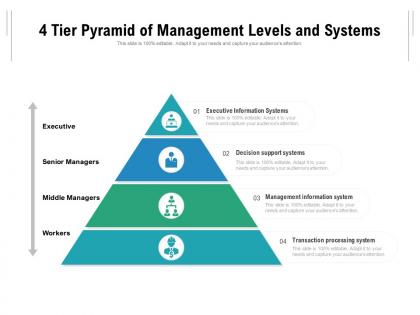
4 tier pyramid of management levels and systems




Try Before you Buy Download Free Sample Product
 Impress Your
 Audience
 100%
100% Editable
 Save Hours
 of Time


Our 4 Tier Pyramid Of Management Levels And Systems are topically designed to provide an attractive backdrop to any subject. Use them to look like a presentation pro.
People who downloaded this PowerPoint presentation also viewed the following :
4 tier pyramid of management levels and systems with all 2 slides:
Use our 4 Tier Pyramid Of Management Levels And Systems to effectively help you save your valuable time. They are readymade to fit into any presentation structure.
FAQs for 4 tier pyramid of management
So there's basically three levels to think about. Top executives handle the big picture strategy stuff - you know, where the company's headed long-term. Middle managers are stuck translating all that into actual plans while running their departments. First-line supervisors deal with the daily grind and managing frontline workers. Middle management honestly gets the worst of it - pressure from above AND below. Each level needs totally different skills too. Short bursts vs. longer strategic thinking, if that makes sense. When you're thinking about moving up or whatever, just figure out which level you're aiming for first.
Basically, it's like having a good filing system for decisions. Top-level stuff goes straight to executives, but day-to-day problems get sorted out lower down without bugging the big bosses. People know exactly who can approve what, so you're not wasting time asking the wrong person. Information gets summarized as it goes up the chain too - nobody wants their CEO buried in tiny details about office supplies or whatever. Just make sure everyone actually knows who reports to who, because I've seen places where decisions ping-pong around forever because the hierarchy's a mess.
So basically you flip everything upside down - frontline people and customers go at the top instead of executives calling all the shots. Middle managers become more like support staff (which honestly should've been obvious from the start). Decision-making gets pushed down to whoever's actually doing the work and dealing with problems daily. It's way more efficient than having every tiny choice go up the chain for approval. You should map out who needs to sign off on stuff in your department - I bet half those approval steps are totally unnecessary and just slow things down.
Different management levels need totally different leadership approaches, which honestly makes sense when you think about it. CEOs should be visionary and big-picture focused. Middle managers work best when they're collaborative - they're translating all that strategy down to actual teams. Front-line supervisors? They're coaching daily and need to be way more hands-on. The real problem happens when there's a mismatch. You don't want a micromanaging CEO breathing down everyone's necks, or some hands-off supervisor leaving newbies completely lost. Match your style to where you sit and what your people actually need right now.
Honestly, you've gotta build channels that go both ways - up and down. Regular one-on-ones between management levels catch problems early. Skip-level meetings are huge too, where senior people talk directly to folks two levels down. Sounds weird but it stops info from getting twisted in the middle. Weekly dashboards help, team standups work well. I'd also do open office hours - makes sharing feel natural instead of forced. The trick is making it routine, not some big formal thing. People actually open up when it's just part of how things work, you know?
Ugh, honestly the worst part is how everything gets twisted as it goes up the chain - like a game of telephone but with your actual work. Middle managers get crushed between what the executives want and what's actually happening on the ground. Decision-making? Forget about it. Takes forever when five people need to sign off on ordering new pens. Then you've got managers guarding their little kingdoms like dragons, and regular employees who have zero clue what leadership is thinking. My advice? Set up direct communication paths and spell out who does what. Saves so much drama later.
Yeah, those management pyramids can totally backfire on motivation. Too many layers and people feel cut off from anyone who actually makes decisions. Information gets super watered down going up and down - like that telephone game we played as kids, remember? I'd say keep it as flat as you can without losing accountability. Give people real control over their work, not just busy work. Skip-level meetings help too - sometimes you gotta bypass the middle managers to actually connect with your team. Direct communication beats playing telephone any day.
There's a bunch of ways to make these! PowerPoint has decent pyramid templates built right in - same with Google Slides. Personally I'd go with Lucidchart though, their designs look way cleaner. Canva's got some nice ones too if you want something that doesn't scream "corporate presentation." For really complex stuff, Visio works well, or you could try draw.io (think they renamed it to diagrams.net or something). Honestly, I've even made decent ones in Excel using shapes and text boxes when I was being lazy. Just start with whatever you already know how to use - no point learning a whole new tool right away.
Yeah, totally works for both! Small businesses just have fewer layers - like owner at top, maybe a manager, then your regular employees. Done. Big corporations? They go crazy with it - CEO, VPs, directors, the whole nine yards. But honestly, the basic idea stays the same no matter what size you're dealing with. You just need everyone knowing who reports to who and who makes which decisions. Whether it's 10 people or some massive company, that pyramid structure helps keep things organized. The main thing that changes is how many levels you're stacking up.
Look, each management level has totally different priorities. Top execs set the big vision - where's the company going in 3-5 years? Middle management gets the fun job of translating that into actual plans while managing both directions. Frontline supervisors? They're in the weeds with daily ops and coaching people. Honestly, the biggest thing is matching your time to your role. Executives need blocks for strategic thinking. Frontline managers spend way more time with their people. I'd start by tracking where your hours actually go versus where they should be - might surprise you how off it is.
Yeah, remote work totally changes the management game. Those middle layers get squished because everyone can just ping the CEO directly now - no more gatekeepers filtering messages up the chain. Some managers are honestly freaking out about it lol. Communication flows way more directly when you're all on Slack anyway. The whole "watch over your shoulder" management style is pretty much dead. Now it's more about setting clear goals and checking in regularly. Focus on what people actually get done, not whether they're sitting at their desk looking busy. Way better system if you ask me.
So here's the thing - you need different metrics for each level. Frontline managers should track team stuff like productivity and employee happiness, plus operational things like quality scores. Middle management focuses on department performance and budget tracking. Executives need the big picture metrics - revenue growth, market share, ROI on major projects. Honestly, the biggest mistake I see is when these don't connect properly. You'll get teams optimized for totally different goals, which creates chaos. Start with what "winning" looks like at each level, then pick maybe 3-5 things you can actually measure that drive those results.
Honestly, it all comes down to keeping communication flowing both ways - up and down the chain. Set up regular check-ins (not just when everything's on fire). Middle management loves to create bottlenecks, so watch out for that. Get different levels working together on actual projects. Your senior people need to stay grounded in what's really happening day-to-day. Oh, and this is huge - be crystal clear about who decides what. Otherwise you'll have people collaborating when they should just be getting stuff done. I'd start by figuring out who actually needs to know what and when.
Skipping levels in your management structure is a recipe for disaster, honestly. You lose middle management? Now executives are micromanaging everything while your frontline people have no clue what's happening at the top. Skip the strategic layer and you're just putting out fires all day instead of actually planning ahead. It's like - imagine removing the middle floor of a building and hoping everything stays up. Spoiler: it won't. Each level has a job to do, whether that's translating big picture stuff or handling day-to-day decisions. Map out what each layer actually does first, then figure out how to cover those gaps.
Ugh yeah, those pyramid structures are such a pain for quick decisions. Everything has to crawl through like 5 different approval levels - I've seen simple changes take weeks just because of that. Innovation gets weird though. Sure, you have the budget and stability for big projects, but middle managers tend to shut down anything that feels risky. Honestly, most creative stuff dies in committee. If you want to move faster, try flattening some layers or maybe set up project teams that can skip the usual chain of command. Not saying blow up the whole structure, but give people ways around it when they need to actually get stuff done.
No Reviews