

Four step venn diagram for effective workplace communication




Try Before you Buy Download Free Sample Product
 Impress Your
 Audience
 100%
100% Editable
 Save Hours
 of Time


Our Four Step Venn Diagram For Effective Workplace Communication are topically designed to provide an attractive backdrop to any subject. Use them to look like a presentation pro.
People who downloaded this PowerPoint presentation also viewed the following :
Content of this Powerpoint Presentation
Description:
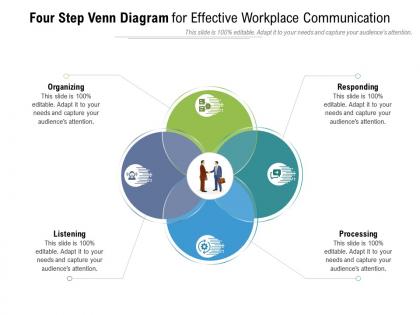
The image features a PowerPoint slide titled "Four Step Venn Diagram for Effective Workplace Communication." The slide contains a Venn diagram with four overlapping circles, each representing a key component of communication:
1. Organizing:
The green circle suggests structuring thoughts or a meeting agenda.
2. Listening:
The dark blue circle implies the importance of actively hearing and understanding others.
3. Responding:
The light blue circle indicates the need for providing feedback or reactions.
4. Processing:
The gray circle represents the internal understanding and analysis of information.
Each circle has an associated icon that visually represents the concept, and they overlap to emphasize that effective communication is where these elements intersect.
Use Cases:
Industries where this slide can be effectively utilized:
1. Human Resources:
Use: Training on interpersonal skills.
Presenter: HR Trainer.
Audience: Employees, Managers.
2. Education:
Use: Teaching communication strategies.
Presenter: Educator.
Audience: Students, Teaching Staff.
3. Healthcare:
Use: Enhancing patient-provider communication.
Presenter: Healthcare Administrator.
Audience: Medical Professionals, Support Staff.
4. Customer Service:
Use: Improving client engagement techniques.
Presenter: Service Trainer.
Audience: Customer Service Representatives.
5. Marketing:
Use: Crafting coherent brand messaging.
Presenter: Marketing Manager.
Audience: Marketing Teams, Brand Strategists.
6. Legal:
Use: Developing argumentation and negotiation skills.
Presenter: Legal Consultant.
Audience: Lawyers, Paralegals.
7. IT & Software Development:
Use: Facilitating team communication in projects.
Presenter: Project Manager.
Audience: Developers, Technical Teams.
Four step venn diagram for effective workplace communication with all 2 slides:
Use our Four Step Venn Diagram For Effective Workplace Communication to effectively help you save your valuable time. They are readymade to fit into any presentation structure.
FAQs for Four step venn diagram for
Honestly, it's usually just bad listening and unclear messages. People multitask in meetings constantly - drives me nuts. Then you get those super vague emails where nobody knows what's actually expected. Remote work made it worse too since we lost all those random coffee conversations. Oh, and hierarchy stuff is huge - junior people stay quiet even when they should speak up. Cultural differences don't help either. I'm definitely guilty of sending confusing messages sometimes though! Best thing is just double-checking that people actually got what you meant to say.
Honestly, body language matters way more than most people realize at work. You could tell someone "nice work" but if you're crossing your arms and avoiding eye contact, they'll totally sense something's off. I've seen this happen so many times in meetings - someone says one thing but their face says another. People pick up on whether you seem trustworthy or if you're actually paying attention. Even small stuff like sitting up straighter or making better eye contact can make you look way more approachable. It's wild how much your posture affects how others see you.
Ugh, workplace tech is such a mixed bag. Slack and Teams are amazing for quick updates and file sharing - I actually love having everything in one place. Video calls save so much time when you're dealing with complicated stuff. But honestly? Sometimes I miss the days when you could just... log off. The constant pings drive me crazy, and trying to read tone in messages is impossible. Half the time someone sounds mad when they're just being efficient. My advice: save video for anything that might get messy over text, and seriously, just call people when there's confusion. Way faster than going back and forth.
Honestly, you've gotta walk the walk first. Admit when you're stumped by something and actually ask people what they think in meetings. Set up regular check-ins where the team can vent without you getting all weird about it. I swear, so many managers claim they want honesty but then act butthurt when someone's actually real with them! Listen to what people say and follow through - even if you can't fix everything right away. Maybe start simple? Ask "what's bugging you this week?" at the beginning of meetings and then actually do something about it.
Daily standups are a lifesaver for keeping everyone on the same page. Quick stuff goes in Slack, but hop on video calls when things get complicated - trust me on this one. Honestly, I'd rather overcommunicate than have someone sitting there confused. Oh, and definitely set response time expectations upfront so people aren't wondering if you got their message. Different tools work better for different things, like shared docs when you're collaborating on something bigger. Maybe do a weekly check-in to see what's actually working? Communication gets weird when everyone's remote, so being super intentional about it really helps.
Honestly, feedback is everything - without it you're just shooting in the dark hoping stuff works. Be specific about what you mean instead of dancing around issues for weeks. I can't tell you how many disasters I've watched that could've been avoided with one real conversation early on. Talk about what people actually *do* and the results, not their personality quirks. Weekly check-ins work way better than some formal sit-down months later. Oh and don't just dump criticism - mention what's going well too. Makes the whole thing feel less like you're getting called to the principal's office, you know?
Oh man, cultural diversity is such a mixed bag for team communication! Some people are crazy direct while others dance around everything. Don't even get me started on time - you've got the always-early crowd versus the "ish" people. Language stuff is obvious, but there's also weird hierarchy expectations, personal space bubbles, and whether silence in meetings means agreement or confusion. Plus eye contact rules are all over the place. Honestly? Just ask when you're lost and give everyone time to figure out the group vibe. It usually works out.
Oh man, unclear expectations are the worst culprit. Like when your boss says "soon" but means tomorrow and you're thinking next week. Email tone is another nightmare - I swear a simple "thanks" can feel passive-aggressive depending on your mood that day. My go-to fix? Get stupidly specific about deadlines. Don't assume people know what you mean either. If something feels off tonally, just call them. Sounds old school but it works. Also in meetings, I'll repeat stuff back like "so you need X by Friday?" Feels awkward but prevents so many headaches later.
Dude, visuals are a game changer for presentations. People process images like 60,000 times faster than text - which honestly sounds made up but I swear it's true. Charts and infographics give your audience's brain a major shortcut. Would you rather slog through a paragraph about quarterly numbers or glance at a simple bar chart? Yeah, exactly. Your audience will actually remember stuff when you ditch those wall-of-text slides. Just don't throw in random pretty graphics that don't match your point. Start simple - one visual for each main thing you're trying to say.
Okay so first - actually prep beforehand and bring your talking points. Don't be that person just scrolling Instagram the whole time (guilty as charged sometimes lol). When you have something to add, speak up! Ask questions if you're confused about something. Keep your comments short and on-topic though. I always jot down action items during the meeting, then follow up later. The biggest thing? Don't let meetings drag on forever with random side conversations - everyone's got stuff to do. Oh and sending a quick recap email afterward isn't a bad idea either, just so you're all on the same page.
Honestly, it's all about matching people's energy and communication style. Like, introverts usually hate surprise meetings - they want detailed emails so they can think things through first. Meanwhile extroverts love those quick brainstorming sessions. Some people need ALL the details upfront, but others (especially big-picture types) just get overwhelmed. I totally bombed a presentation once because I gave my manager way too much info when she just wanted the main points. Also pay attention to whether someone's super direct or more people-focused. Direct folks want clear action items, while others need to know how it affects everyone. Just watch how your coworkers naturally communicate and adapt.
Oh totally, communication styles can completely derail things at work. Like if you're super direct and your coworker is all diplomatic, you'll sound like a jerk and they'll seem fake - it just spirals from there. I've learned to watch how people naturally talk first. Some need the facts laid out, others want to process feelings before getting anywhere. It's honestly kind of annoying but whatever works, right? Try matching their vibe when stuff gets tense. You'd be surprised how much smoother conflicts go when you speak their language.
Honestly, good communication is like half the battle with keeping people engaged at work. People hate being out of the loop - especially when decisions affect their day-to-day stuff. Weekly one-on-ones are a game changer, and actually asking for their input on projects makes them feel heard. Here's the thing though: it goes both ways. Once your team feels more connected, they'll start opening up to you more too. I'd say start with something simple, maybe just regular check-ins about what's working and what isn't. You'll probably see people caring more about their work pretty fast.
Look, I used to think I was great at listening until I caught myself just rehearsing my comeback while people talked - yikes. Real active listening means actually caring about what they're saying, not just waiting your turn. Put your phone face down (seriously), make eye contact, and ask follow-up questions that show you get it. The whole reflecting-back thing helps too - like "so you're saying the deadline feels unrealistic because..." It's honestly what separates decent coworkers from the ones people actually want to work with. Makes such a difference.
Honestly, pulse surveys are your best bet - just ask people if they actually understand what's being communicated and if they feel heard. That's where the real insights are. Also check email open rates and how fast people respond to urgent stuff. Meeting attendance tells you a lot too, though sometimes people show up just to show up, you know? Time-to-resolution for questions is solid data. The trick is measuring both sides: did your message reach people AND did they get it enough to act? Don't overthink it - pick 2-3 metrics that fit your vibe and stick with them.
-
Presentation Design is very nice, good work with the content as well.
-
Awesome presentation, really professional and easy to edit.
-
It saves your time and decrease your efforts in half.