

Functional work streams powerpoint guide




Try Before you Buy Download Free Sample Product
 Impress Your
Audience
 100%
Editable
 Save Hours
of Time


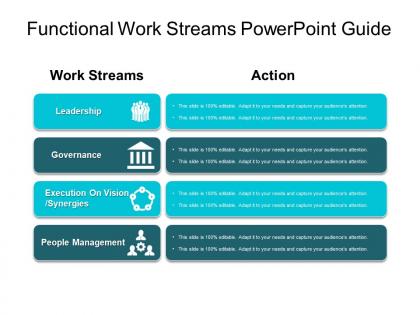
Pick this functional work streams PowerPoint guide for the presentation which facilitates the presenter to use it for working on functional area(s) such as application development, training, business analysis, sales, product delivery and / or engineering. The progressive completion of business projects are completed by different groups within a company which are required to finish a single project, for that specific purpose, the progressive completion of projects PowerPoint diagram is proficient enough which can also be used in the work stream; such as for manufacturing facility may includes engineering, drafting, procurement, fabrication, quality control and shipping. This performance workflow PowerPoint template comprises of four work areas which are people management, execution on vision, governance and leadership corresponding to their action plan also. This intent and purpose of incorporating four work areas and corresponding action explaining bars is to provide the user complete premises which is a requisite condition while presenting such types of PowerPoint shape. Quickly download this slideshow for your business presentation and avail the opportunity at your doorstep. Don't spend all night trying to get your presentation looking good. Out library of high quality Functional Work Streams Powerpoint Guide can have you done in now time.
People who downloaded this PowerPoint presentation also viewed the following :
Functional work streams powerpoint guide with all 5 slides:
Encourage an eco-friendly attitude with our Functional Work Streams Powerpoint Guide. Advocate the development of green habits.


FAQs for Functional work
Effective functional work streams include clearly defined objectives, dedicated cross-functional teams, established governance structures, regular milestone tracking, and robust communication protocols. These components work together by ensuring accountability, maintaining strategic alignment, and facilitating seamless collaboration across departments, with many organizations finding that this structured approach significantly accelerates project delivery and enhances operational efficiency.
Functional work streams enhance cross-departmental collaboration by creating structured communication channels, establishing shared objectives, and standardizing processes across teams. Through aligned workflows and regular touchpoints, organizations streamline decision-making, reduce silos, and accelerate project delivery, with many companies finding that these frameworks ultimately improve resource allocation and operational efficiency.
Technology streamlines functional work stream management by automating task coordination, enabling real-time collaboration, and providing comprehensive performance analytics across teams. Through project management platforms and AI-driven workflow optimization, organizations enhance resource allocation, minimize bottlenecks, and accelerate delivery timelines, with many enterprises finding that integrated digital solutions ultimately deliver improved operational efficiency and competitive advantage.
Identifying critical functional work streams involves analyzing core business processes, revenue impact, customer touchpoints, regulatory requirements, and operational dependencies across departments. Organizations typically prioritize streams that directly affect customer experience, generate revenue, or support compliance, with many finding that mapping interdependencies between finance, operations, and customer service reveals the most strategically important areas.
Key metrics for evaluating functional work streams include delivery timelines, budget adherence, quality standards, stakeholder satisfaction scores, and process efficiency improvements. These measurements enable organizations to track performance across departments like finance, operations, and marketing, while identifying bottlenecks and resource optimization opportunities, ultimately delivering enhanced operational efficiency and measurable business outcomes.
Functional work streams align with business objectives through strategic mapping of departmental activities to company goals, regular cross-functional collaboration sessions, and integrated performance metrics that connect operational tasks to strategic outcomes. This alignment enables organizations to streamline resource allocation, enhance operational efficiency, and accelerate decision-making processes, with many companies finding that synchronized work streams ultimately deliver improved market responsiveness and competitive advantage.
Common challenges in managing functional work streams include siloed communication, conflicting priorities, resource allocation disputes, inconsistent timelines, and lack of cross-functional visibility. These issues create bottlenecks by hampering collaboration, delaying deliverables, and reducing operational efficiency, with many organizations finding that implementing integrated project management systems and regular cross-stream alignment meetings ultimately delivers smoother workflows and better outcomes.
Cultural differences significantly impact functional work streams through varying communication styles, decision-making processes, hierarchy expectations, and collaboration preferences across global teams. Organizations increasingly address these challenges by implementing cultural awareness training, establishing clear communication protocols, and adopting flexible management approaches, with many multinational companies finding that embracing diverse perspectives ultimately enhances innovation and operational effectiveness.
Strategies include process standardization, cross-functional collaboration frameworks, automation of routine tasks, performance metrics implementation, and resource allocation optimization. These approaches streamline operations by eliminating redundancies, enhancing communication flow, and accelerating decision-making cycles, with many organizations finding that strategic workforce planning and technology integration ultimately deliver improved productivity and competitive advantage.
Stakeholders can be effectively engaged through early involvement in requirements gathering, regular communication touchpoints, collaborative workshops, and clear role definition within each work stream. By establishing structured feedback loops and cross-functional representation, organizations enable stakeholders to contribute meaningful input while maintaining project momentum, ultimately delivering solutions that meet diverse business needs and enhance organizational buy-in.
Project management platforms like Asana, Monday.com, Trello, Microsoft Project, and Smartsheet excel at managing functional work streams through task assignment, timeline tracking, and cross-departmental collaboration features. These tools streamline workflow coordination, resource allocation, and progress monitoring across finance, HR, operations, and marketing functions, with many organizations finding that integrated dashboards ultimately deliver enhanced transparency and operational efficiency.
Functional work streams adapt to market shifts through cross-functional collaboration, agile methodologies, real-time data analytics, and flexible resource allocation. These approaches enable organizations to pivot quickly when consumer preferences change, with companies in retail and financial services finding that streamlined communication between departments accelerates product development, enhances customer responsiveness, and ultimately delivers competitive advantage in dynamic markets.
Best practices for knowledge transfer within functional work streams include structured documentation systems, cross-functional mentoring programs, regular knowledge-sharing sessions, standardized handover processes, and collaborative digital platforms. These approaches streamline information flow by creating accessible repositories, fostering direct expertise exchange, and establishing clear communication protocols, with many organizations finding that systematic knowledge transfer reduces project delays while enhancing team capabilities and operational continuity.
Functional work streams scale through standardizing processes, implementing cross-functional governance structures, and establishing clear accountability frameworks across departments. As organizations expand, these streams enhance coordination by creating repeatable workflows, defining role hierarchies, and integrating technology platforms, with many enterprises finding that structured work streams ultimately deliver improved operational efficiency and strategic alignment.
Feedback serves as the critical mechanism for identifying bottlenecks, measuring performance gaps, and validating process improvements across functional work streams. Through systematic feedback loops, organizations in manufacturing, healthcare, and financial services can streamline operations, enhance cross-departmental collaboration, and accelerate decision-making cycles, ultimately delivering improved efficiency and competitive advantage in increasingly complex business environments.
-
Great product with highly impressive and engaging designs.
-
Great designs, really helpful.