


Governance Structure For Call Center Quality Assurance




Try Before you Buy Download Free Sample Product
 Impress Your
 Audience
 100%
100% Editable
 Save Hours
 of Time


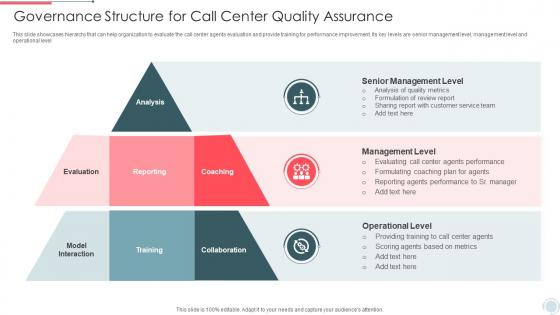
This slide showcases hierarchy that can help organization to evaluate the call center agents evaluation and provide training for performance improvement. Its key levels are senior management level, management level and operational level.
People who downloaded this PowerPoint presentation also viewed the following :
Governance Structure For Call Center Quality Assurance with all 6 slides:
Use our Governance Structure For Call Center Quality Assurance to effectively help you save your valuable time. They are readymade to fit into any presentation structure.





FAQs for Governance Structure For Call
Honestly, just focus on three things: who gets to decide what, how you'll track if people are doing their jobs, and keeping communication super clear. Board oversight matters too - I've literally watched companies implode because nobody knew their role from day one. Map out how decisions currently flow through your org and find the messy spots where authority gets fuzzy. That's where everything usually goes sideways first. Build in regular check-ins, clear escalation paths, and decent risk management. Oh, and don't forget stakeholder engagement processes or you'll hate yourself later.
First thing - figure out what you're actually trying to accomplish, then build your governance around that. Don't inherit some clunky committee structure that takes forever to make decisions if you're supposed to be moving fast. Put the right people in charge of stuff that matters for your goals. Honestly, I've seen so many companies mess this up by just accepting whatever they started with. Your board makeup, who reports to who, how often you meet - it should all push you toward your strategy. Oh and make sure decision-makers actually have real authority, not just fancy titles.
Look, you absolutely need stakeholder input if you want your governance stuff to actually work. I've watched so many initiatives fail because leadership thought they knew better than the people doing the work day-to-day. Get diverse voices involved early - they'll spot problems you'd never see coming. The trick is making it real consultation, not just going through the motions (you know what I mean). Map out who your actual stakeholders are first. Then set up regular check-ins where people can give honest feedback. When stakeholders feel heard, they'll actually support what you're building instead of fighting it.
So basically it comes down to who they're trying to please. Corporations have shareholders who elect boards, and those boards hire the executives - profit's the whole game there. Non-profits are different though, their boards care more about the mission than making money. You'll get like 12 passionate volunteers with crazy strong opinions (trust me, those meetings get wild). Public sector's another beast entirely - they answer to politicians and taxpayers, so there's tons more paperwork and transparency stuff. Each one just reflects who they're actually serving, you know?
Honestly, start with making sure everyone actually knows what their job is and who they answer to - this gets messy way more often than it should. Set up regular check-ins so people can't just hide problems until the quarterly review. Independent board members are clutch here because internal teams tend to become buddies and stop questioning each other. Oh, and create different ways for people to speak up when something's wrong without worrying they'll get fired for it. Multiple feedback channels are key. Sounds basic but most companies screw this up.
Honestly, tech can make your governance way less of a headache. Digital platforms are great for sharing meeting notes and updates so nobody's left wondering what happened. Video calls make it super easy for remote people to join in. I'd start simple though - maybe just move your documents online first instead of trying to do everything at once. Collaborative tools let people contribute when they can, and digital voting speeds things up a lot. The trick is finding stuff that actually works with how your team operates. Don't overcomplicate it by adding tools just because they exist.
Dude, the main thing that'll trip you up is everyone getting confused about who decides what. Authority gets messy real quick when you're mixing old-school board stuff with newer management styles. Think two different GPS apps arguing over directions - super annoying. Communication breaks down between the different governance streams too. What works? Be crazy specific upfront about decision rights and map out clear escalation paths. Oh, and definitely figure out where your traditional and modern elements overlap before jumping in. Trust me, that planning saves headaches later.
So yeah, regulatory stuff basically dictates how you have to set up your governance - no choice there. Public companies need audit committees, certain industries require independent directors, that whole thing. You can't just throw together a basic board and call it good anymore. Financial services? You'll need risk committees. Healthcare has those clinical governance layers too, which honestly can get pretty complex. The smart move is figuring out what regulations hit you first, then building your framework around those requirements. Way easier than trying to jam compliance stuff in later when everything's already running.
Track the obvious stuff like decision speed and compliance rates, but don't ignore the softer signs. Board meeting quality is huge - if everyone's just nodding along, something's wrong. Risk incidents and stakeholder satisfaction give you real data too. Oh, and see how governance actually affects business stuff like employee engagement. Honestly though, you'll go crazy trying to measure everything. Pick 3-5 things that match what you're trying to fix. Start with what you're already tracking and figure out what's missing from there.
Think of governance like having a good referee system - everyone knows the rules and who calls the shots when things get messy. You'll want clear decision-making chains so people aren't just winging it or stepping on each other's toes. Regular check-ins help you catch problems while they're still small instead of waiting for everything to blow up. Honestly, most companies I've seen skip this step and regret it later. Map out how decisions actually flow through your org right now, then figure out where things are falling through the cracks. The paperwork part sucks but it keeps you out of compliance trouble.
Honestly, you've gotta be super intentional from day one. Set actual diversity targets and track them - sounds boring but it works. Don't just ask the same old boys' club for recommendations. Partner with diverse professional orgs, find search firms that specialize in underrepresented candidates. Skills matter more than fancy pedigree anyway. Here's the thing though - once you get diverse voices in the room, you better actually listen to them. Meeting structures need to encourage different perspectives, not shut them down. Start with auditing what you have now. Figure out the gaps first.
So basically, good governance makes investors way more comfortable putting their money in. They see transparency and solid decision-making, and suddenly you're not a risky bet anymore. Your performance usually gets better too since you've got proper oversight catching dumb moves before they happen. I mean, some startups still do crazy stuff regardless, but that's startup life I guess. Board composition is honestly where I'd start - get that right along with decent reporting processes. You'll see the financial results follow once there's real accountability happening. Short wins turn into longer-term success.
Dude, culture totally shapes how multinationals set up their governance structures. Like, in high power distance countries you'll get way more approval layers - it's just how they operate. Meanwhile individualistic cultures want that decentralized decision-making. Board composition changes too depending on the region. Oh, and communication styles are huge - some cultures need totally different reporting setups than others. Honestly makes sense when you think about it. Companies that try to copy-paste the same governance model everywhere? They're gonna have a bad time. Better to adapt to what each region actually expects.
So board committees are just smaller groups that focus on specific stuff - audit, compensation, governance, that kind of thing. The full board doesn't have time to get into every nitty-gritty detail, you know? These committees become your go-to experts who can really dig into complex issues. Like, your audit committee handles all the financial oversight while compensation deals with executive pay. It's honestly way more efficient than having everyone weigh in on everything. Just make sure each committee has a clear purpose and people who actually know what they're talking about. Otherwise you're just creating more meetings for no reason.
When crisis hits, most companies basically throw out their normal chain of command and create fast-moving response teams. You'd be surprised how quickly you can cut through red tape when you have to. Flatten that hierarchy temporarily - trust me, you'll discover half your approval processes were just slowing things down anyway. Pick your core decision-makers and actually give them the power to act without jumping through hoops. Set up clear communication channels so everyone knows who's calling the shots. Just don't forget to document these changes and plan when you'll switch back to normal operations.
-
Definitely a time saver! Predesigned and easy-to-use templates just helped me put together an amazing presentation.
-
My presentations were a bit amateur before I found SlideTeam’s designs. I’ve been able to find slides for nearly every topic I’ve had to present. Thanks, Slideteam!