


Green Technology Devices And Their Environmental Sustainable Development With Green Technology




Try Before you Buy Download Free Sample Product
 Impress Your
 Audience
 100%
100% Editable
 Save Hours
 of Time


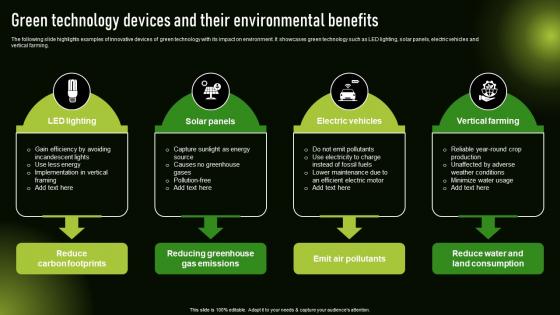
The following slide highlights examples of innovative devices of green technology with its impact on environment. It showcases green technology such as LED lighting, solar panels, electric vehicles and vertical farming.
People who downloaded this PowerPoint presentation also viewed the following :
Green Technology Devices And Their Environmental Sustainable Development With Green Technology with all 9 slides:
Use our Green Technology Devices And Their Environmental Sustainable Development With Green Technology to effectively help you save your valuable time. They are readymade to fit into any presentation structure.









FAQs for Green Technology Devices And Their Environmental Sustainable Development
Green technology principles include resource efficiency, renewable energy integration, waste minimization, lifecycle sustainability, and circular economy design. Unlike traditional technologies that prioritize cost and performance alone, green alternatives emphasize environmental impact reduction, energy conservation, and sustainable material usage, with industries like manufacturing and construction finding that these approaches deliver long-term cost savings while enhancing competitive positioning.
Green technology contributes to reducing urban carbon footprints by implementing solar panels, electric vehicle infrastructure, smart energy grids, green building systems, and waste-to-energy solutions. These technologies streamline energy consumption, minimize emissions, and enhance resource efficiency, with many cities finding that strategic combinations ultimately deliver cleaner air, lower operational costs, and significant environmental improvements.
Renewable energy serves as the foundational power source for green technologies, enabling electric vehicles, smart grids, energy storage systems, and sustainable manufacturing processes. By providing clean electricity generation through solar, wind, and hydroelectric sources, renewable energy drives innovation across sectors like transportation, construction, and industrial automation, ultimately delivering reduced carbon footprints and long-term operational cost savings.
Advances in green technology revolutionize agriculture by enabling precision farming, reducing chemical inputs, and optimizing resource management through IoT sensors, drone monitoring, and AI-driven analytics. These innovations help farmers increase crop yields while minimizing environmental impact, with many agricultural operations finding that sustainable practices ultimately deliver cost savings, enhanced soil health, and competitive market positioning.
Successful green technology implementations include Tesla's electric vehicle manufacturing, Patagonia's renewable energy operations, Interface Inc.'s carbon-neutral carpet production, Unilever's sustainable packaging initiatives, and Google's data centers powered by renewable energy. These companies streamline operations while reducing environmental impact, demonstrating that sustainable practices enhance brand reputation, lower operational costs, and deliver competitive advantages in increasingly eco-conscious markets.
Green technology revolutionizes waste management through automated sorting systems, AI-powered recycling optimization, smart waste collection routes, and advanced material recovery processes. These innovations enable municipalities and corporations to reduce operational costs, increase recycling rates by up to 40%, and minimize environmental impact, while companies like Waste Management increasingly find that technology-driven approaches deliver both sustainability goals and competitive advantage.
Green technology adoption presents both significant upfront investments and substantial long-term financial benefits, including reduced energy costs, tax incentives, regulatory compliance savings, and enhanced brand value. While initial capital requirements can be considerable, many organizations find that operational efficiencies, government subsidies, and improved customer loyalty ultimately deliver competitive advantage and measurable ROI within 3-5 years.
Green technology enhances building energy efficiency through smart HVAC systems, LED lighting, solar panels, energy management software, and high-performance insulation. These solutions streamline energy consumption by automating temperature controls, reducing electricity usage, and optimizing resource allocation, with many commercial facilities and residential developments finding significantly lower operational costs and improved environmental performance.
Green technology startups face funding gaps, regulatory complexities, lengthy development cycles, market adoption barriers, and competition from established players. While these challenges are significant, many startups overcome them through strategic partnerships, government incentives, and consumer demand shifts, with sectors like renewable energy and sustainable manufacturing increasingly attracting investment and delivering competitive advantages.
Government regulations and incentives significantly accelerate green technology adoption by establishing emission standards, offering tax credits, providing research funding, and creating regulatory frameworks that favor sustainable solutions. These policies drive innovation across renewable energy, electric vehicles, and clean manufacturing sectors, while delivering competitive advantages for early adopters, ultimately enabling organizations to reduce costs and enhance market positioning.
Emerging green transportation innovations include electric vehicle batteries with faster charging, hydrogen fuel cell systems, autonomous electric fleets, smart traffic optimization software, and sustainable aviation fuels. These technologies streamline urban mobility by reducing emissions, minimizing energy consumption, and enhancing route efficiency, with many cities finding that integrated smart transportation systems deliver significant cost savings while improving air quality.
Green technology facilitates sustainable water management through smart irrigation systems, water recycling technologies, IoT-enabled monitoring sensors, rainwater harvesting solutions, and advanced filtration methods. These innovations streamline resource conservation by reducing waste, optimizing usage patterns, and enhancing water quality, with municipalities and agricultural operations finding significantly lower costs and improved environmental outcomes.
Consumers are driving green technology demand through increased environmental awareness, willingness to pay premiums for sustainable products, preference for energy-efficient appliances, and support for renewable energy options. This shift influences purchasing decisions across sectors like automotive, home electronics, and energy services, with many companies finding that eco-conscious consumers increasingly prioritize brands demonstrating genuine environmental commitment and measurable sustainability outcomes.
Green technology's future in combating climate change involves advanced renewable energy systems, carbon capture technologies, smart grid infrastructure, sustainable manufacturing processes, and AI-driven environmental monitoring. These innovations streamline emissions reduction by enhancing energy efficiency, automating resource optimization, and enabling real-time environmental tracking, with many organizations finding that strategic green technology adoption delivers significant cost savings while building competitive advantage in an increasingly sustainability-focused marketplace.
Educational institutions can integrate green technology through renewable energy labs, sustainability-focused courses, smart campus systems, green building projects, and environmental data analysis programs. These approaches enhance learning by combining theoretical knowledge with hands-on experience, enabling students to develop practical skills while reducing operational costs, ultimately preparing graduates for careers in an increasingly sustainability-driven job market.
-
Editable templates with innovative design and color combination.
-
Templates are beautiful and easy to use. An amateur can also create a presentation using these slides. It is amazing.