

Header Tag Its Importance And Best Practices For SEO Edu Ppt




Try Before you Buy Download Free Sample Product
 Impress Your
 Audience
 100%
100% Editable
 Save Hours
 of Time


This set of slides covers the details of header tags and ways to write SEO-friendly header tags. Further, these PPT slides include information about the significance of XML sitemaps in performing on-page SEO.
People who downloaded this PowerPoint presentation also viewed the following :
Content of this Powerpoint Presentation
Slide 1
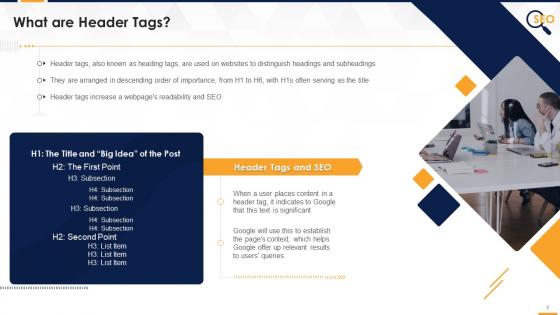
This slide covers details on Header tags. It also depicts that Google will use header tags to establish the page's context, which helps Google offer up relevant results to user’s' queries.
Instructor's Notes:
- H1 - The title of a post. They are generally keyword-focused, centered on the "main concept" of a page or article, and written to pique a reader's interest
- H2 - These are sub headers that categorize the significant ideas of the paragraphs and divide them into parts. You can consider utilizing semantic keywords linked to the "main concept" of the page. This will make it easy for the reader to discover the portions they want to read
- H3 — These are subsections that expand on the ideas made in H2. They can also be used to format lists and bullet points
- H4 —These are subsections that expand on the ideas stated in H3. They can also be used to format lists and bullet points
Header tags can assist in structuring a piece of text by drawing attention to the essential concepts, topics, and (in effect) keywords. As a result, header tags are essential for keyword relevance and readability.
Slide 2
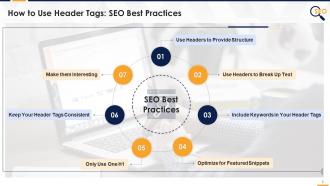
This slide covers how to write SEO-friendly header tags. It also depicts that Header tags provide structure and context for the articles
Instructor's Notes:
Header tags provide structure and context for the articles:
- H1 introduces the page's topic, much like a title tells a reader what a book is all about
- The H2s are similar to a book’s ‘Table of content’ in that they describe the key themes it will cover in different portions of the content
- Subsequent headers, H3s through H6, serve as extra sub-headings inside each section, just as a book chapter might be divided into several sub-topics
Use Headers to Break Up Text
- A scannable article is readable, and a readable article is more likely to rank well in search engines
- Scanability is critical to the success of an article because just 16% of internet users read an article word for word. The others are scanning
- A scannable content is 58% more likely to do well with readers
Include Keywords in Header Tags
- Headers have a significant influence on SEO since Google uses them to acquire context for the pages
- The page should be first and foremost understandable, with keywords used organically
Optimize for Featured Snippets
What is feature snippets and how it help in SEO?
- Featured snippets are short extracts from a website that shows in Google search results to answer a user's query rapidly. Google automatically pulls featured snippet content from pages that have been indexed
- Definitions, lists, steps, and tables are the most typical types of highlighted snippets
Only Use One H1
- Google has said that utilizing numerous H1s is not an issue. Using numerous H1s on a page, however, is not an SEO-recommended practice
- Multiple H1s can be utilized as long as they are not overused to the point of spamming and fit contextually within the page layout
Keep the Header Tags Consistent
- A basic rule of thumb for UX is to provide users with a consistent experience
- To utilize title case format, apply it consistently across all pages (and vice versa if you choose sentence case). Also, keep the headers as brief as possible
Make Them Interesting
- This guideline applies to all the copywriting, not just the headers
- The first copy may have dull headers utilized to construct the outline, but one should always examine and modify them before posting to make them more appealing to visitors
Slide 3
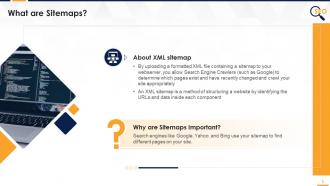
This slide covers details on XML sitemaps. It also depicts that a XML sitemap is a method of structuring a website by identifying the URLs and data inside each component.
Additional Slide 1
This slide contains icons related to Search Engine Optimization (SEO). The slide uses the same color theme and similar design elements as the main deck.
Additional Slide 2
This slide can be edited to provide information about one's organization. The slide uses the same color theme and similar design elements as the main deck.
Additional Slide 3
This editable slide can be used to share the organization's vision, mission, and goals. The slide uses the same color theme and similar design elements as the main deck.
Additional Slide 4
This slide can be edited to provide information about the organization's core team. The slide uses the same color theme and similar design elements as the main deck.
Additional Slide 5
This slide can be used to present multiple discussion ideas to the stakeholders concerned.
Additional Slide 6
This slide contains an editable 30-60-90-day plan to suit the presenter's needs.
Additional Slide 7
This slide contains a timeline to showcase multiple milestones of the organization.
Additional Slide 8
This slide contains a roadmap template for effective strategic planning. The slide uses the same color theme and similar design elements as the main deck.
Additional Slide 9
This fully editable training certificate template can be presented to attendees post the successful completion of training.
Header Tag Its Importance And Best Practices For SEO Edu Ppt with all 18 slides:
Use our Header Tag Its Importance And Best Practices For SEO Edu Ppt to effectively help you save your valuable time. They are readymade to fit into any presentation structure.










FAQs for Header Tag Its Importance And Best Practices For
Header tags are HTML elements (H1, H2, H3, etc.) that structure content hierarchically, with H1 being the main title and subsequent tags organizing subheadings. These tags enhance SEO by helping search engines understand content structure, improving readability for users, and enabling better keyword optimization, with many websites finding that proper header tag implementation significantly boosts search rankings and user engagement.
Header tags significantly enhance user experience on presentation template websites by creating clear navigation hierarchies, enabling quick content scanning, and improving accessibility for screen readers. Through strategic H1-H6 implementation, visitors can rapidly locate specific template categories, pricing information, and download sections, while search engines better understand site structure, ultimately delivering faster user journeys and higher engagement rates.
H1 tags serve as the primary page title with highest SEO weight, while H2 tags indicate main sections, H3 tags represent subsections, and subsequent headers create deeper hierarchical structure. This strategic organization enhances search engine crawling, improves user navigation, and delivers better content accessibility, with many websites finding that proper header hierarchy significantly boosts organic rankings and user engagement.
Header tags should follow a hierarchical structure with H1 for the main title, H2 for major sections, and H3-H6 for subsections, incorporating relevant keywords naturally while maintaining readability. This strategic approach enhances search engine crawling, improves user navigation, and delivers better rankings, with many content marketers finding that properly structured headers increase organic traffic and user engagement significantly.
Using multiple H1 tags can negatively impact SEO by confusing search engines about page hierarchy and primary content focus, though modern algorithms are increasingly tolerant of this practice. For presentation template sites, multiple H1s may dilute keyword effectiveness and reduce content clarity, with many SEO professionals finding that single, descriptive H1 tags deliver better search rankings and user experience.
**INPUT**: What are the best practices for incorporating keywords into header tags? **OUTPUT**: Best practices include placing primary keywords in H1 tags, using long-tail variations in H2-H3 tags, maintaining natural readability, ensuring hierarchical structure, and avoiding keyword stuffing. These techniques enhance search visibility by improving content organization, user experience, and semantic relevance, with many businesses finding that strategic header optimization delivers higher rankings and increased organic traffic.
Header tags help organize content by creating hierarchical structure, improving readability, establishing clear information flow, and enabling search engines to understand page topics and relevance. Through strategic H1-H6 implementation, websites enhance user navigation, reduce bounce rates, and boost SEO rankings, with many organizations finding that well-structured headers increase engagement and search visibility significantly.
Header tags create a hierarchical structure that screen readers and assistive technologies use to navigate content, enabling visually impaired users to jump between sections efficiently. By implementing proper H1-H6 sequencing, websites enhance user experience for disabled visitors while simultaneously improving SEO performance, with many organizations finding that accessible design ultimately delivers broader audience reach and better search rankings.
Header tags should be updated whenever significant content changes occur, including new sections, restructured information, or revised messaging that affects the hierarchical flow of your presentation templates. For template sites experiencing regular content updates, a quarterly review ensures header tags accurately reflect current offerings, maintain SEO relevance, and deliver optimal user navigation experiences, with many organizations finding that consistent header tag maintenance significantly improves search visibility and user engagement.
Improperly using header tags typically doesn't result in direct penalties from search engines, but can significantly harm SEO performance through reduced rankings, poor user experience, and decreased crawlability. While Google and other search engines focus on content quality over technical violations, misused headers create accessibility issues, confuse content hierarchy, and ultimately deliver weaker search visibility, with many websites finding that proper header structure enhances both user engagement and organic traffic performance.
Tools for analyzing header tag effectiveness include Google Search Console, SEMrush, Ahrefs, Screaming Frog, and Yoast SEO plugin. These platforms streamline SEO analysis by identifying header structure issues, tracking keyword performance, and monitoring search rankings, with many digital marketing teams finding that comprehensive header tag optimization ultimately delivers improved organic visibility and competitive search advantage.
Header tags influence click-through rates by creating compelling, keyword-rich titles that capture searcher attention in search results, with well-crafted H1 tags often becoming the clickable headline. Strategic header optimization enhances visibility and relevance signals, ultimately delivering higher engagement rates and improved search performance, with many businesses finding that optimized headers increase organic traffic by 15-25%.
Common header tag SEO mistakes include skipping H1 tags, using multiple H1s per page, stuffing keywords unnaturally, ignoring hierarchical order, and creating headers that don't match content context. These errors confuse search engines and users alike, undermining page structure and keyword relevance, with many businesses finding that proper header optimization significantly improves search rankings and user engagement rates.
Images or graphics within presentation templates should use descriptive alt text that mirrors nearby header tag content, maintains keyword consistency with surrounding H2 or H3 tags, and follows hierarchical naming conventions. Through strategic labeling that aligns with header structure, organizations enhance accessibility compliance, improve SEO performance, and create cohesive content experiences, ultimately delivering better search visibility and user engagement across digital presentations.
Header tags for mobile presentation websites should prioritize concise, scannable text with strategic keyword placement, faster loading through proper HTML hierarchy, and touch-friendly navigation elements. Mobile users typically scan content quickly, so optimizing H1-H6 tags with shorter phrases, front-loaded keywords, and clear visual hierarchy enhances user experience while improving search rankings, ultimately delivering better engagement and competitive advantage.
-
The Designed Graphic are very professional and classic.
-
Use of different colors is good. It's simple and attractive.