


Health Information Management System Powerpoint Presentation Slides




Try Before you Buy Download Free Sample Product
 Impress Your
 Audience
 100%
100% Editable
 Save Hours
 of Time


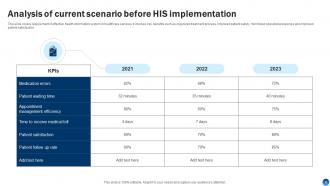
Health Information System is a designed approach to enhance medical services. Implementing HIS facilitates electronic health records and better medical practice management. Grab our Health information management system template. It helps to analyze the implementation of a health management system to increase patient outcomes and serve the better to public. Our HIS Implementation deck involves technology transformation in health information systems, such as the implementation of artificial intelligence, the internet of medical things, and big data analytics, which facilitates medical imagery, predictive analysis, and error-free patient record. It also includes a workflow chart and strategic planning process. Moreover, our Health IT system PPT contains cost analysis and comparative software assessment for enhancing the information system. Lastly, it provides KPI dashboards and impact analysis for measuring the effectiveness of implementing strategies in medical services. Get access to this powerful template now.
People who downloaded this PowerPoint presentation also viewed the following :
Content of this Powerpoint Presentation
Slide 1: This slide introduces Health information management system. Commence by stating Your Company Name.
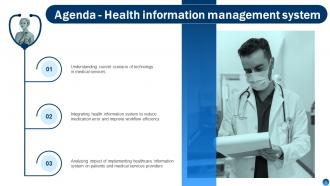
Slide 2: This slide depicts the Agenda of the presentation.
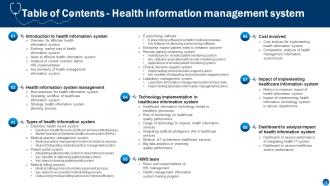
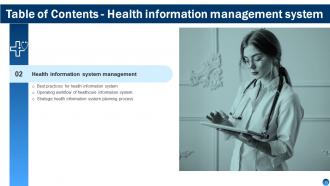
Slide 3: This slide includes the Table of contents.
Slide 4: This slide highlights the Title for the Topics to be covered further.
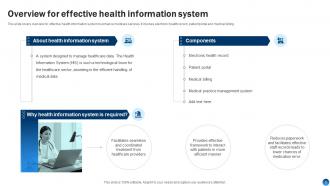
Slide 5: This slide covers overview for effective health information system to enhance medicare services.
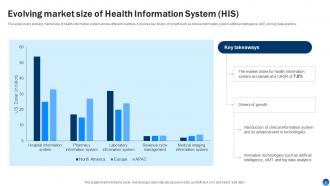
Slide 6: This slide deals with Evolving market size of Health Information System (HIS).
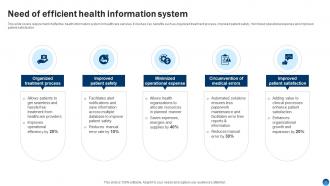
Slide 7: This slide exhibits the Need of efficient health information system.
Slide 8: This slide covers requirement of effective health information system in healthcare services.
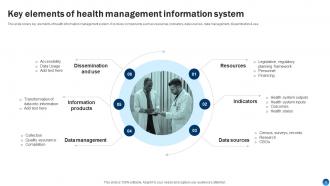
Slide 9: This slide highlights the Key elements of health management information system.
Slide 10: This slide indicates the Heading for the Contents to be discussed next.
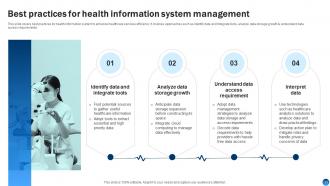
Slide 11: This slide displays the Best practices for health information system management.
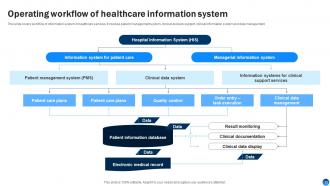
Slide 12: This slide covers workflow of information system in healthcare services.
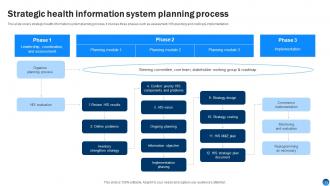
Slide 13: This slide mentions the Strategic health information system planning process.
Slide 14: This slide includes the Title for the Ideas to be covered next.
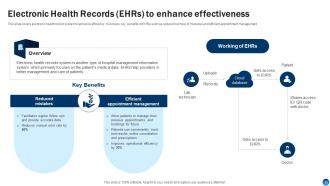
Slide 15: This slide covers electronic health record system to enhance efficiency.
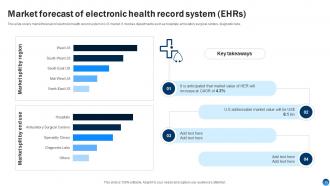
Slide 16: This slide presents the Market forecast of electronic health record system (EHRs).
Slide 17: This slide depicts the Heading for the Ideas to be discussed further.
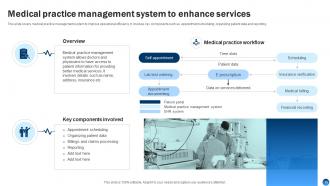
Slide 18: This slide covers medical practice management system to improve operational efficiency.
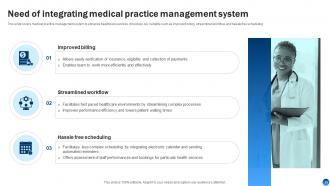
Slide 19: This slide exhibits the Need of integrating medical practice management system.
Slide 20: This slide contains the Title for the Contents to be covered in the upcoming template.
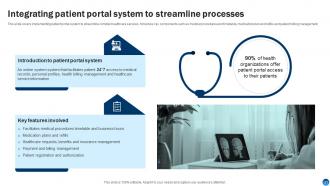
Slide 21: This slide deals with Integrating patient portal system to streamline processes.
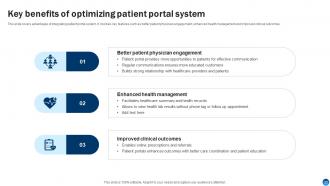
Slide 22: This slide exhibits the Key benefits of optimizing patient portal system.
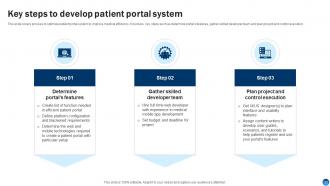
Slide 23: This slide states the Key steps to develop patient portal system.
Slide 24: This slide displays the Heading for the Topics to be discussed further.
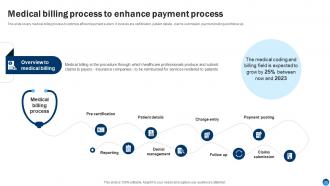
Slide 25: This slide covers medical billing process to optimize efficient payment system.
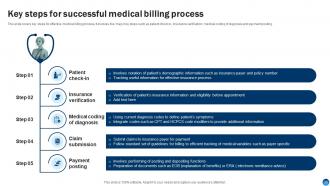
Slide 26: This slide covers key steps for effective medical billing process.
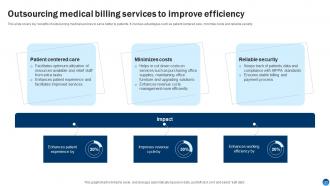
Slide 27: This slide deals with Outsourcing medical billing services to improve efficiency.
Slide 28: This slide contains the Title for the Topics to be covered in the upcoming template.
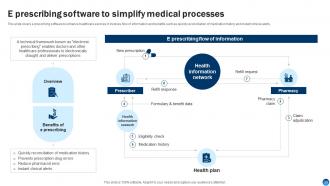
Slide 29: This slide covers e prescribing software to enhance healthcare services.
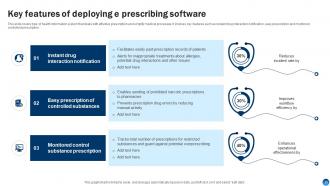
Slide 30: This slide states the Key features of deploying e prescribing software.
Slide 31: This slide contains the Heading for the Contents to be further discussed.
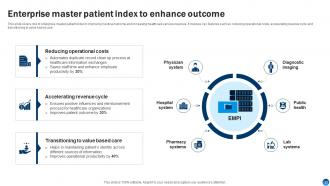
Slide 32: This slide focuses on Enterprise master patient index to enhance outcome.
Slide 33: This slide displays the Title for the Ideas to be further discussed.
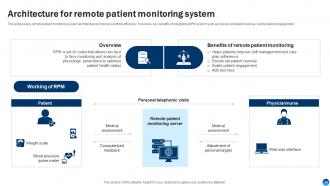
Slide 34: This slide covers remote patient monitoring system architecture to improve workflow efficiency.
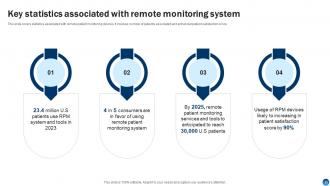
Slide 35: This slide highlights the Key statistics associated with remote monitoring system.
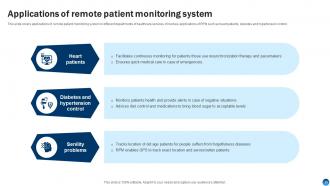
Slide 36: This slide contains the Applications of remote patient monitoring system.
Slide 37: This slide depicts the Heading for the Ideas to be covered in he upcoming template.
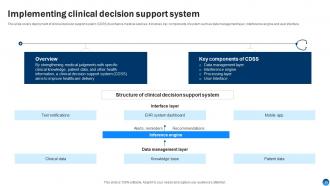
Slide 38: This slide covers deployment of clinical decision support system (CDSS) to enhance medical services.
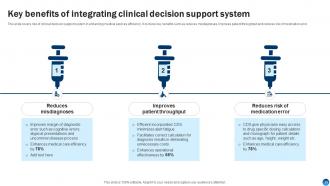
Slide 39: This slide states the Key benefits of integrating clinical decision support system.
Slide 40: This slide displays the Title for the Contents to be discussed in the upcoming template.
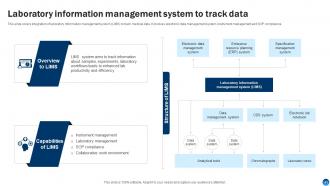
Slide 41: This slide covers integration of laboratory information management system (LIMS) to track medical data.
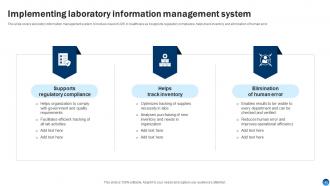
Slide 42: This slide focuses on Implementing laboratory information management system.
Slide 43: This slide exhibits the Heading for the Topics to be covered further.
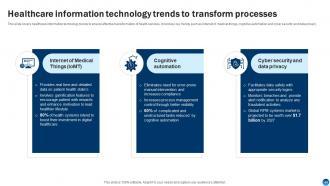
Slide 44: This slide covers healthcare information technology trends to ensure effective transformation of health services.
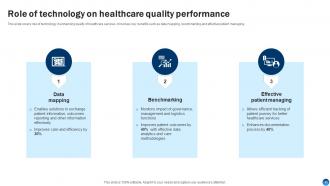
Slide 45: This slide presents the Role of technology on healthcare quality performance.
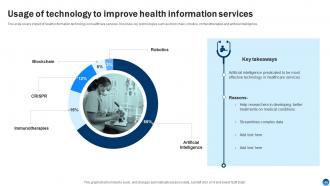
Slide 46: This slide displays the Usage of technology to improve health information services.
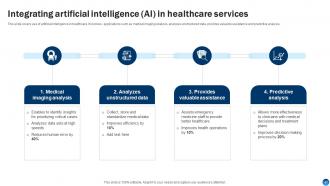
Slide 47: This slide focuses on Integrating artificial intelligence (AI) in healthcare services.
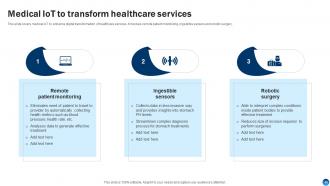
Slide 48: This slide covers medical IoT to enhance digital transformation of healthcare services.
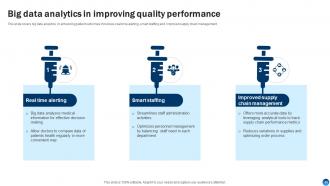
Slide 49: This slide highlights the Big data analytics in improving quality performance.
Slide 50: This slide incorporates the Title for the Topics to be discussed next.
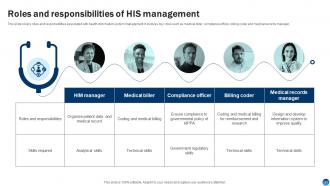
Slide 51: This slide covers roles and responsibilities associated with health information system management.
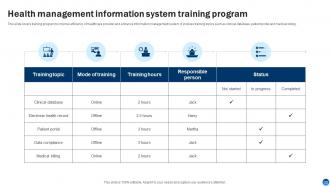
Slide 52: This slide shows training program to improve efficiency of healthcare provider and enhance information management system.
Slide 53: This slide depicts the Heading for the Contents to be covered further.
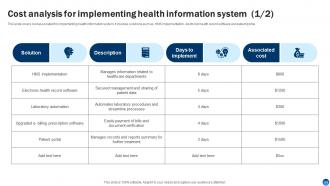
Slide 54: This slide covers cost associated for implementing health information system.
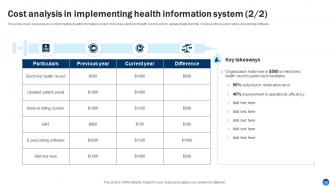
Slide 55: This slide continues the Cost analysis in implementing health information system.
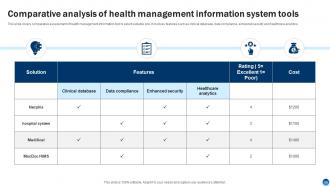
Slide 56: This slide portrays comparative assessment of health management information tool to select suitable one.
Slide 57: This slide indicates the Title for the Ideas to be discussed next.
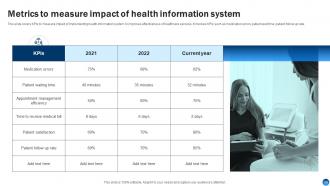
Slide 58: This slide highlights the Metrics to measure impact of health information system.
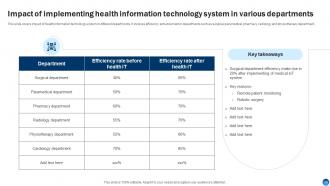
Slide 59: This slide reveals the Impact of implementing health information technology system in various departments.
Slide 60: This slide contains the Heading for the Ideas to be covered in the following template.
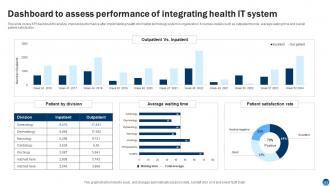
Slide 61: This slide depicts the Dashboard to assess performance of integrating health IT system.
Slide 62: This slide covers KPI dashboard to assess performance f medical services.
Slide 63: This is the Icons slide containing all the Icons used in the plan.
Slide 64: This slide is used for displaying some Additional information.
Slide 65: This slide elucidates the Pie chart.
Slide 66: This slide displays the vision, mission and goal of the company.
Slide 67: This slide displays the Post it notes for reminders and deadlines.
Slide 68: This is Our target slide.
Slide 69: This slide represents the SWOT analysis.
Slide 70: This is Meet our team slide. State your team-related information here.
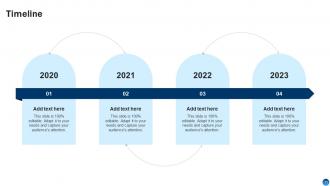
Slide 71: This slide exhibits the company's Timeline.
Slide 72: This is the Quotes slide for motivation.
Slide 73: This is the Thank You slide for acknowledgement.
Health Information Management System Powerpoint Presentation Slides with all 81 slides:
Use our Health Information Management System Powerpoint Presentation Slides to effectively help you save your valuable time. They are readymade to fit into any presentation structure.










FAQs for Health Information Management System
So there's data governance, coding/classification, privacy compliance, and health record management. Quality assurance and analytics too. Revenue cycle stuff is big. Honestly the coding part is what trips most people up - you're basically translating doctor notes into standardized codes for billing. Think of it like the nervous system of healthcare data, everything flows through HIM somehow. I'd start by sketching out how patient info moves around your place, then see where HIM touches each step. It's overwhelming at first but you'll get the hang of it pretty quick.
So HIM work actually saves lives through better record keeping. Clean data means doctors won't prescribe conflicting meds or order redundant tests. Documentation has to be spot-on because incomplete records lead to missed diagnoses - scary stuff. The coding part is honestly boring as hell, but it feeds into quality reporting that tracks patient outcomes. When you nail the data accuracy piece, patient info flows smoothly between hospitals and clinics. Focus on getting documentation workflows right and timely. That's where you'll make the biggest difference for real patients.
Honestly, AI and machine learning tools are where it's at right now. They're automating so much coding work and catching errors before they become headaches. Cloud platforms are pretty massive too - being able to pull up patient data securely from anywhere is a game changer. I keep hearing about blockchain for data integrity, but most places I know aren't really there yet. Oh, and natural language processing is finally making sense of all those messy clinical notes we used to dread dealing with. If I were you, I'd start with AI-powered coding tools first since that's what'll actually change your day-to-day work the fastest.
Ugh, HIPAA controls literally everything we do with patient info. Gotta have proper access controls and encrypt stuff - plus you'll need audit trails for every single interaction with patient data. Such a headache but beats getting sued lol. Physical security matters too, not just the computer stuff. Staff training, how you document things, what to do if there's a breach - it all has to follow their rules. Oh and here's the thing that saved me once: when you're not sure about sharing data, just don't. Always go with the strictest option.
So you're basically the translator between all that messy healthcare data and stuff people can actually use. Your job is cleaning up EHR records and turning them into datasets that make sense. Then you write reports that doctors and administrators can understand - honestly, this part is harder than it sounds because they all want different things. You'll also spot trends, help with population health projects, and make sure everything follows privacy rules when analyzing data. Oh, and you're constantly making sure the data quality doesn't suck. I'd start with learning basic analytics tools and figuring out how your specific workplace handles data workflows.
Start with an audit of your current data flows - you'll spot the biggest gaps right away. Push hard for consistent coding like SNOMED CT and ICD-10. Your EHR mappings need to be squeaky clean too. API management is honestly where most places screw up, so get your IT team on board with solid data exchange protocols. Half the battle? Getting departments to actually communicate about their workflows instead of working in silos. Document everything and set up clear data governance policies. I know it sounds boring, but it'll save you tons of headaches later when you're trying to figure out why systems aren't talking.
You definitely need the analytical stuff since you're always digging through data and coding records. Getting comfortable with healthcare software and EHRs is huge too - honestly the tech learning curve kind of sucks at first but you get used to it. Communication skills are super important because you're basically translating between doctors and IT people all day. Oh, and attention to detail is everything when you're handling patient info and compliance stuff. I'd probably start with learning ICD-10 coding systems. Maybe throw in some basic data analysis training too if you can swing it.
You're literally the bridge between messy health data and actual policy decisions. Data quality, trend spotting, translating complex stuff into something policymakers can actually work with - that's all you. Clean, standardized data prevents policies from being total guesswork, you know? Your coding accuracy and analytics work directly impacts resource allocation and public health programs. You also handle compliance so patient privacy stays protected while still allowing research to happen. Honestly, you should start documenting how your data work connects to policy outcomes. Leadership needs to see your strategic impact - they probably don't realize it yet.
Ugh, the cybersecurity stuff is honestly terrifying - medical records are like crack to hackers. Data breaches in healthcare are through the roof right now. Plus you've got all these different systems that refuse to play nice together, so sharing patient info between doctors becomes this whole ordeal. HIPAA compliance makes everything worse too, especially once you throw cloud storage into the mix. Start with solid encryption and train your staff properly. Oh, and push for standardized data formats early or you'll hate yourself later.
So HIM uses this layered security thing that's pretty smart. First off, you need solid access controls - like, only certain people can see certain patient info based on their role. Encryption is massive for protecting data whether it's sitting there or moving around. Security audits catch problems early, which is clutch. Here's what drives me nuts though - everyone skips proper staff training! Your team has to actually understand HIPAA and spot those sketchy phishing attempts. I'd honestly start with a full risk assessment of what you've got now. That'll show you where the real weak spots are so you're not just guessing.
Three things you gotta nail: train your staff properly, plan the data move, and customize workflows. Seriously, don't let people wing it - EHRs are brutal when you're unprepared. Clean up those duplicate patient records first (ugh, what a mess that always is). Map how your team actually works now, then set up the system to match that flow. If you can swing it, start with just a few people as guinea pigs. Have IT on speed dial those first couple weeks because something always breaks. Oh, and double whatever timeline you're thinking - these transitions drag on forever.
HIM is basically the foundation for all population health work. You're pulling data from everywhere, cleaning it up, and making it actually useful for analysis. Disease patterns become visible. High-risk groups get identified. Community-wide health outcomes can finally be tracked properly. Honestly, the data quality part is make-or-break territory - messy data gives you useless results. Public health folks depend on you to build those comprehensive datasets they need for spotting trends and planning interventions. I'd start by looking at your current collection processes first, see where you're missing population-level stuff.
So AI and machine learning are huge right now - they're already writing code and completely changing how we do analytics. FHIR standards are finally making data exchange between systems way less painful (thank god). Patient data from wearables and apps is everywhere now. Sometimes I wonder if we're drowning in it, honestly. Cloud systems and remote work aren't going anywhere either. My advice? Pick up some data science basics ASAP. Even knowing predictive analytics at a surface level will make you super valuable as everything gets more data-driven.
So HIM is still super important with telehealth - honestly maybe more complicated than regular visits. You're dealing with the same documentation and coding stuff, but now it's spread across different platforms. The tricky part is making sure everything talks to your EHR properly. There are also special telehealth codes you gotta use instead of the normal ones. Privacy gets messier too since patient data is bouncing through multiple systems. Oh, and compliance doesn't just disappear because it's a video call. I'd start by checking how your telehealth platform actually connects with your current workflows.
Honestly, the biggest headaches you'll run into are around patient privacy and HIPAA stuff. Can't just share records with anyone - even if they look legit. Getting proper consent before releasing anything is crucial too. Data accuracy is another pain point because outdated info can actually mess up someone's treatment, which is scary when you think about it. The worst part? Trying to figure out what to tell families versus other doctors when they want information. My advice - always check your facility's rules first since they're usually way stricter than what's legally required. Better safe than sorry with this stuff.
-
Innovative and Colorful designs.
-
I was never satisfied with my own presentation design but SlideTeam has solved that problem for me. Thank you SlideTeam!