

Hiring funnel sourcing screening assessing verifying offering




Try Before you Buy Download Free Sample Product
 Impress Your
 Audience
 100%
100% Editable
 Save Hours
 of Time


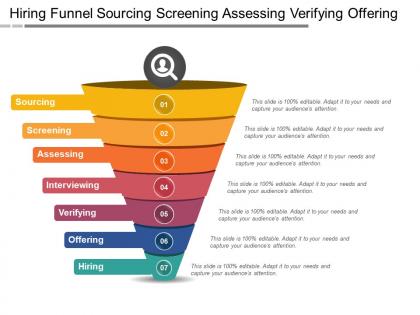
Planning to create a stunning presentation on hiring funnel? Not sure where to find the best quality graphic designs? SlideTeam, being a professional PowerPoint template agency has come up with an editable hiring funnel sourcing screening assessing verifying offering PowerPoint template created by a team of graphic designing experts. This editable hiring funnel sourcing management PPT template highlights seven stages process funnel. Graphics of funnel and icon of a magnifying glass have been used for crafting this stunning template slide. Using this staffing management funnel presentation slide, you can showcase stages like sourcing, screening, assessing, interviewing, verifying, offering, and hiring. This professional recruitment funnel PPT template slide allows you to add your content in the presentation as per requirement. You can highlight the overall procedure of attracting, shortlisting, selecting and appointing suitable candidates for jobs within a company. You can employ this hiring funnel template slide to design a presentation on topics like hiring management, staffing management, recruitment process, human resource management, hiring new employees, Recruitment process outsourcing, and multitier recruitment model. Download this hiring funnel sourcing screening assessing verifying offering PPT template. Devise and deploy with our Hiring Funnel Sourcing Screening Assessing Verifying Offering. Enable your ideas to fructify effectively.
People who downloaded this PowerPoint presentation also viewed the following :
Hiring funnel sourcing screening assessing verifying offering with all 5 slides:
Encourage folks to demonstrate confidence with our Hiring Funnel Sourcing Screening Assessing Verifying Offering. Enable them to fight inhibitions.

FAQs for Hiring funnel sourcing screening
Honestly? Adaptability is everything right now. The job market moves so fast that what mattered two years ago is already old news. I'd way rather hire someone curious who learns quickly than someone with perfect experience but can't roll with changes. Problem-solving beats credentials every time. COVID really showed how critical emotional intelligence became too - especially with remote work. Ask behavioral questions about handling weird situations or ambiguity. Oh, and watch for people who ask good questions during interviews. That curiosity usually translates to better performance later.
Dude, recruiting is SO different now - like seriously, night and day from even 2019. AI can handle your initial screenings automatically. You can blast job posts everywhere at once. Video interviews mean you're talking to people from anywhere without spending a fortune on flights. LinkedIn makes finding passive candidates way easier too (though honestly, everyone's doing it now so candidates are kinda overwhelmed). But here's the thing - people expect you to move fast and have your digital stuff together. Don't ghost them for weeks. Use tech for the boring admin tasks. Just remember to actually be human when you're talking to them.
Honestly, clean up your job descriptions first - ditch the gendered language and random requirements that shut out good people. Post beyond the typical sites too. Your interview panels need different perspectives, not just the same five people every time. Structure interviews with standard questions so you're actually comparing candidates fairly. Try blind resume reviews where you strip out names initially - it's pretty eye-opening what happens. I mean, we shouldn't even need to say this stuff anymore but whatever. Track your numbers because diverse hiring doesn't just magically happen. You gotta be deliberate about it.
Ditch the corporate speak and get specific about daily tasks - like, what will they actually be doing at 10am on a Tuesday? I'd focus on must-have skills vs wishlist stuff. Nobody cares about "leveraging synergies" or whatever. Paint the real picture: growth ops, team culture, even the annoying parts. People appreciate honesty upfront. Also throw in why your company doesn't suck - perks, learning opportunities, cool projects. When candidates can actually visualize the role, you'll get better matches. Oh, and read it out loud before posting. If it sounds like a robot wrote it, you've lost half your audience already.
So employer branding is basically your rep as a workplace, right? Top talent actually researches companies now - they're checking your social media, reading Glassdoor reviews, seeing what current employees say online. It's wild how much info is out there. Strong branding means good people WANT to work for you, not just apply because they're desperate. Who'd choose a company with awful reviews anyway? Quick tip: make your online presence match reality and get happy employees sharing their stories. Oh, and don't fake it - people see right through that stuff.
So for remote roles, you want people who can actually work without constant check-ins - strong communicators who won't disappear for days. Self-motivated types, obviously. Office positions are different though. Focus more on how they'll vibe with the team since they're stuck together all day. Oh, and match your interview style to the role! Video calls for remote people, face-to-face for office folks. Gives everyone a better sense of what they're signing up for. I learned this the hard way after hiring someone "perfect" who couldn't handle working from home.
Start with time-to-fill and cost-per-hire - those are straightforward to track. Quality of hire is harder but honestly the most telling metric. Look at performance reviews, how many people stick around after 90 days, stuff like that. Your offer acceptance rate tells you a lot too. Which sources actually work? Don't spread yourself thin across every job board - figure out if referrals beat LinkedIn or whatever. My advice? Pick maybe 3-4 metrics max. Leadership probably cares more about retention than how fancy your tracking spreadsheet looks anyway.
Honestly, social media is where it's at for finding people. LinkedIn's obvious, but don't sleep on Twitter or even Instagram - tons of good candidates scroll those who aren't actively job hunting. Behind-the-scenes content works way better than boring job posts. Show actual employees, what a typical day looks like, that kind of stuff. People want the real deal, not corporate fluff. Facebook groups are clutch for specialized roles too. Oh, and figure out where your ideal people actually hang out online first - no point posting on platforms they don't use. Just be genuine about it.
Oh man, recruitment bias is everywhere. You've got confirmation bias where you basically look for reasons to like someone you already clicked with. Then there's the halo effect - like when someone went to Harvard so suddenly they're perfect at everything. Affinity bias is probably the worst though - we just gravitate toward mini-versions of ourselves. Plus there's all that resume stuff based on names or employment gaps. Best fixes? Structured interviews help tons. Do blind resume reviews if you can, get different people involved in decisions. Set your criteria before you meet anyone - otherwise you'll just move the goalposts. And honestly, just slow down and question your gut reactions more.
Honestly, AI screening tools are crushing it right now - they'll scan resumes and even handle those awkward first video interviews. Companies are finally ditching the whole "you need a degree" thing for skills-based hiring, which is about time. TikTok and Discord recruiting sounds weird but it's actually working for reaching Gen Z talent. Oh, and VR assessments are getting pretty wild - though I'm not sure I'd want to do a job interview in virtual reality lol. Just don't try implementing everything at once or you'll lose your mind. Test one thing, see how it goes, then move on.
Honestly, candidate experience can totally make or break your hiring game. People remember when they're treated well - they'll actually want to work for you and tell their friends good things. But mess it up? Good luck getting quality applicants later because word spreads fast. Here's the thing though - even people you reject might become customers or send amazing candidates your way down the road. So don't ghost people for weeks. Send those confirmation emails right away, give them realistic timelines, and actually follow through. It's really not that hard but makes a huge difference.
Anti-discrimination stuff is huge - don't make hiring calls based on race, gender, age, religion, disability, you know the drill. Your job posts and interview questions need to be bulletproof here. Background check laws vary wildly by state (some are crazy strict about timing), so watch that. Also hitting wage transparency rules and data privacy if you're collecting personal details. Document everything because people will challenge your decisions - learned that one the hard way. Honestly though, if something feels sketchy just bounce it off legal first. Way better than dealing with a lawsuit later.
Honestly, start with what "winning" actually means for your company, then figure out who can get you there. Scaling like crazy? Find people who don't freak out when everything's on fire and can juggle ten things at once. More focused on innovation? Go for the creative weirdos with messy resumes - they're usually gold. Your job posts should match real priorities, not some cookie-cutter template you found online. Oh, and get your department heads involved in writing requirements. They know what actually matters way better than HR does.
Honestly, AI tools are pretty great for the initial resume dump - they'll churn through hundreds in minutes and catch stuff you'd probably miss. But here's the thing: if their training data sucks, they just repeat the same old biases. Candidates also hate feeling like they're interviewing with a computer (which, duh, they are). Short sentences work better sometimes. You might end up tossing perfectly good people who just don't check the algorithm's boxes. I'd say use them for the first round but don't let robots make your final hiring decisions.
Honestly, candidate feedback is pure gold for fixing your hiring mess. Send short surveys about communication, interview clarity, the whole experience - people actually respond if you don't make it a novel. The patterns will blow your mind. Everyone's probably confused about your tech assessment, or you're ghosting them for weeks (been there as a candidate, ugh). Fix your timing, rewrite those confusing job posts, maybe train your managers to not be weird in interviews. I'd start simple though - just ask your last few hires what sucked most.
-
Colors used are bright and distinctive.
-
Very well designed and informative templates.