

Recruitment Funnel For Talent Sourcing And Acquisition




Try Before you Buy Download Free Sample Product
 Impress Your
 Audience
 100%
100% Editable
 Save Hours
 of Time


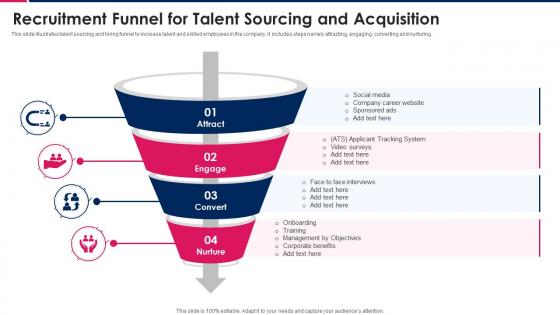
This slide illustrates talent sourcing and hiring funnel to increase talent and skilled employees in the company. it includes steps namely attracting, engaging, converting and nurturing.
People who downloaded this PowerPoint presentation also viewed the following :
Recruitment Funnel For Talent Sourcing And Acquisition with all 1 slides:
FAQs for Recruitment Funnel For Talent
Key recruitment funnel stages include sourcing, screening, interviewing, assessment, offer negotiation, and onboarding, each designed to progressively filter candidates while maintaining engagement. These stages streamline hiring by automating initial screening, standardizing evaluation criteria, and tracking candidate progression, with many organizations finding that structured funnels reduce time-to-hire by 40% while improving candidate quality and experience.
Organizations effectively attract top talent through strategic employer branding, competitive compensation packages, strong social media presence, employee referral programs, and partnerships with universities and professional networks. These approaches streamline talent acquisition by showcasing company culture, offering compelling career opportunities, and leveraging existing relationships, with many companies finding that authentic storytelling and targeted outreach ultimately deliver higher-quality candidates and reduced hiring costs.
Employer branding significantly influences recruitment funnel effectiveness by attracting quality candidates, reducing time-to-hire, and improving candidate experience throughout the hiring process. Strong employer branding enables organizations to differentiate themselves in competitive talent markets, with companies like Google and Microsoft finding that consistent brand messaging across recruitment touchpoints ultimately delivers higher acceptance rates and lower recruitment costs.
Applicant tracking systems enhance recruitment funnel efficiency by automating resume screening, streamlining candidate communication, centralizing applicant data, and enabling collaborative hiring decisions across teams. Through AI-powered filtering and workflow automation, organizations significantly reduce time-to-hire, minimize manual administrative tasks, and deliver better candidate experiences, with many companies finding faster placements and improved hiring quality.
Key recruitment funnel metrics include application-to-interview conversion rates, time-to-hire, cost-per-hire, interview-to-offer ratios, and offer acceptance rates at each stage. These metrics enable organizations to identify bottlenecks, optimize resource allocation, and streamline hiring processes, with many companies finding that tracking stage-specific data ultimately delivers faster placements and enhanced candidate experiences.
Companies reduce candidate drop-off rates by streamlining application processes, maintaining transparent communication throughout each stage, providing regular status updates, and minimizing lengthy assessment periods. Through mobile-optimized applications and automated candidate tracking systems, organizations in sectors like technology and healthcare enhance candidate experiences, reduce friction points, and ultimately improve conversion rates while building stronger employer brands.
Effective candidate engagement strategies include personalized communication, transparent timeline updates, interactive assessment methods, regular feedback loops, and mobile-optimized application processes. These approaches streamline recruitment by reducing drop-off rates, enhancing candidate experience, and building employer brand reputation, with many organizations finding that engaged candidates ultimately deliver better hiring outcomes and stronger long-term retention rates.
The screening process significantly impacts recruitment funnel effectiveness by filtering qualified candidates, reducing time-to-hire, and improving candidate quality at each stage. Through strategic screening methods, organizations streamline their hiring workflows, minimize resource allocation on unsuitable applicants, and enhance interviewer productivity, with many companies finding that structured screening processes ultimately deliver faster placements and better cultural fits.
Common recruitment funnel challenges include poor employer branding attracting unqualified candidates, lengthy screening processes losing top talent, inconsistent interview experiences, delayed decision-making, and inadequate onboarding reducing retention. These bottlenecks compound throughout the funnel, with many organizations finding that streamlining each stage through automation and standardized processes significantly improves candidate quality and reduces time-to-hire.
Diversity and inclusion initiatives can be integrated through inclusive job descriptions, diverse sourcing channels, bias-aware screening processes, structured interviews, and diverse hiring panels. These approaches streamline equitable talent acquisition by expanding candidate pools, minimizing unconscious bias, and enhancing decision-making consistency, with many organizations finding that strategic integration ultimately delivers stronger team performance and competitive advantage.
Recruitment funnel visualization tools include applicant tracking systems with analytics dashboards, HR analytics platforms, business intelligence software, recruitment marketing tools, and custom reporting solutions. These technologies streamline performance monitoring by tracking conversion rates, identifying bottlenecks, and measuring time-to-hire metrics, with many HR departments finding that integrated analytics ultimately deliver faster hiring decisions and improved candidate experiences.
Candidate feedback improves recruitment funnels by identifying bottlenecks, enhancing communication clarity, and streamlining interview processes through direct insights on user experience. Organizations leveraging systematic feedback collection find significant improvements in application completion rates, candidate satisfaction scores, and time-to-hire metrics, ultimately delivering stronger employer branding and competitive talent acquisition advantages.
AI significantly transforms the recruitment funnel by automating candidate screening, enhancing job matching accuracy, and streamlining interview scheduling processes. Through machine learning algorithms, organizations accelerate time-to-hire, reduce recruitment costs, and improve candidate experience quality, with many companies finding that AI-powered tools ultimately deliver more precise talent acquisition and competitive hiring advantages.
Recruitment funnels should be evaluated monthly for performance metrics and optimized quarterly for strategic improvements, with continuous monitoring of key indicators like time-to-hire and candidate drop-off rates. Many organizations find that regular assessment enables them to identify bottlenecks, streamline processes, and enhance candidate experiences, ultimately delivering faster placements and competitive talent acquisition advantages.
Collaboration between HR and hiring managers enhances the recruitment funnel by aligning job requirements, streamlining candidate evaluation processes, and accelerating decision-making timelines. Through shared screening criteria and regular communication touchpoints, organizations minimize misaligned expectations, reduce time-to-hire, and improve candidate experience quality, ultimately delivering stronger talent acquisition outcomes and competitive hiring advantages.
-
Satisfied with the way SlideTeam resolved my query regarding the right business PPTs that I was having difficulty finding. I found the perfect match with their assistance.
-
I loved the hassle-free signup process. A few minutes and, I had this giant collection of beautiful designs.