


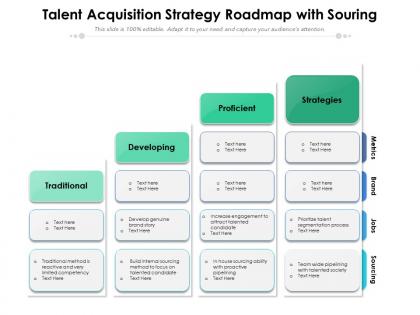
Talent acquisition strategy roadmap with souring




Try Before you Buy Download Free Sample Product
 Impress Your
 Audience
 100%
100% Editable
 Save Hours
 of Time


Our Talent Acquisition Strategy Roadmap With Souring are topically designed to provide an attractive backdrop to any subject. Use them to look like a presentation pro.
People who downloaded this PowerPoint presentation also viewed the following :
Talent acquisition strategy roadmap with souring with all 2 slides:
Use our Talent Acquisition Strategy Roadmap With Souring to effectively help you save your valuable time. They are readymade to fit into any presentation structure.
FAQs for Talent acquisition strategy
Honestly, talent acquisition breaks down to five things that actually matter. First, nail your employer brand - people need to know why they'd want to work there. Define roles clearly so you're not just hoping for the best. Diversify where you source candidates because job boards alone are kinda useless now. Make your interview process not suck (seriously, candidates talk). Track your data so you know what's working. Oh, and get hiring managers bought in early on what they actually want - that part will save you so much back-and-forth later. You'll thank me for that one.
Honestly, start tracking just 2-3 things consistently - time-to-hire, which sources actually work, and maybe candidate quality scores. You'll probably discover that expensive job board isn't worth it while employee referrals are crushing it. Data helps you spot where things get stuck in your process. Plus it takes the guesswork out of hiring decisions - way better than going with your gut every time. Oh, and you can predict when you'll need more people based on turnover patterns. I'd focus on reducing bias too by sticking to actual performance metrics rather than "cultural fit" nonsense.
Dude, employer brand and culture fit are huge for getting good people. Top candidates always have options, so they're picking companies where they actually want to work - not just whoever pays well. Show off your real culture through employee posts and reviews. Don't try to seem perfect though, that's so obvious and fake. Good people see right through the BS anyway. They want to know what it's actually like day-to-day, you know? Be genuine about your vibe and values - that's what separates you from everyone else fighting for the same talent.
Honestly, just pick one thing to automate first - don't go crazy trying to fix everything. ATS systems are great for filtering resumes so you're not drowning in applications. Chatbots handle those same candidate questions over and over (what's the salary range, when do you get back to people, etc.). Video interviews save tons of time on scheduling back-and-forth. AI job description tools are actually pretty solid now, which surprised me. Set up some basic email sequences for updates - candidates hate radio silence. Oh, and track your sourcing data so you know if LinkedIn is worth the money or if referrals work better for your company.
Start with structured interviews - same questions for everyone plus scorecards. That'll give you the biggest bang for your buck right away. Blind resume reviews help too, just remove names and photos during initial screening. Diverse interview panels are smart because different people notice different red flags. Bias training for managers is... honestly hit or miss. Some swear by it, others think it's total BS, but at least it gets people thinking about their assumptions. Track your hiring data to see patterns - like if you're only hiring from certain schools or whatever. The structured interview thing though? Do that first, you'll see results immediately.
Dude, candidate experience matters way more than most companies realize. Think about it - you screw someone over with a terrible interview process, and they're gonna tell everyone they know. I've seen people trash companies on Glassdoor just because some recruiter ghosted them for weeks. But flip side? Treat candidates well and they become walking advertisements for your company, even if you don't hire them. Those rejected people might be perfect for something else later too. Honestly, just map out your hiring process and find where it totally sucks - fix those parts first.
Honestly, start with time-to-fill and cost-per-hire since those are easiest to track. Quality of hire is where it gets interesting though - check performance reviews and whether people actually stick around after 6 months. Candidate experience matters too because word spreads fast when your hiring process sucks. Oh, and definitely measure which job boards actually bring in good people versus just eating your budget. I know it's tempting to track everything, but pick like 2-3 metrics first. You'll go crazy trying to measure it all at once.
Honestly, most of this comes down to getting everyone aligned before you even post the job. I always do a kickoff meeting now to nail down the must-haves vs nice-to-haves - learned that the hard way when searches went completely off track because we weren't actually on the same page. Weekly check-ins are clutch during active searches. Share feedback fast, and don't let hiring managers get away with crazy unrealistic expectations. Oh, and teach them how to interview properly if they suck at it. Trust me, it'll save you so many headaches later. The whole thing falls apart without clear communication from day one.
Your current team probably knows other talented people - set up a referral program. GitHub's amazing for finding developers, Behance for designers. I've gotten lucky in industry forums where people aren't even job hunting but share cool work. Alumni networks are honestly underrated goldmines since everyone stays connected there. Oh, and reach out to former employees who left on good terms - sometimes they're ready to come back. Pick whatever fits your industry first. Track response rates so you'll know what actually works for your specific situation.
Honestly, stop relying on the same old job boards everyone else uses. You'll want to partner with HBCUs, women's organizations, community groups - basically cast a wider net. Clean up those job descriptions too (Textio's pretty good for catching biased language). For interviews, ask everyone the same core questions and mix up your interview panels. Can't have the same three dudes evaluating every candidate, you know? Oh, and track your numbers - application rates, who's getting offers by demographic. Otherwise you're just throwing darts in the dark hoping something sticks.
Dude, remote work totally changed the hiring game. You can literally find anyone, anywhere now - your talent pool went from your city to the entire world. Pretty wild, right? But here's the thing: you're gonna need to completely redo how you hire. Job posts need to spell out remote expectations clearly. Video interviews are the new normal, and honestly, figuring out someone's personality through a screen is trickier than you'd think. The downside? You're not just competing with local companies anymore - it's everyone. Your company culture better be solid because that's what'll set you apart now.
Dude, you gotta move fast these days - good people get snatched up in like a week. Start building relationships with candidates before you even have openings, because that "post and pray" thing is dead. Keep your company looking cool on social media too. Honestly? Your interview process is probably way too slow. Speed that up. Also - and this might sound obvious but so many companies mess this up - actually check what competitors are paying. I've seen great hires fall through because someone was offering 20k less than market rate. Oh, and don't just stick to LinkedIn. Try those newer platforms where younger talent actually hangs out.
Honestly, start with an ATS like Greenhouse or Workday - that's your base layer for keeping everyone updated. Slack integration is clutch for quick back-and-forth with your team. For scheduling, Calendly saves so much headache (I used to spend way too much time on email tennis just to book interviews). Zoom or Teams for remote stuff, obviously. Oh, and set up some automated email sequences so candidates don't feel ghosted - nothing fancy, just basic status updates. Build it piece by piece rather than trying to implement everything at once. The ATS first, then add whatever communication tools actually make sense for how your team works.
Honestly, onboarding is just the last part of recruiting - not some separate thing HR does later. If you promised them a cool culture and growth opportunities during interviews, your first 90 days better actually deliver that stuff. Otherwise they'll feel bamboozled and start looking elsewhere (which happens way too much). I'd audit what you're telling people vs. what they actually experience when they start. The whole point is making them think "yeah, I definitely made the right call turning down that other offer." Connect them with the work environment you sold them on. Half of retention is just... not disappointing people right off the bat.
Dude, social media is where all the good talent lives now. LinkedIn's obvious for recruiting, but Instagram and TikTok? Gold mines for showing your company culture. We've hired people who literally just followed us first - wild, right? Don't just spam job posts though. Share actual behind-the-scenes content, spotlight your team, make people want to work there. TikTok still feels weird for recruiting but Gen Z loves it. Start by checking where your dream candidates actually spend time online. Being real and consistent beats polished corporate posts every time.
-
Excellent design and quick turnaround.
-
Enough space for editing and adding your own content.
-
Use of different colors is good. It's simple and attractive.
-
Very well designed and informative templates.